Statistics Korea Announces January Employment Trends
'Job Government' 5 Years... Employment Rate Stagnates at 60.8→60.5%
'Idaenam' Working Over 36 Hours Employment Numbers Decrease Compared to Last Year... Youth Job Quality Deteriorates
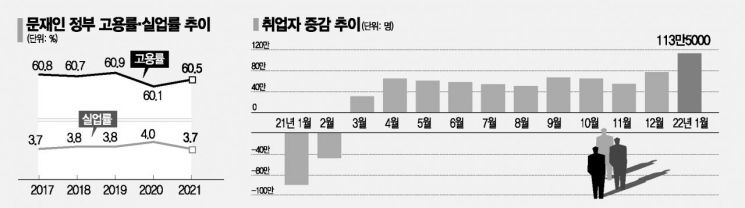
[Asia Economy Sejong=Reporters Kim Hyewon, Son Seonhee, and Moon Jewon] The number of employed people in the first month of the new year increased by 1,135,000, the largest increase in over 22 years, mainly due to the base effect from the ‘employment disaster’ caused by COVID-19 a year ago. Since employment nearly dropped by one million in January last year due to strengthened social distancing measures, the relative increase this year is significant. Additionally, changes in industrial structure such as non-face-to-face and digital transformation, along with strong exports, have contributed to the total employment indicator rising for 11 consecutive months since rebounding in March last year, showing a clear recovery trend.
◆ Employment Performance = Last month, the employment market saw an increase of 1,135,000 employed people compared to the same period last year, marking the largest increase in 21 years and 10 months since March 2000 (1,211,000), when the Korean economy was recovering from the foreign exchange crisis. It was the first time in 90 months that employment increased evenly across all age groups, including those in their 30s, who returned to positive employment growth after 23 months.
By industry, employment increased in most sectors, including healthcare and social welfare services (250,000), and accommodation and food services (128,000), which were heavily impacted by COVID-19. Notably, employment in accommodation and food services increased for two consecutive months following 66,000 in December last year. Employment also rose in manufacturing (66,000) and transportation and warehousing (121,000), benefiting from strong export performance.
Although recent monthly employment indicators are trending upward, the overall assessment of the Moon Jae-in administration, which promoted itself as a ‘job government,’ is generally unfavorable. The employment rate during the government’s five years (2017: 60.8% → 2021: 60.5%) remained stagnant, and there are significant disparities by age, gender, and industry, raising doubts about the quality of jobs.
Choi Young-gi, visiting professor at Hallym University’s Business Administration Department and former president of the Korea Labor Institute, said, "It is true that Korea, along with Japan and Germany, performed relatively well in employment during the COVID-19 crisis. However, even if the total numbers are similar, qualitative management is essential to address the pain index actually felt by employed individuals and the instability caused by the increase in part-time or contract workers."
Academia also raises concerns about the government’s employment statistics methodology. Recently, the Korea Economic Research Institute commissioned Professor Park Ki-sung’s team at Sungshin Women’s University to analyze full-time equivalent employment to assess employment changes under the Moon administration. The results showed that last year’s employment was 26,512,000, a decrease of 2,092,000 (7.3%) compared to 2017, which is the exact opposite of Statistics Korea’s analysis showing an increase of 548,000 (2.1%) during the same period.
◆ Employment Insecurity Persists Among 30s and 40s = Although the government self-assessed that the employment market has achieved ‘clear improvements in both quantity and quality,’ it is difficult for the core working-age group of people in their 30s and 40s to relate. Of the 1,135,000 increase in employed people last month, half (522,000) were jobs for seniors aged 60 and over.
Among the increased employed, those in their 30s accounted for only 22,000 and those in their 40s for 24,000. Combined, they barely exceeded 4%. Due to the extremely poor employment situation in January last year, jobs for people in their 30s turned positive after 23 months, but the employment rate improved by only 1.8 percentage points, which is significantly lower than other age groups. The employment rate recovery for those in their 40s was also the lowest at 1.0 percentage point. Notably, the ‘inactive’ population?those capable of working but not working?increased only among people in their 30s across all age groups.
The warmth of employment recovery has not reached young people in their 20s entering society for the first time. An analysis by Asia Economy of Statistics Korea’s 2020-2021 Economically Active Population Survey microdata found that among the 105,400 new jobs for people in their 20s last year, about 90% (94,000) were short-term jobs with weekly working hours of only 0 to 35 hours. The number of employed people working 36 hours or more per week increased by only 11,400.
Especially for the so-called ‘Itaedam’ (20s males), the number of full-time jobs with 36 hours or more per week decreased compared to 2020, when the COVID-19 employment shock occurred. Professor Choi emphasized, "Since digital transformation and restructuring of self-employment are irreversible changes, even if the COVID-19 situation normalizes later, employment conditions will not return to previous levels. The government must remain vigilant and respond to rapid fluctuations caused by regional and industry disparities."
© The Asia Business Daily(www.asiae.co.kr). All rights reserved.
![Clutching a Stolen Dior Bag, Saying "I Hate Being Poor but Real"... The Grotesque Con of a "Human Knockoff" [Slate]](https://cwcontent.asiae.co.kr/asiaresize/183/2026021902243444107_1771435474.jpg)















