TSMC Increases Investment in Kumamoto, Japan Factory Construction... Additional 1.9 Trillion KRW Invested
Intel Announces Acquisition of Tower Semiconductor for 6.5 Trillion KRW
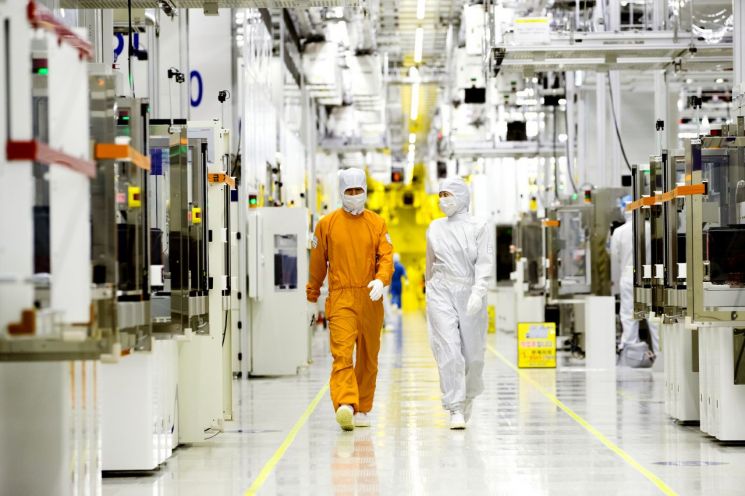
[Asia Economy Reporter Jeong Hyunjin] The global foundry (semiconductor contract manufacturing) industry has been buzzing since the beginning of the year with successive investment announcements. Amid expectations that the semiconductor supply shortage triggered by COVID-19 will continue this year, industry leaders Taiwan's TSMC and Samsung Electronics, as well as Intel, which has re-entered the market as a latecomer, are aggressively expanding their scale to gain the upper hand in the market leadership battle.
According to Japan's Nihon Keizai Shimbun on the 16th, TSMC, the world's largest foundry, decided to invest 980 billion yen (approximately 1.9 trillion KRW), which is 180 billion yen more than originally planned, to build a factory in Kumamoto Prefecture, Japan. This is an increase from the investment amount announced last November to expand production capacity. TSMC will jointly build a semiconductor factory in Kumamoto with Japan's Sony Group and start producing 45,000 12-inch wafers per month from the end of 2024. The factory will produce semiconductor products using 22 to 28 nanometer (1 nm = one billionth of a meter) process technology.
In particular, semiconductors produced at this factory are highly likely to be supplied to Japanese automobile manufacturers. On the same day, Japanese auto parts maker Denso also decided to invest 40 billion yen in the joint venture established by TSMC and Sony Group, acquiring more than 10% of the shares. Accordingly, TSMC appears to have expanded its investment in line with demand, judging that there is no problem securing customers.
Intel, the U.S. semiconductor company that announced the resumption of its foundry business last year, has also announced large-scale investments one after another this year. On the 15th (local time), Intel announced that it would acquire Israeli semiconductor foundry company Tower Semiconductor for $5.4 billion (approximately 6.5 trillion KRW) at $53 per share. Since the foundry business itself relies heavily on manufacturing facilities and existing customer relationships, Intel, which had stopped and then restarted this business, seems to have judged that mergers and acquisitions (M&A) are more advantageous. The fact that Intel acquired the relatively smaller Tower Semiconductor after GlobalFoundries, which it had been pursuing last year, shifted its stance to an initial public offering (IPO), is also understood to be based on this background. Tower Semiconductor has semiconductor manufacturing facilities in Israel, California and Texas in the U.S., and Japan, so it is expected to strengthen its business based on these assets.
Last month, Intel also announced plans to build a semiconductor factory in Ohio, USA, with an investment of at least $20 billion, actively demonstrating its intention to secure competitiveness by standing at the forefront of the foundry market through aggressive investment.
Samsung Electronics, which is expanding its business centered on advanced processes, will begin construction in the first half of this year after announcing a $17 billion investment in a U.S. foundry factory last year. At the earnings conference call for 2021 held last month, Samsung Electronics also stated, "We will focus on expanding process technology leadership through mass production of the first-generation Gate-All-Around (GAA) process and increasing supply to global customers to achieve growth exceeding the market." With Samsung Electronics setting the goal of becoming the 'No. 1 system semiconductor company by 2030,' the market is paying attention to the possibility of large-scale M&A in the semiconductor sector.
Meanwhile, as of the third quarter of last year, TSMC holds the throne in the global semiconductor foundry market with a 53.1% market share, followed by Samsung Electronics at 17.1%. Taiwan's UMC and the U.S.'s GlobalFoundries hold 7.3% and 6.1%, respectively, while China's SMIC holds 5.0%. The semiconductor industry expects the market to move with TSMC and Samsung Electronics, which are pouring investments into advanced processes, leading the foundry market, while Intel rapidly grows by enhancing its technological capabilities.
© The Asia Business Daily(www.asiae.co.kr). All rights reserved.
![Clutching a Stolen Dior Bag, Saying "I Hate Being Poor but Real"... The Grotesque Con of a "Human Knockoff" [Slate]](https://cwcontent.asiae.co.kr/asiaresize/183/2026021902243444107_1771435474.jpg)















