Closure of 112 SSM Stores Causes 'Negative Growth'
Closing One Large Mart Leads to 1,374 Job Losses
Urgent Need to Redesign Distribution Policy
[Asia Economy Reporters Lim Chun-han, Koo Eun-mo, Jeon Jin-young] Although consumption trends are shifting from offline to online due to the prolonged COVID-19 pandemic, large discount stores and Super Supermarkets (SSM) are shrinking due to outdated, regulation-focused legislation. Domestic experts argue that as the distribution market is rapidly being reorganized, distribution policies need to be redesigned with a comprehensive consideration of the market environment.
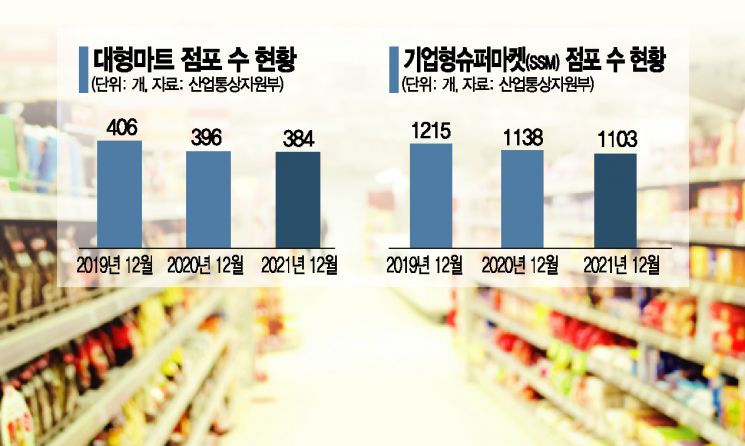
◆ ‘Mart and SSM’ Struggling Due to Excessive Regulation = According to the Ministry of Trade, Industry and Energy on the 17th, the number of large discount stores and SSM outlets has been decreasing every year. Large discount stores decreased from 406 in 2019 to 384 last year, and during the same period, SSMs dropped from 1,215 to 1,103. In the past two years, 22 large discount stores and 112 SSMs have closed, showing negative growth.
The decrease in the number of large discount stores and SSMs has adversely affected sales and pushed them down in the offline retail sales rankings. Until 2019, the order was large discount stores - department stores - convenience stores, but last year it shifted to department stores - convenience stores - large discount stores. The decline of large discount stores negatively impacts not only direct and indirect employment but also employment in surrounding commercial districts. According to the Korea Distribution Science Association’s research analysis titled ‘Evaluation of 10 Years of Distribution Regulation and Win-Win Measures,’ when one large discount store closes, 945 jobs are lost directly, and 429 jobs disappear within a 3 km radius. This means a total of 1,374 jobs are lost when one large discount store closes. This is why the Distribution Industry Development Act is criticized for failing to revive neighborhood commercial districts as originally intended and for increasing the management burden on distribution companies, worsening investment and employment conditions.
◆ Shift in Consumption Focus... "Policy Redesign Needed" = In overseas markets, the world’s largest online retailer Amazon surpassed Walmart, the offline retail leader, in retail sales to general consumers as of August last year, signaling that distribution dominance has shifted online. At the core of this trend is a fundamental change where consumers’ information search shifted from after visiting stores to before visiting. In response to these changes, major countries abroad are easing distribution regulations. Japan has adopted a notification system for opening large stores without special entry restrictions and does not regulate operating hours. France relaxed the permit criteria for retail stores from over 300㎡ to over 1,000㎡. The UK has no restrictions on opening stores in city centers; rather, to prevent urban hollowing, if a store larger than 2,500㎡ is established outside the city center, proof must be provided that there is no space available within the city center.
Experts emphasize the urgency of redesigning distribution policies. Professor Seo Yong-gu of the Department of Business Administration at Sookmyung Women’s University said, “Regulations on distribution companies in Korea have always been economically unreasonable, but excessive legislation was enacted due to political logic. Since mandatory closure days for large discount stores have become practically meaningless with the growth of the online market, it is necessary to level the playing field.” Jeong Yeon-seung, president of the Korea Distribution Science Association, said, “In an unpredictable business environment, it is desirable to encourage autonomous competition rather than regulation for distribution companies to make aggressive investments and strategies. Regulations should be based on concrete damages such as consumer harm or unfair trade, and preemptive regulation on events that have not occurred is not appropriate.” Professor Lee Eun-hee of Inha University’s Department of Consumer Studies also advised, “It is better to ease excessive regulations for consumer convenience. Since opposition from local commercial districts remains intense, problems should be resolved by supporting local small business owners with infrastructure and other means.”
© The Asia Business Daily(www.asiae.co.kr). All rights reserved.
![Clutching a Stolen Dior Bag, Saying "I Hate Being Poor but Real"... The Grotesque Con of a "Human Knockoff" [Slate]](https://cwcontent.asiae.co.kr/asiaresize/183/2026021902243444107_1771435474.jpg)
















