[Seoul District News] Gwanak-gu Invests 4.88 Billion Won of Own Funds to Support Over 855 Businesses and 8,700 People Including Daycare Centers, Local Child Centers, Elderly Care Facilities, and Village Buses Before Lunar New Year... Yeongdeungpo-gu Offers 3 Billion Won Scale Loans, Up to 200 Million Won per Application, 1-Year Grace Period, 4-Year Equal Repayment, 1.5% Annual Interest, Especially Interest-Free in 2022... Seodaemun-gu Provides Multifaceted Support for COVID-19 Affected Small Businesses... Gwangjin-gu Enrolls All Residents in Life Safety Insurance Covering Accidents from Direct Injury Regardless of Fault
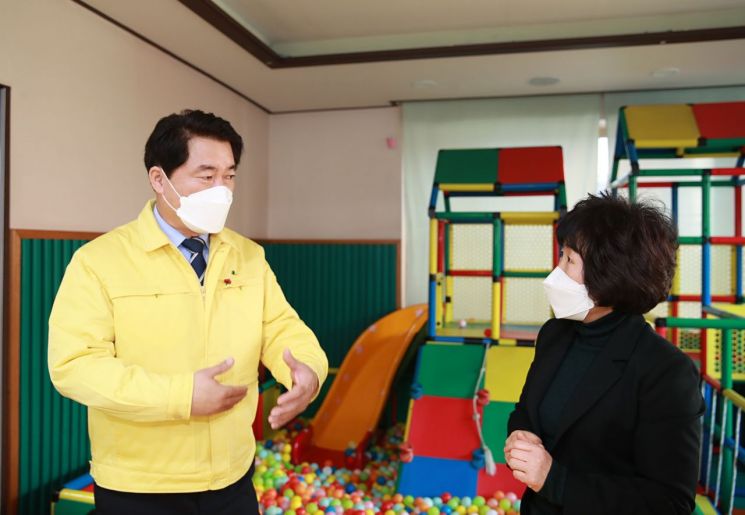 Park Jun-hee, the mayor of Gwanak-gu, visited local daycare centers last month to inspect quarantine sites and listen to difficulties.
[Asia Economy Reporter Park Jong-il] Gwanak-gu (Mayor Park Jun-hee) is making smooth progress with the payment of the ‘Together Euddeum Gwanak-type COVID-19 Disaster Relief Fund’ announced on the 28th of last month.
The ‘Together Euddeum Gwanak-type COVID-19 Disaster Relief Fund’ aims to help stabilize livelihoods and restore daily life by selecting those excluded from the government and Seoul city disaster relief payments and those who need additional support.
The district is investing 4.88 billion KRW of its own funds to support about 855 businesses and 8,700 people. Considering the prolonged difficulties due to COVID-19, the district accelerated payments of targeted relief funds before the Lunar New Year holiday.
Accordingly, 1 million KRW was paid before the Lunar New Year holiday to 189 daycare centers, 27 local children’s centers, and 34 elderly nursing facilities and day/night care centers; 500,000 KRW each to 19 elderly nursing group homes; and 10 million KRW each to 7 village bus companies.
About 530 religious facilities received sequential deliveries of quarantine supplies worth 500,000 KRW per facility. Kindergartens received 1 million KRW, and elementary, middle, and high schools were supported with up to 5 million KRW for purchasing quarantine supplies.
Individual and corporate taxi drivers facing difficulties due to COVID-19 are supported with 400,000 KRW.
The support target is individual or corporate taxi drivers in Gwanak-gu who have continuously maintained their driver qualification from January 21, 2022, to the announcement date of February 3. Residents registered in other Seoul districts are excluded.
The application period is until the 18th, and detailed information on how to apply for the relief fund can be obtained by contacting the Gwanak-gu Transportation Administration Division.
Small business owners who closed businesses in restricted or prohibited industries can also receive 500,000 KRW. Support is provided within a total budget limit of 500 million KRW until funds are exhausted, targeting small business owners who closed after March 22, 2020. However, those who received support in 2021 are excluded.
Small business owners wishing to apply can check the announcement on the Gwanak-gu website (News & Notices → Public Notices), prepare the required documents, and apply by visiting, email, mail, or fax. For detailed information, inquiries can be made to the relevant department by industry listed in the announcement.
Additionally, 500,000 KRW worth of Gwanak Love Gift Certificates will be provided as employment incentives to unemployed youth. The support method and criteria are currently being prepared, and support will be announced on the Gwanak-gu website in March.
A district official said, “Rapid response from the public sector is more important during this difficult time for all residents due to the spread of COVID-19,” adding, “We will carry out the disaster relief fund payments without delay to revitalize the local economy and stabilize people’s livelihoods.”
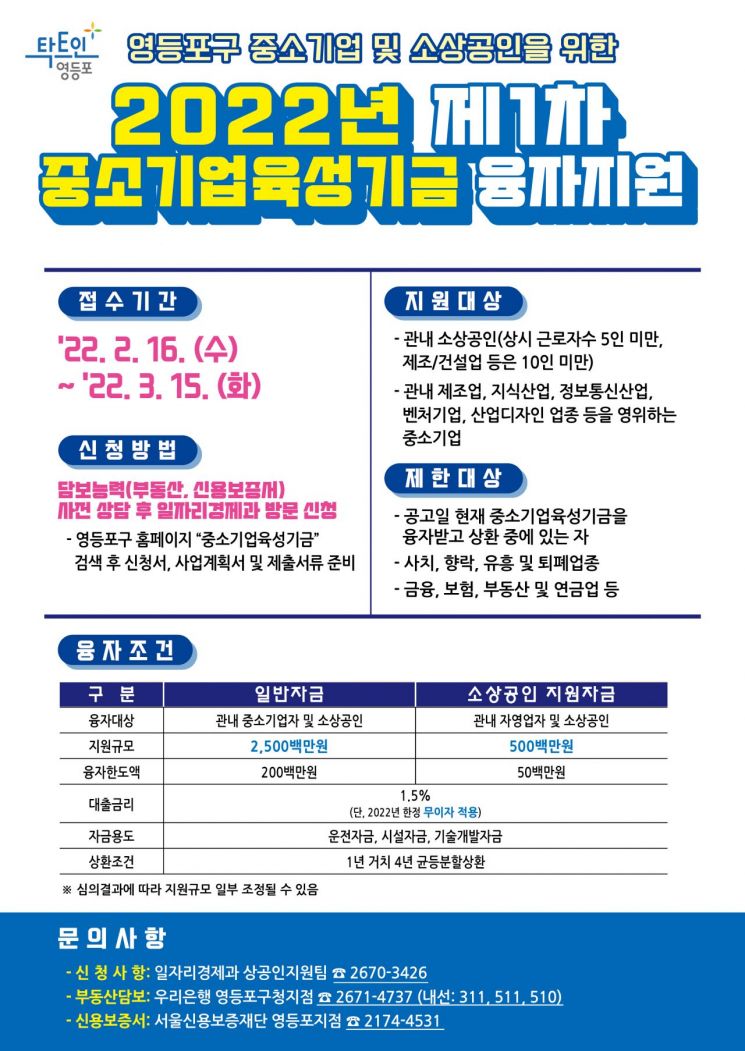
Yeongdeungpo-gu (Mayor Chae Hyun-il) is providing loans from a 3 billion KRW Small and Medium Enterprise (SME) Development Fund to support small business owners and SMEs facing economic difficulties due to COVID-19.
Manufacturing, knowledge industry, and information and communication industry SMEs and small business owners can apply for up to 200 million KRW, while other self-employed and small business owners can apply for up to 50 million KRW.
Applicants must be SMEs or small business owners registered in Yeongdeungpo-gu. If there are many applicants, priority is given to businesses registered with a factory in Yeongdeungpo-gu, businesses registered in Yeongdeungpo-gu with a factory registered in Seoul, and companies residing in the Yeongdeungpo-gu SME Startup Support Center. However, those currently repaying loans from the Yeongdeungpo-gu SME Development Fund as of the loan support plan announcement date, and businesses in luxury, entertainment, nightlife, vice industries, finance, insurance, real estate, and pension industries are excluded.
The funds are provided at a low interest rate of 1.5% per annum with a 1-year grace period and 4 years of equal installment repayment. Especially, to ease the burden on small business owners and SMEs hit by COVID-19, interest-free support is provided only in 2022.
Businesses wishing to apply should check collateral capacity (real estate, credit guarantee) at Woori Bank Yeongdeungpo-gu Office Branch and Seoul Credit Guarantee Foundation Yeongdeungpo Branch, then visit the Yeongdeungpo-gu Job Economy Division to apply from February 16 to March 15.
After document and on-site verification to confirm eligibility, the Yeongdeungpo-gu SME Development Fund Operation Review Committee will review and decide the final support targets and amounts in March. Selected companies are expected to receive loan support as early as the end of March.
For more details, search ‘Small and Medium Enterprise Development Fund’ on the Yeongdeungpo-gu Office website or contact the Job Economy Division.
Mayor Chae Hyun-il said, “The prolonged COVID-19 pandemic has worsened the management difficulties of SMEs and small business owners,” adding, “We will create a business-friendly Yeongdeungpo-gu by preparing various support measures such as overseas market development, brand development, marketing, and investment attraction, in addition to loan support.”
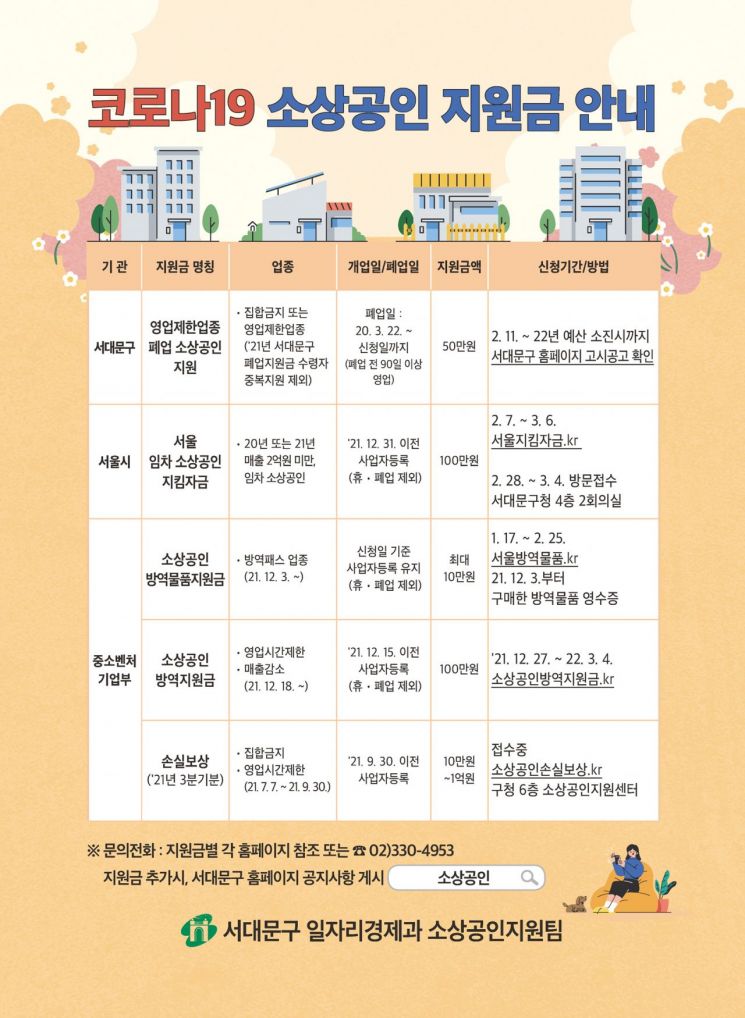
Seodaemun-gu (Mayor Moon Seok-jin) announced on the 16th that it is implementing multifaceted support projects for small business owners struggling due to COVID-19.
Considering that government support has mainly targeted operating businesses, the district will also provide 500,000 KRW to small business owners who closed due to gathering bans and business restrictions.
The application period started on the 11th of this month and continues until the budget is exhausted. The target is small business owners in gathering ban or business restriction industries who reported closure to Seodaemun Tax Office from March 22, 2020, to the application date. However, those who received closure support from Seodaemun-gu last year are excluded. Detailed application methods and related documents can be found on the Seodaemun-gu website under Public Notices.
Small business tenants located in Seodaemun-gu with annual sales under 200 million KRW in 2020 or 2021 can also receive 1 million KRW of ‘Seoul City Keeper Fund.’ Applications can be made on the relevant website until the 6th of next month.
If online application is difficult, applicants can visit the 4th floor, Room 2 of Seodaemun-gu Office by the 4th of next month to apply. Application documents are available on the website.
The district also supports ‘quarantine supplies purchase costs’ for facilities subject to the government’s social distancing and quarantine pass.
Facilities must submit receipts (simple receipts not accepted) for quarantine supplies purchased since December 3 of last year and a copy of their bankbook to the Seoul Quarantine Supplies website. Support of up to 100,000 KRW is provided based on the receipt amount.
Depending on the case, additional submission of small business confirmation, disaster relief fund receipt confirmation (Hope Recovery Fund, Quarantine Support Fund, etc.), and business registration certificate may be required. The application period is until the 25th of this month and may end early if the budget is exhausted.
Furthermore, businesses with operating hour restrictions or decreased sales that opened before December 15 last year can receive 1 million KRW small business quarantine support funds by applying through the Small Business Quarantine Support Fund website by the 4th of next month.
If an administrative order compliance certificate is required to prove operating hour restrictions, it can be issued by the district office’s business registration department. Businesses with decreased sales must submit VAT standard tax base certificates or tax-exempt business income certificates from HomeTax (Tax Office). Support decisions are made by the Ministry of SMEs and Startups and paid via bank transfer.
Additionally, the third quarter small business loss compensation is continuously accepted through the Small Business Loss Compensation website or the 6th floor Small Business Support Center of Seodaemun-gu Office. If the government announces additional small business support programs, they can be checked by searching ‘small business’ in the notices section of the Seodaemun-gu website.
Mayor Moon Seok-jin said, “I hope the various support projects of Seodaemun-gu, Seoul City, and the government will be of some help to small business owners struggling with the prolonged COVID-19 pandemic.”
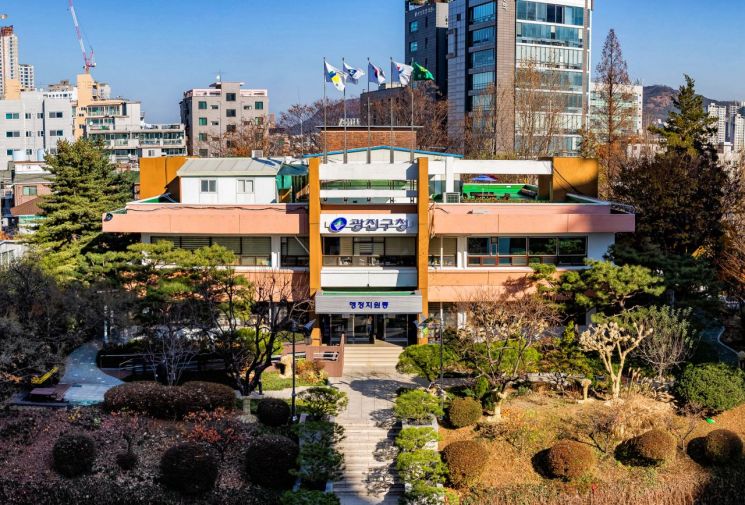
Gwangjin-gu (Mayor Kim Seon-gap) will continue to operate the ‘All Residents Life Safety Insurance’ introduced for the first time last year to protect residents from safety accidents.
The district enacted the ‘Resident Life Safety Insurance Operation Ordinance’ to implement the insurance, reviewed it to avoid overlap with Seoul City’s Citizen Safety Insurance, and started operating the insurance from February last year.
Gwangjin-gu’s Life Safety Insurance is designed to cover medical expenses from accidents rather than fixed-amount consolation payments for death or disability, which most districts provide, to better assist residents in real life.
Residents registered in the district are automatically enrolled and can receive benefits. It can be paid concurrently with individually subscribed actual medical expense insurance, and claims can be made within 3 years from the accident date occurring during the insurance period (February 1 to December 31, 2022).
The coverage includes funeral and emergency expenses, treatment, surgery, X-ray examinations, dental treatment, hospitalization, and other medical expenses resulting directly from injury regardless of the victim’s fault.
The coverage limit is up to 700,000 KRW per person, with a 30,000 KRW deductible per claim. However, medical expenses due to illness, traffic accidents, industrial accidents, bicycle and personal mobility device accidents, and accidents covered by other liability insurance or national support funds are excluded.
Mayor Kim Seon-gap said, “Through the insurance operation, residents are expected to receive minimum livelihood stability and compensation for damages from various safety accidents,” adding, “Gwangjin-gu will continue to pursue policies in various ways to ensure residents’ safe living.”
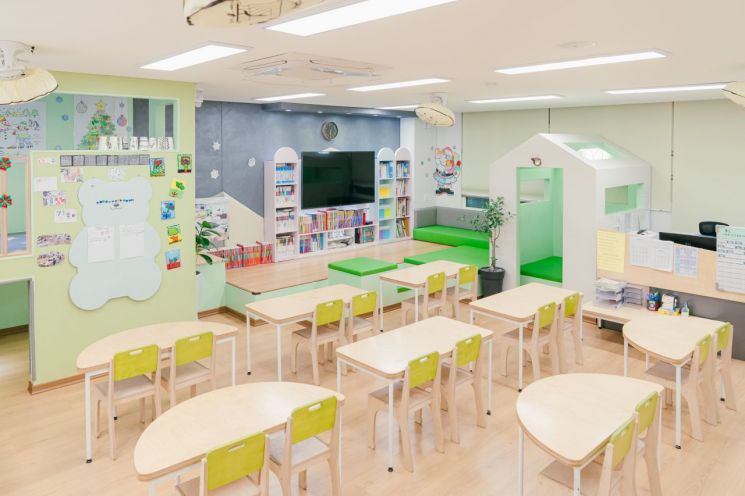
Jung-gu, Seoul (Mayor Seo Yang-ho) announced on the 16th that applications for new students for the 2022 Jung-gu-type Elementary Care Class exceeded 125% of the selection quota.
The district conducted application acceptance in three rounds since January to accommodate as many students as possible. A total of 1,192 applied for 948 seats across 41 care classrooms in 16 care centers inside and outside schools, showing a significantly higher application rate than last year.
According to the Ministry of Education’s ‘2022 Government-wide All-day Care Demand Survey,’ the number of parents wishing for local care is increasing annually. Over 60% of surveyed parents expressed a desire for all-day care, with elementary care classrooms being the most preferred care type at 53% (multiple responses allowed).
Regarding the increase in parents entrusting their children to Jung-gu-type elementary care despite the prolonged infectious disease situation, a district official evaluated, “There are various reasons, but trust in Jung-gu-type care grew stronger among parents who experienced the emergency care system immediately after the COVID-19 outbreak.” In fact, a satisfaction survey conducted at the end of last year showed 99% of parents were satisfied with the district’s COVID-19 response.
‘Jung-gu-type Elementary Care’ operates care classrooms directly managed by the district using unused school spaces. By incorporating care into the public domain and having the local government take responsibility for staffing, facility management, and program operation, the quality of care services has been dramatically improved, and treatment of care staff has been greatly enhanced. To institutionalize this, the district enacted the ‘Ordinance on Support for Elementary Student Care in Jung-gu, Seoul’ in 2020.
The biggest change through direct management is operating hours. Reflecting the needs of dual-income couples, care hours have been extended significantly until 8 p.m.
Additionally, the scope of care has expanded with diverse and high-quality programs covering culture, arts, and physical education. The introduction of a two-teacher system per classroom eliminated care blind spots and improved working conditions for care teachers. Jung-gu-type elementary care teachers belong to the Jung-gu Facilities Management Corporation, guaranteeing seniority promotion and retirement benefits. Starting with direct management of Heungin Elementary School’s care classroom in March 2019, the district converted all nine public elementary schools in the area to direct management by June last year.
Jung-gu-type elementary care is evolving. To secure external funding for elementary care, which is severely under-supported compared to infant care, the district plans to provide public-private-academic elementary care services linking CSR (Corporate Social Responsibility) projects with companies, local governments, and schools. Last year, Shinsegae, Doosan Management Headquarters, and TRN supported care classroom operating costs. This year, the number of after-school helpers will be increased to 13 to expand safe after-school support for children.
Furthermore, to increase participation of parents, most of whom are dual-income, the district plans to expand communication networks using online platforms such as Naver Care Cafe, open chat, and Zoom, and collect user feedback through various channels including care experience essay contests, parent monitoring groups, and entrance briefings to reflect in policies.
Mayor Seo Yang-ho said, “By incorporating elementary care into the public domain, more children can enjoy quality care benefits,” adding, “We will continue responsible operation to create care classrooms satisfying children, parents, teachers, and all participants in care.”
© The Asia Business Daily(www.asiae.co.kr). All rights reserved.
![Clutching a Stolen Dior Bag, Saying "I Hate Being Poor but Real"... The Grotesque Con of a "Human Knockoff" [Slate]](https://cwcontent.asiae.co.kr/asiaresize/183/2026021902243444107_1771435474.jpg)

















