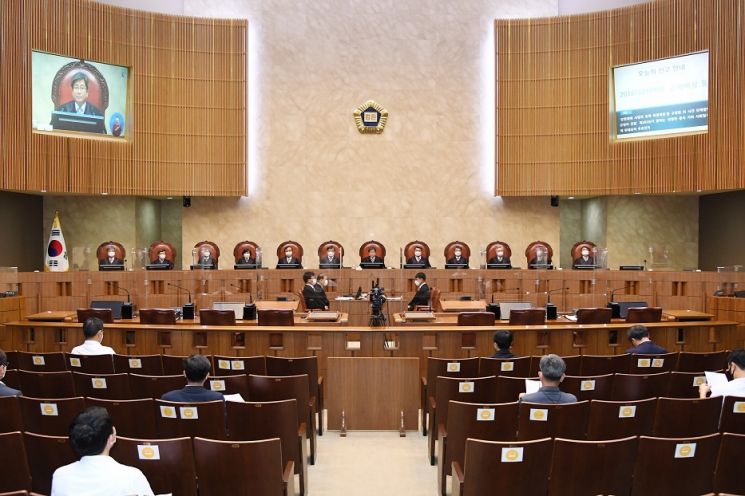
[Asia Economy Reporter Choi Seok-jin, Legal Affairs Specialist] The Supreme Court has ruled that even if a patient was informed about the possible side effects of surgery before the procedure, failing to provide sufficient time for the patient to decide whether to proceed with the surgery may constitute a breach of the duty to explain.
The Supreme Court's 3rd Division (Presiding Justice Ahn Cheol-sang) announced on the 14th that it overturned the lower court's ruling, which had dismissed the plaintiff's claim, in the damages lawsuit filed by patient A against doctor B, who operates a hospital in Pyeongtaek-si, Gyeonggi-do, and remanded the case to the Suwon High Court.
The court stated, "The defendant hospital's internal medicine doctor C, who was requested to evaluate the surgery, performed carotid artery and cardiac ultrasound examinations around 10:30 a.m. on June 11, 2018, the day of the surgery, and explained to the plaintiff's guardian that 'the plaintiff has a relatively higher risk of stroke compared to people without arteriosclerosis.' The defendant hospital's anesthesiologist D began anesthesia for the surgery around 11:10 a.m. on the same day, and shortly thereafter, the surgery commenced."
The court continued, "There is a possibility that the plaintiff proceeded with the surgery without fully considering the risks, including potential sequelae, associated with the surgery. This implies that the plaintiff's opportunity to choose whether to undergo the surgery was infringed upon, and there is room to view that the defendant hospital's doctors violated their duty to explain by not providing sufficient time to the plaintiff."
The court added, "Therefore, the lower court should have examined whether there was an appropriate time interval between the doctors' explanation and the surgery, and whether the plaintiff made the decision to undergo the surgery after due consideration, to determine if the doctors fulfilled their duty to explain. However, the lower court judged that there was no breach of the duty to explain solely based on the fact that the doctors provided explanations regarding the surgery, without such examination."
It further stated, "The lower court's judgment contains an error in legal interpretation regarding the fulfillment of the doctor's duty to explain, resulting in insufficient examination that affected the verdict. The claim in the appeal pointing out this issue is valid," explaining the reason for overturning and remanding the case.
Patient A visited the spine center of the hospital operated by doctor B on June 7, 2018, due to symptoms including back pain and difficulty walking caused by muscle weakness.
Four days later, on June 11 of the same year, starting at 11 a.m., A underwent surgery including interbody fusion, posterior instrumentation fixation, and artificial disc replacement, and was moved to the recovery room around 6:30 p.m.
However, when A was unable to express himself voluntarily and medical staff confirmed muscle weakness in A's left limbs, a brain computed tomography (CT) scan was performed around 6:50 p.m. on the same day, revealing signs of cerebral infarction.
A was transferred to hospital C at 7:30 p.m. on the same day and later to hospital D for treatment, but ultimately suffered left hemiplegia due to cerebral infarction, became unable to control bladder and bowel functions independently, and due to cognitive impairment, had difficulty communicating, requiring assistance from others in all aspects of daily life.
A filed a damages lawsuit claiming approximately 440 million KRW plus interest, including lost future earnings (loss of profit), medical expenses, and 30 million KRW in consolation damages, arguing that despite A's already high risk of stroke due to carotid artery stenosis before surgery, the medical staff proceeded with the surgery without special measures and neglected observation after the cerebral infarction occurred, missing the "golden time."
The first trial court judged, based on expert opinions that "there was no neurological abnormality in the brain before surgery," that A likely suffered cerebral infarction during the surgery.
However, the court did not recognize A's claims of medical negligence or breach of the duty to explain.
The court found no problem with the decision to proceed with A's surgery, noting that the surgeon F had requested preoperative evaluation from internal medicine and anesthesiology departments, and received a reply from internal medicine doctor G, who performed carotid ultrasound on A, stating that "the surgery could proceed as planned without major issues."
Although A's blood pressure rose during surgery, the court judged it difficult to find a breach of the duty to monitor during surgery, citing reasons such as ▲ this phenomenon being common in hypertensive patients, ▲ continuous administration of medication to lower blood pressure during surgery, and ▲ the fact that under general anesthesia, consciousness and reflexes are absent, making it mostly impossible to detect neurological abnormalities such as cerebral hemorrhage or infarction.
The court also denied breach of the duty to monitor after surgery, based on the fact that when A showed abnormal symptoms after surgery, a brain CT was immediately performed, and A was transferred to a higher-level hospital within an hour after being moved to the recovery room.
Meanwhile, the first trial court also rejected A's claim of breach of the duty to explain, reasoning that on the day A first visited the hospital, the medical staff explained the purpose of the surgery, surgical methods, and possible unexpected outcomes (complications) including nerve damage to A's guardian son, and that on the day of surgery, internal medicine doctor C, who was consulted, explained to A's son that "the risk of stroke may be relatively higher compared to people without arteriosclerosis."
A appealed, but the second trial court also found no problem with the first trial court's judgment and dismissed the appeal.
© The Asia Business Daily(www.asiae.co.kr). All rights reserved.
![Clutching a Stolen Dior Bag, Saying "I Hate Being Poor but Real"... The Grotesque Con of a "Human Knockoff" [Slate]](https://cwcontent.asiae.co.kr/asiaresize/183/2026021902243444107_1771435474.jpg)
















