Introducing New Technology for Synthesizing Single-Atom Catalysts: Eco-Friendly and Low-Cost
 Ulsan National Institute of Science and Technology (UNIST) has introduced a new technology for producing single-atom catalysts using ball milling. (From left: Professor Baek Jong-beom, Dr. Gao Feng Han, Professor Jung Hoo-young)
[Asia Economy Yeongnam Reporting Headquarters Reporter Se-ryeong Lee] Ulsan National Institute of Science and Technology (UNIST) has introduced a new technology that synthesizes 'Single Atom Catalysts (SACs),' which are attracting attention as next-generation catalysts, through a simple process.
The research team led by Professor Jongbeom Baek from the Department of Energy and Chemical Engineering succeeded in manufacturing single atom catalysts using a technique called ball milling, which involves colliding metal beads inside a container.
The principle is that metal atoms detached when the metal beads collide embed into the support material, synthesizing the single atom catalyst.
‘Single atom catalysts’ are catalysts in which tiny metal particles at the single-atom level are fixed on a support material, allowing all metal particles scattered on the support to be used as active sites.
They typically use inexpensive carbon materials as supports and employ a bottom-up method that synthesizes compounds at high temperatures by adding precursors, which are materials containing raw materials.
Because they use less expensive rare metals than bulk metal catalysts and are efficient, they are considered next-generation catalysts.
Existing methods for synthesizing single atom catalysts require multiple steps and emit organic pollutants or gases during the process.
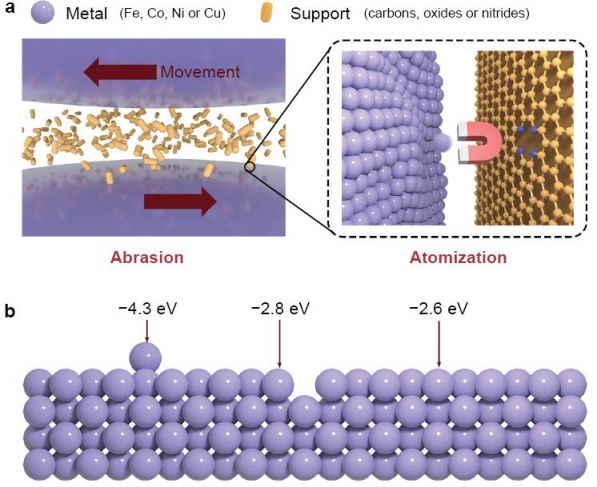
The research team announced that they developed a synthesis method that only requires placing metal beads, nitrogen gas, and support material in a container and rotating it.
When the metal beads collide strongly, their surfaces repeatedly compress and expand, becoming activated; at this time, the support material pulls the activated metal, causing metal atoms to easily detach, which is the principle utilized.
The nitrogen gas added together also enters the support structure in the form of nitrogen atoms, and thanks to the nitrogen, the metal is stably fixed on the support in a single atom state.
Unlike conventional catalyst synthesis that uses organic liquids with environmental pollution concerns, this synthesis method does not even require water and does not produce harmful gases such as carbon monoxide or chlorine gas, making it eco-friendly and economical.
By simply changing the raw material of the metal beads, various types of single atom catalysts can be synthesized, and by adjusting the container rotation speed, the amount of support material, and reaction time, the amount of metal fixed on the support can be easily controlled.
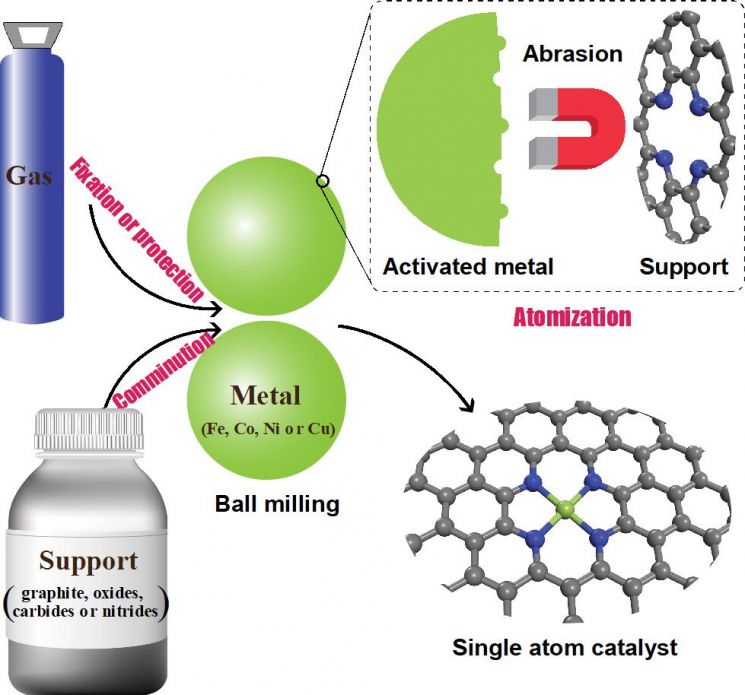
The research team synthesized catalysts by changing the metal bead raw materials to iron, nickel, cobalt, copper, and others.
They explained that the performance of the synthesized single atom catalysts is superior to that of existing expensive precious metal catalysts, making commercialization highly promising.
They emphasized that catalysts are used in almost every field, from processes producing plastic or cosmetic raw materials to diesel vehicle exhaust reduction devices.
As clean technologies such as green hydrogen production (water electrolysis) and carbon dioxide conversion technologies become fully commercialized, the demand for rare metals is expected to increase, making single atom catalyst technology that uses fewer rare metals very important.
The findings were published on February 10 in Nature Nanotechnology, the most authoritative journal in the field of nanotechnology, and the research was supported by the Ministry of Science and ICT’s Leader Researcher Support Project, the Science Research Center (SRC), the Creative Materials Discovery Program, and Ulsan National Institute of Science and Technology.
Dr. Gao-Feng Han, who led the research as the first author, said, “We repurposed a commonly used ball milling machine around us to develop a very simple yet excellent catalyst manufacturing method.”
Professor Jongbeom Baek said, “We developed a synthesis method that can solve the problems of existing single atom catalyst synthesis at once. It can be applied to various industries in the future and will greatly contribute to realizing the hydrogen economy and a carbon-neutral society.”
© The Asia Business Daily(www.asiae.co.kr). All rights reserved.
![Clutching a Stolen Dior Bag, Saying "I Hate Being Poor but Real"... The Grotesque Con of a "Human Knockoff" [Slate]](https://cwcontent.asiae.co.kr/asiaresize/183/2026021902243444107_1771435474.jpg)


















