TrendForce Forecasts 5-10% Rebound in NAND Flash Prices in Q2 This Year
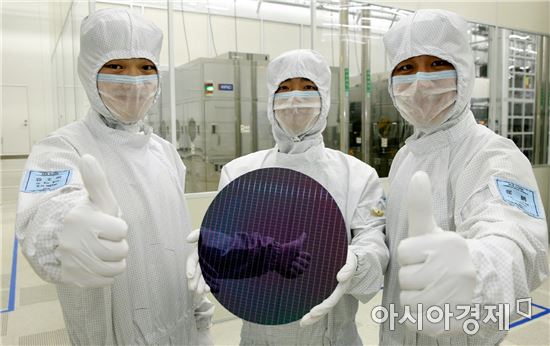 NAND flash products manufactured at Samsung Electronics Xi'an Semiconductor<Photo by Samsung Electronics>
[Asia Economy Reporter Park Sun-mi] The price of NAND flash memory semiconductors is expected to rebound by 5-10% in the second quarter of this year, allowing Korean semiconductor companies to benefit from a faster-than-expected price recovery.
On the 11th, market research firm TrendForce diagnosed that due to material contamination issues at the NAND factories jointly operated by Western Digital (WD) of the U.S. and Kioxia of Japan, which hold a 32.5% share of the global NAND flash market, the NAND price rebound could occur sooner than anticipated.
TrendForce stated that NAND prices could rise by 5-10% in the second quarter. Initially, NAND prices were expected to fall by 8-13% in the first quarter and continue to decline by 5-10% in the second quarter, but the forecast was revised to a smaller drop of 5-10% in the first quarter followed by a 5-10% rebound in the second quarter. The prevailing outlook was that the NAND flash market would experience downward price pressure in the first and second quarters due to supply exceeding demand.
The NAND price rebound is largely influenced by material contamination problems at two Japanese factories jointly operated by WD and Kioxia, ranked 2nd and 4th in the global NAND flash market share, which have rendered normal operations impossible. As of the third quarter of last year, WD and Kioxia held market shares of 13.2% and 19.3%, respectively, competing with domestic companies such as Samsung Electronics and SK Hynix.
WD and Kioxia have not provided specific information regarding the level of material contamination or the expected timeline for normal operations, but the industry believes that contamination is concentrated in 3D NAND, and production of NAND flash memory is expected to decrease by at least 6.5EB (exabytes; 1 exabyte is approximately 1 billion GB). TrendForce explained, "This accounts for about 13% of WD-Kioxia's shipments in the first quarter of this year and about 3% of their annual shipments." They added, "If the extent of contamination damage is confirmed, the scale of the damage could increase."
Some experts suggest that since NAND production typically takes 2-3 months and 3D NAND, which has a longer production cycle, was heavily impacted, it may take several months for the factory lines to resume production. Park Yu-ak, a researcher at Kiwoom Securities, said, "There is a possibility of additional losses being discovered beyond the 6.5EB during the process of normalizing production at WD-Kioxia factories, and the timing of resuming normal operations is uncertain. The benefits of the production disruption could be reflected in Samsung Electronics, SK Hynix, and other NAND supply chain companies."
© The Asia Business Daily(www.asiae.co.kr). All rights reserved.
![Clutching a Stolen Dior Bag, Saying "I Hate Being Poor but Real"... The Grotesque Con of a "Human Knockoff" [Slate]](https://cwcontent.asiae.co.kr/asiaresize/183/2026021902243444107_1771435474.jpg)














