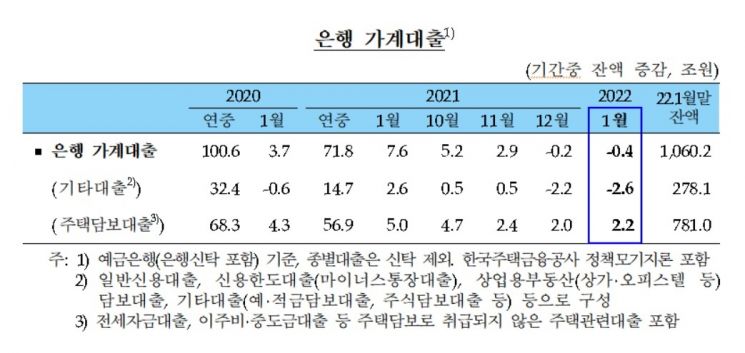
[Asia Economy Reporter Seo So-jung] Due to rising interest rates and strengthened loan regulations, household loans in the banking sector have decreased for two consecutive months. This is the first time since statistics began in 2004 that household loans have declined for two months in a row.
According to the "Financial Market Trends" released by the Bank of Korea on the 10th, as of the end of January this year, the outstanding balance of household loans at banks stood at 1,060.2 trillion won, down 400 billion won from the end of December last year.
Looking at the changes in household loans by type, the balance of mortgage loans, including Jeonse deposit loans, was 781 trillion won as of the end of January, increasing by 2.2 trillion won in one month. Of the 2.2 trillion won increase, Jeonse deposit loans rose by 1.4 trillion won, a decrease compared to the previous month’s increase of 1.8 trillion won.
Other loans, including unsecured loans, decreased by as much as 2.6 trillion won in one month. This decline was larger than the 2.2 trillion won decrease in December last year.
A Bank of Korea official explained, "In January, household loans at banks slightly decreased again due to an expanded decline in other loans," adding, "Other loans declined more due to rising loan interest rates, continued credit loan management by banks, strengthened government loan regulations, and seasonal factors such as inflows from holidays and performance bonuses."
He also added, "Mortgage loans slightly increased compared to the previous month due to a slowdown in housing transaction-related fund demand but an increase in group loans."
As of the end of January, the outstanding balance of corporate won-denominated loans at banks was 1,079 trillion won, increasing by 13.3 trillion won in one month.
Loans to large corporations turned to an increase due to year-end lump-sum repayments being re-borrowed, and loans to small and medium-sized enterprises (SMEs) rose sharply amid ongoing COVID-19 financial support, driven by demand for facility funds and value-added tax payments.
The total increase in corporate loans (13.3 trillion won) and SME loans (9.2 trillion won) in January were both the highest ever recorded for January since statistics began in June 2009.
The outstanding balance of bank deposits, which are not loans, stood at 2,119 trillion won as of the end of January, down 17.1 trillion won from the end of December last year.
By deposit type, demand deposits decreased by 31 trillion won due to corporate fund withdrawals related to value-added tax payments and bonus payments, but time deposits increased by 9.7 trillion won due to banks’ efforts to attract deposits to manage regulatory ratios and rising deposit interest rates.
Deposits at asset management companies also increased by 26.6 trillion won in January. Money Market Funds (MMFs) rose by 22.5 trillion won, reversing to an increase as banks redeposited funds withdrawn at the end of last year to manage the year-end BIS ratio (capital adequacy ratio based on the Bank for International Settlements standards) and as government treasury surplus funds flowed in.
© The Asia Business Daily(www.asiae.co.kr). All rights reserved.
![Clutching a Stolen Dior Bag, Saying "I Hate Being Poor but Real"... The Grotesque Con of a "Human Knockoff" [Slate]](https://cwcontent.asiae.co.kr/asiaresize/183/2026021902243444107_1771435474.jpg)















