Abolishing the $5,000 Purchase Limit
Still 'Closing the Barn Door After the Cow Is Lost' Coldly
Raising the Duty-Free Limit Needed to Boost Consumption Effectively
[Asia Economy Reporters Lim Chun-han and Jeon Jin-young] Although the government has decided to abolish the domestic duty-free purchase limit (USD 5,000) to support duty-free shops struggling due to COVID-19, the market response remains cold. Critics say it is a case of "closing the barn door after the horse has bolted," as luxury brands have already withdrawn amid sluggish sales.
A duty-free shop official told Asia Economy on the 10th, "This measure is too late as luxury brands are all leaving," adding, "Of course, it is better than doing nothing, but abolishing the purchase limit alone is unlikely to have a significant effect on boosting consumption. We hope the duty-free limit will be raised quickly."
The duty-free purchase limit was introduced in 1979 (USD 500) to curb excessive spending and prevent foreign currency outflow and has been maintained for 43 years. It has since been expanded to USD 1,000, USD 3,000, and USD 5,000. The recent decision to abolish the limit aims to redirect overseas consumption domestically and revitalize the duty-free industry. In the past, due to the low purchase limit, high-priced products had to be bought overseas, but now it is possible to purchase items such as Chanel bags and Rolex watches priced in the 10 million won range. However, since the duty-free allowance of USD 600 remains unchanged, taxes must be paid on the amount exceeding this limit.
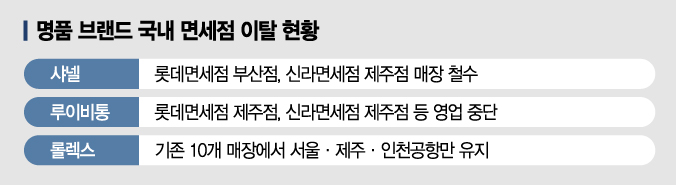
Currently, domestic duty-free shops are losing competitiveness due to the withdrawal of luxury brands and the rise of Chinese duty-free shops. French luxury brand Chanel plans to close its stores at Lotte Duty Free Busan and Shilla Duty Free Jeju by the end of next month. French luxury brand Louis Vuitton, after ceasing operations at Lotte Duty Free Jeju earlier this year, plans to close additional stores at Shilla Duty Free Jeju, Lotte Duty Free Busan, and Lotte Duty Free Jamsil World Tower. Louis Vuitton is reportedly focusing on Chinese domestic airport duty-free shops and made this decision accordingly. Swiss luxury watch brand Rolex also reduced its domestic duty-free stores from 10 last year to just one each at Seoul, Jeju, and Incheon airports.
The reason luxury brands are withdrawing from domestic duty-free shops is that the number of duty-free customers has sharply declined due to the prolonged COVID-19 situation. Additionally, Chinese smugglers purchasing large quantities of goods at domestic downtown duty-free shops and illegally distributing counterfeit products in China have damaged brand value. Last year, domestic duty-free sales amounted to KRW 17.8333 trillion, which is 71.7% of the KRW 24.8586 trillion recorded in 2019. The proportion of foreign sales increased from 83% in 2019 to 95.4% last year. Since the COVID-19 outbreak, sales have effectively depended mostly on Chinese smugglers.
Professor Seo Yong-gu of the Department of Business Administration at Sookmyung Women's University said, "Duty-free shops have been the hardest hit by COVID-19 over the past two years, but the government's response was delayed," adding, "Since the duty-free allowance remains unchanged, this will not be an effective policy."
© The Asia Business Daily(www.asiae.co.kr). All rights reserved.
![Clutching a Stolen Dior Bag, Saying "I Hate Being Poor but Real"... The Grotesque Con of a "Human Knockoff" [Slate]](https://cwcontent.asiae.co.kr/asiaresize/183/2026021902243444107_1771435474.jpg)















