KCCI, 'Regional Job Status' Report
Job Net Increase Slows Since 2016
"Job Creation Dynamism Weakening"
KCCI Calls for Expanding Foreign Direct Investment Attraction
Strengthening Reshoring Policies
Recommendations for Service Industry Deregulation
[Asia Economy Reporter Jeong Dong-hoon] An analysis has emerged showing that the net job growth rate in South Korea has slowed since 2016. In particular, the situation is more severe in non-metropolitan areas compared to the metropolitan area.
The Korea Chamber of Commerce and Industry's Sustainable Growth Initiative (SGI) stated in its report titled "Regional Job Status and Future Policy Tasks" on the 10th, "The nationwide job creation rate of businesses has declined since 2016, resulting in continued employment sluggishness," and added, "Both metropolitan and non-metropolitan areas have shown a downward trend in job creation rates since 2016, causing the net increase rate?the difference between job creation and destruction rates?to fall, thereby weakening the dynamism of job creation."
This report is based on an analysis of job creation and destruction rates using microdata from the National Business Survey from 2010 to 2019. The job creation rate refers to the proportion of new jobs created through business expansion or startups. The destruction rate refers to the proportion of existing jobs lost due to business contraction or closures. This study was jointly conducted by SGI and Professor Kim Min-jung of Chungnam National University.
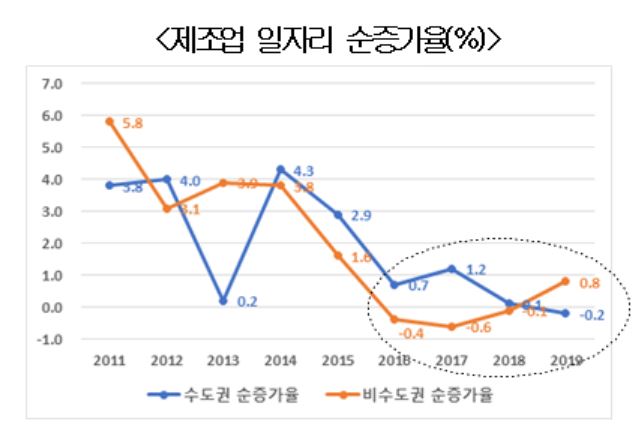
The report noted that the net job growth rate in the manufacturing sector showed a declining trend from 2010 to 2019, with employment sluggishness being more severe in non-metropolitan areas than in the metropolitan area.
Metropolitan Area’s Net Job Growth Rate Turns Negative in 2019
In the metropolitan area, the decline in job creation widened recently, turning the net growth rate negative in 2019. In non-metropolitan areas, the net growth rate was negative for three consecutive years from 2016 to 2018 (△0.4%, △0.6%, △0.1%). The report explained, "This indicates that the deterioration of the manufacturing employment market in non-metropolitan areas is more severe compared to the metropolitan area."
Furthermore, both metropolitan and non-metropolitan areas showed declines in job creation and destruction rates compared to the early 2010s, indicating a weakening dynamism in job creation. The metropolitan area exhibited higher job creation and destruction rates than non-metropolitan areas, implying greater dynamism in job creation due to business entry, exit, growth, and contraction in the metropolitan area.
Professor Kim Min-jung of Chungnam National University said, "Generally, startups play a positive role in expanding jobs, but in non-metropolitan areas, the startup infrastructure is poorer compared to the metropolitan area, resulting in low startup activity and lower job creation rates than in the metropolitan area."
SGI recommended policies to improve the employment market and promote regional balanced development through quality job creation, including ▲expanding foreign direct investment (FDI) attraction and strengthening reshoring policies for manufacturing ▲deregulating high value-added service industries and expanding startup support infrastructure ▲supporting the cultivation of new growth engines in super-regional clusters.

Strengthening Incentives for Domestic Return of Overseas-Expanded Companies
First, SGI called for expanding foreign direct investment attraction and strengthening incentives for high-tech companies to return domestically. The report diagnosed, "Since COVID-19, reshoring to enhance supply chain security and create domestic jobs has spread, and a so-called 'China+Alpha(@)' phenomenon is emerging, where advanced countries are seeking diverse production bases outside China," and argued, "In response to recent global value chain (GVC) restructuring, foreign direct investment attraction should be expanded, focusing on advanced industries with high global investment demand such as semiconductors, displays, and materials, parts, and equipment."
To this end, it proposed boldly introducing comprehensive support packages (tax benefits, visa privileges, etc.) for core small and medium-sized enterprises possessing advanced technologies and R&D personnel, while creating a system through dedicated regional foreign direct investment (FDI) organizations that can handle related tasks scattered across central and local governments at once.
It also argued that customized reshoring policy support considering the characteristics of specialized industries linked to regional key industries needs to be strengthened. Support eligibility and scale, such as tax, subsidies, and manpower support, are determined by company size and location, and the aim is to increase incentives for high-tech companies to return through segmented policy support considering the characteristics of regional key industries and advanced industries.
Second, SGI urged the creation of quality jobs through bold deregulation in high value-added service industries such as digital healthcare and knowledge-based services, and revitalization of the regional economy through startup support infrastructure. To this end, it argued, "Innovative systems such as regulatory free zones and regulatory sandboxes that ease bundled regulations related to new businesses faced by regions and local companies should be actively utilized."

SGI also noted the need to pay attention to the Localize Gunsan project, a social venture nurturing project that has revitalized the Gunsan region’s economy, which had been stagnant for years due to manufacturing decline, and added, "Support for high value-added service startups and fostering them as regional innovative companies should increase the influx of young talent."
It also recommended expanding super-regional cooperation projects to build growth hubs by region and foster new growth engine industries. The idea is to discover future strategic industries and promote regional innovation growth and job creation through super-regional cooperation beyond existing administrative boundaries centered on local governments. The report pointed out that continuous cooperation between the government and local governments and the development of successful models considering the characteristics of regional industrial structures are important to activate super-regional cooperation projects.
Woo Tae-hee, Executive Vice Chairman of the Korea Chamber of Commerce and Industry, said, "We must expand quality jobs through value-added creation and regional industrial advancement by converging manufacturing and service industries," and added, "In the metropolitan area, it is important to enhance the effectiveness of job creation through customized support policies considering corporate growth paths and industry characteristics, while in non-metropolitan areas, it is crucial to increase regional economic dynamism through startup activation linked to regional key industries."
© The Asia Business Daily(www.asiae.co.kr). All rights reserved.
![Clutching a Stolen Dior Bag, Saying "I Hate Being Poor but Real"... The Grotesque Con of a "Human Knockoff" [Slate]](https://cwcontent.asiae.co.kr/asiaresize/183/2026021902243444107_1771435474.jpg)

















