Suwon, Osan and Other Southern Gyeonggi Areas See Years of Crow Swarms
Experts: "Crows Lose Habitat Due to New Town Development"
"Damage Exists, But Coexistence Should Also Be Explored"
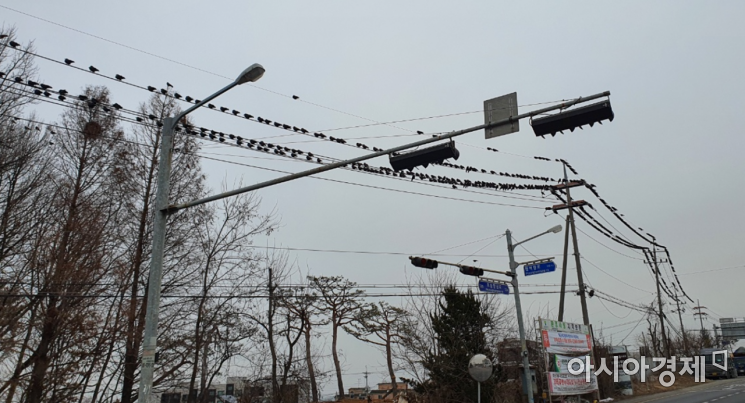 A flock of crows perched on a utility pole on a road in Pyeongtaek, Gyeonggi-do. Photo by a Pyeongtaek citizen.
[Asia Economy Reporter Kang Juhee] Every winter, flocks of rooks gather in various parts of the city. During the day, they forage for food, but in the evening, these flocks fly into the city and rest on power lines above the roads, creating a remarkable sight as they sit closely lined up in a row.
However, the rooks' droppings dirty the roads and vehicles, and local residents feel uneasy about being splattered while walking, causing inconvenience and becoming a problem. Mr. Lee, in his 50s, living in Pyeongtaek, Gyeonggi Province, said, "I think I started seeing the rooks about 6 to 7 years ago. Every night, the utility poles are packed with them sitting tightly together." He added, "Once, while waiting at a traffic light in my car, droppings fell onto the window, which was quite embarrassing."
Recently, citizens' sightings of rooks have also been shared on online communities, drawing attention. Netizens who watched the videos commented, "The ground becomes a sea of droppings," "I live in Suwon, and every night, they gather in such numbers that you can't even see the sky," and "Honestly, it's a bit scary," expressing their discomfort.
Since the winter of 2016, flocks of rooks have been spotted in southern Gyeonggi areas such as Suwon, Hwaseong, Osan, and Pyeongtaek. Ulsan and parts of Jeju Island are also known rook habitats. Rooks are winter migratory birds believed to spend summers in northern Eurasian regions like Siberia and Mongolia and migrate to Korea in winter to escape the cold. During the day, they forage in fields and paddies, and at night, they flock to urban areas to rest, avoiding birds of prey.
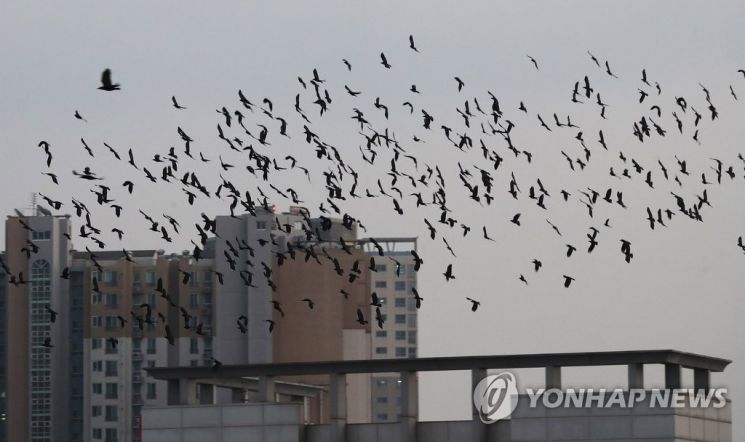
However, as rooks have been arriving every winter for several years, causing crop damage and power outages, residents' complaints have increased, raising demands for measures such as establishing alternative habitats.
The Ministry of Environment and Suwon City have been collecting reports from citizens about rook sightings from last November to this March as part of the 'Urban Ecosystem Health Enhancement Technology Development Project.' They are running an event where citizens receive 500 won per photo uploaded to the 'KADA' app if the photo captures rooks in Suwon, Hwaseong, or Ansan areas. The aim is to gather data on the times and locations of rook appearances based on citizen-submitted photos to respond effectively.
However, there are limits to fundamentally preventing rooks from flying into urban areas, and some argue that coexistence strategies between humans and animals should also be explored.
Researcher Kim Hwajeong from the National Migratory Bird Research Center explained, "Rooks originally gather and sleep in forested areas, but due to the expansion of new towns in the Seoul metropolitan area, their natural habitats have been damaged or lost, causing these issues." She added, "While establishing alternative habitats has been proposed as a solution, professional review regarding location and environmental conditions is necessary to expect positive effects. In Ulsan, the restoration of the Samho Bamboo Grove led to rooks using the forest as a resting place."
However, Researcher Kim also suggested reflecting on why the birds come to the city. She said, "The problem of rooks flocking is actually a phenomenon caused by artificial environmental changes where their habitats disappeared due to urban development. Although there are negative perceptions of rooks and inconveniences caused by birds to people, it is important to consider coexistence from the perspective of sharing our living space with animals."
© The Asia Business Daily(www.asiae.co.kr). All rights reserved.
![Clutching a Stolen Dior Bag, Saying "I Hate Being Poor but Real"... The Grotesque Con of a "Human Knockoff" [Slate]](https://cwcontent.asiae.co.kr/asiaresize/183/2026021902243444107_1771435474.jpg)
















