Leading Support for AI and Mobility... Establishment of 5·18 International Institute for Freedom, Democracy, and Human Rights
Promise of 'National Balanced Development' Including Early Construction of Dalbit High-Speed Railway and Relocation of Gwa
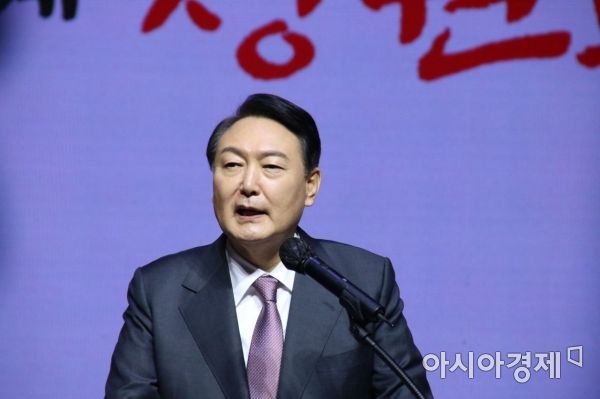 Yoon Seok-yeol, the presidential candidate of the People Power Party, attended the 'Victory Resolution Rally' held at the Kim Dae-jung Convention Center in Gwangju on the 6th and announced seven regional pledges.
[Asia Economy Honam Reporting Headquarters Reporter Yoon Jamin] Yoon Seok-yeol, the presidential candidate of the People Power Party, visited Gwangju and unveiled seven regional pledges.
On the 6th, Candidate Yoon visited Gwangju, paid respects at the National May 18th Democratic Cemetery, visited the apartment collapse accident site to meet with affected families, and attended a ‘Victory Resolution Rally’ where he announced regional pledges.
First, he promised to establish an industry-academia-research AI cluster linked with the National AI Data Center and Gwangju Institute of Science and Technology, create an AI semiconductor specialized complex, and establish an AI gifted high school to build an AI-Metaverse convergence city.
He aims to develop Gwangju into the definitive representative city of artificial intelligence in South Korea, strengthen the AI industrial ecosystem centered on the national AI cluster, and nurture it as South Korea’s Silicon Valley.
The AI era is a future that has already approached us, and since the success of South Korea’s entry into the G7 depends on Gwangju’s AI industry, it is no exaggeration to say. The plan is to lead the global market of AI convergence industries through ▲national industry-specific AI commercialization ▲creation of AI semiconductor specialized complex ▲establishment of industry-academia-research cluster linked with the National Data Center and Gwangju Institute of Science and Technology ▲establishment of AI gifted high school ▲AI-Metaverse-Coding Olympiad, among others.
In particular, based on Gwangju’s AI technological competitiveness and potential, it plans to strategically support the development, production, and distribution of metaverse cultural content, which is receiving much attention in the digital world without spatial and temporal constraints.
Gwangju’s AI innovation is expected to become a driving force for South Korea, a global information and communication powerhouse, to continuously lead global 4th industrial revolution technologies.
He also promised the construction of a highway connecting Gwangju and Yeongam.
The plan is to build a 47 km section connecting Gwangju, a future mobility leading city based on artificial intelligence (AI), and Yeongam, Jeonnam, which has a Formula 1 (F1) racetrack, in the style of Germany’s speed-limit-free highway, the Autobahn, to be used as a testbed for autonomous vehicles.
He mentioned the establishment of the ‘Southwest Radiation Medical Center’ to provide advanced radiation medical services to Gwangju citizens.
The southwest region is the most aged area nationwide with a high burden of cancer diseases, but cancer diagnosis and treatment institutions are concentrated in the metropolitan and southeastern regions, causing great difficulties for residents of Gwangju and the southwest region.
As South Korea’s largest optical industry city, Gwangju is the optimal location for bio-optical medical services. By establishing an advanced radiation and nuclear medical center, it aims to form a specialized medical system for cancer patients and provide optimal medical services that meet the needs of local residents.
Furthermore, plans include ▲installation of a radiation medicine R&D center ▲attraction of radiation convergence industries ▲attracting overseas patients to support the industrialization of radiation medical technology and develop it as a new growth engine for Gwangju. Along with expanding infectious disease dedicated hospitals, essential medical facilities will also be increased.
He also intends to actively respond to the mobility transition represented by electric vehicles, hydrogen vehicles, and autonomous driving, transforming Gwangju into a future mobility leading city.
The plan is to establish a future-type automobile materials, parts, and equipment specialized complex and a vehicle power semiconductor cluster centered on the Bitgreen National Industrial Complex.
Based on globally competitive AI technology, sensor technology and related upstream and downstream industries will also be advanced to promote the sophistication of the automobile industry, the core of Gwangju’s industry.
Additionally, he promised to start early construction of the Gwangju-Daegu Dalbit High-Speed Railway to form a new southern metropolitan economic zone and achieve national balanced development.
The Dalbit High-Speed Railway, connecting six metropolitan local governments and ten basic local governments east to west, is expected to realize the national railway vision for establishing a nationwide 2-hour connection circular railway network and serve as a driving force to promote ties between Honam and Yeongnam. A tourism belt utilizing the cultural and tourism resources of cities located along the railway axis will also be created.
It aims to overcome the unipolar economic structure centered on the metropolitan area, contribute to regional balanced development, and revitalize the economy by utilizing the characteristics of the cities along the route.
He did not omit the relocation of Gwangju Airport within the city.
He plans to integrate the functions of Gwangju’s civilian airport into Muan International Airport to connect the segmented urban living areas into one and recreate it as a future-oriented urban space where advanced technology, culture, history, and ecology harmonize.
The current site will be developed into a green smart city encompassing Gwangju’s 4th industrial revolution technologies to seek new momentum for regional development and transformed into an eco-friendly landmark such as an urban cultural arts garden. He also promised to actively consider the relocation of the military airport.
The final pledge is the establishment of the May 18 International Institute for Freedom, Democracy, and Human Rights.
This institute will confirm the values of the May 18 Democratic Movement, globally spread its noble spirit, and promote various academic, research, and educational projects for the succession and development of the spirit of freedom, democracy, and human rights.
Candidate Yoon emphasized, “The experience of democracy and human rights accumulated in Gwangju will provide great inspiration to the people of many countries currently undergoing pains in the democratization process,” and “It will become a global hub leading agendas for peace on the Korean Peninsula, inter-Korean unification, and Northeast Asian stability as a peacemaker pursuing peace, and a symbolic city of democratization worldwide.”
© The Asia Business Daily(www.asiae.co.kr). All rights reserved.

















