[Asia Economy Reporter Lim Hye-seon] Minister Lim Hye-sook of the Ministry of Science and ICT will mediate by meeting with the CEOs of related companies on the 17th regarding the controversy over the 'additional allocation of 5th generation (5G) frequency bands' that has arisen among the three mobile carriers SK Telecom, KT, and LG Uplus.
According to the telecommunications industry on the 5th, the Ministry of Science and ICT, having received possible schedules from the three carriers, finalized the 'meeting on the 17th.' However, the schedule may change depending on the COVID-19 situation. This meeting was arranged at Minister Lim's proposal. At the New Year's press briefing held on the 27th of last month, Minister Lim stated, "I will meet with the CEOs of the three carriers in February to gather common opinions."
The Beginning of the Sharp Conflict
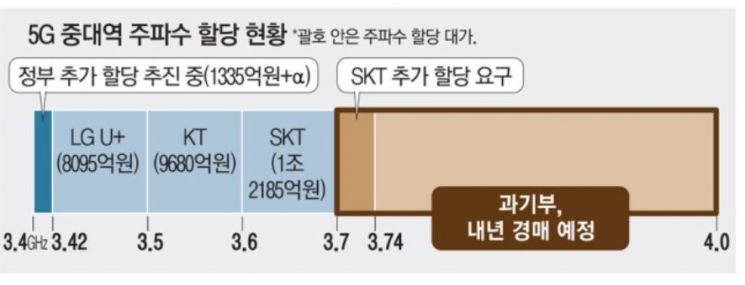
The spark of the conflict ignited when the Ministry of Science and ICT accepted LG Uplus's request for additional 5G frequency allocation. In July last year, LG Uplus requested an additional allocation of 20MHz bandwidth (3.40?3.42GHz) in the 3.5GHz band from the Ministry. This segment was excluded from the 2018 auction due to concerns about interference as it is adjacent to public frequencies. At the start of 5G service, SK Telecom and KT each won 100MHz bandwidth at 1.2185 trillion KRW and 968 billion KRW respectively, out of the 280MHz bandwidth auctioned. LG Uplus acquired 80MHz bandwidth for 809.5 billion KRW. Subsequently, after verification work in 2019, the Ministry concluded that this segment could also be used for commercial 5G service.
Last month, the Ministry announced a plan for additional allocation. The Ministry scheduled an auction this month for an additional 20MHz frequency allocation in the 3.4?3.42GHz band. The minimum competitive price for the auction was set at 135.5 billion KRW, with additional value factors to be added. The allocation condition requires the construction of 150,000 wireless stations by December 31, 2025.
SK Telecom and KT immediately raised concerns about 'fairness.' They argued that the price for frequency allocation should be fairly calculated to create a fair competitive environment. There is a structural problem in that this allocation can only be monopolized by the operator who requested the demand. It is true that this additional allocation is advantageous to LG Uplus. This frequency band is adjacent to the segment where LG Uplus commercialized its 5G service, so it can be used immediately without cost burden by linking with the existing frequency. On the other hand, SK Telecom holds 100MHz bandwidth between 3.60?3.70GHz, and KT holds 100MHz between 3.50?3.60GHz. Since SK Telecom and KT's bandwidths are far apart, they need to use Carrier Aggregation (CA) technology to combine the separated frequencies. This requires additional costs potentially amounting to trillions of KRW. SK Telecom and KT want as many additional allocation conditions as possible beyond the basic allocation condition (construction of 150,000 base stations). Conversely, LG Uplus maintains that additional frequency allocation is justified from the perspective of consumer benefits.
In response to the government's lukewarm reaction, SK Telecom launched a 'counterattack.' On the 25th of last month, SK Telecom sent an official letter to the Ministry proposing that telecom companies secure 5G frequencies under the same conditions before proceeding with the auction. SK Telecom also requested additional allocation of 40MHz in the adjacent 3.7?3.74GHz band.
Can the Ministry of Science and ICT Quell the Controversy?
Minister Lim explained, "We will discuss the parts where common opinions are gathered," adding, "The important thing is to enhance consumer benefits, and since a fair competitive environment among the three carriers must be established, we will discuss from these two perspectives."
Attention is focused on whether Minister Lim can derive a consensus among the three carriers at this meeting. Since securing frequency bands is a competitive advantage, the three carriers stake everything whenever there is an auction. Due to the nature of wireless communication, the bandwidth determines speed and quality. Also, a poorly handled frequency auction can result in losses of thousands of billions of KRW.
An industry insider said, "The timing of the frequency allocation announcement will be decided based on the outcome of this meeting." However, they cautiously predicted, "Normally, announcements are made one month before the auction, but even if the announcement date is set this time, the auction planned for this month is practically impossible," adding, "It will likely be postponed to the next administration."
© The Asia Business Daily(www.asiae.co.kr). All rights reserved.
![Clutching a Stolen Dior Bag, Saying "I Hate Being Poor but Real"... The Grotesque Con of a "Human Knockoff" [Slate]](https://cwcontent.asiae.co.kr/asiaresize/183/2026021902243444107_1771435474.jpg)
















