11.3 Trillion Deficit Bonds Raised
Concerns Over Fiscal Soundness Worsening
Contentious Debates Inevitable Over Funding Plan
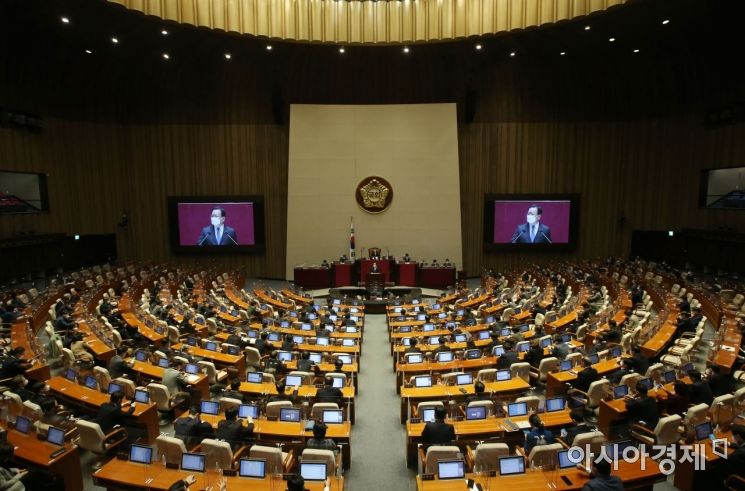 Prime Minister Kim Boo-kyum is delivering a policy speech related to the supplementary budget at the National Assembly plenary session on the 27th. Photo by Yoon Dong-joo doso7@
[Asia Economy Reporter Koo Chae-eun] The National Assembly has expressed concerns about the government's plan to raise 11.3 trillion won through 'government bond issuance' in the supplementary budget (추경) worth 14 trillion won, citing worries over the deterioration of fiscal soundness. With both ruling and opposition parties demanding a supplementary budget of at least 35 trillion won, the National Assembly's move to put the brakes on funding methods suggests that there will be difficulties during the discussion process.
According to the National Assembly on the 4th, Jeong Yeon-ho, the senior expert of the National Assembly's Planning and Finance Committee, stated in the 'Review Report on the 2022 First Supplementary Budget and Fund Operation Plan' prepared ahead of the full committee meeting that day, "While raising funds through deficit government bond issuance (amounting to 11.3 trillion won) may be inevitable, the increased national debt due to the supplementary budget is likely to be sustained continuously," adding, "This could impact fiscal soundness."
The government previously announced that out of the supplementary budget funds, 11.3 trillion won would be raised through government bond issuance (deficit bonds), and 2.7 trillion won would be drawn from surplus funds of public funds. Accordingly, this year's integrated fiscal balance is expected to worsen by 0.7 percentage points from the original plan (-2.5%) to -3.2% of GDP, and the national debt ratio is projected to increase by 0.1 percentage points from the original plan (50.0%) to 50.1% of GDP.
In the review opinion, Senior Expert Jeong pointed out, "The government seems to emphasize that this supplementary budget is based on last year's excess tax revenue of 10 trillion won, minimizing the national fiscal burden," but also noted, "According to Article 90 of the National Finance Act, 40% of excess tax revenue must be used for local allocation tax and local education finance grants, so the funds available for national debt repayment from excess tax revenue are limited." He added, "It is necessary to specifically discuss how to utilize excess tax revenue considering the impact of government bond issuance on fiscal soundness."
Following the expert's remarks, difficulties over funding methods are inevitable during the ruling and opposition parties' discussions on the supplementary budget. The ruling party insists on a minimum 35 trillion won supplementary budget and supports government bond issuance, while the opposition party demands a 46 trillion won supplementary budget along with significant cuts to the existing budget.
The positions of the ruling and opposition floor leaders, who oversee policy, also diverged. Yoon Ho-jung, floor leader of the Democratic Party of Korea, said at a policy coordination meeting the day before, "We will provide sufficient and robust fiscal support through a supplementary budget of at least 35 trillion won," adding, "We will ensure it is processed before the 15th so that payments can be made immediately." Kim Ki-hyun, floor leader of the People Power Party, said on the radio that day, "If we are going to have a supplementary budget, an additional 32 trillion won beyond the government's proposal is needed, making it about 46 trillion won," and added, "Even if the shortfall is covered by government bond issuance, we need to prepare a spending restructuring plan so as not to shame future generations."
© The Asia Business Daily(www.asiae.co.kr). All rights reserved.
![Clutching a Stolen Dior Bag, Saying "I Hate Being Poor but Real"... The Grotesque Con of a "Human Knockoff" [Slate]](https://cwcontent.asiae.co.kr/asiaresize/183/2026021902243444107_1771435474.jpg)
















