Cooperative Employment Inspectors and
Government-Affiliated Agencies Also Handle Multiple Tasks
Reasons Cited Include Delivery Corruption and Non-Member Discrimination,
But Actual Cases Are Rare
Cooperative Side Foresees Job Loss for Specialists
"Unreasonable Amendments at End of Administration" Criticized
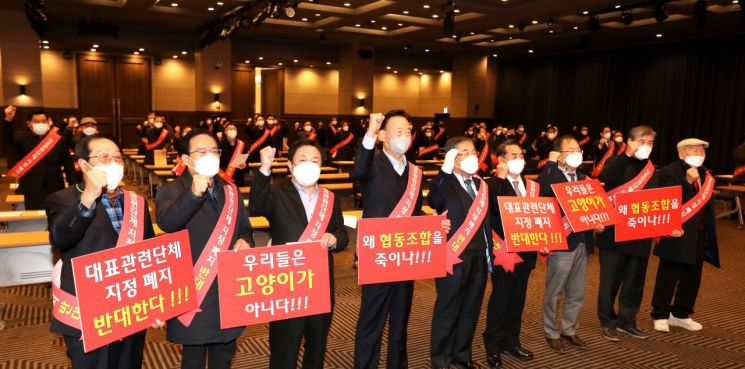 The Emergency Countermeasures Committee Opposing the Abolition of the Designation of Representative Organizations for Direct Production Confirmation held a rally on the 27th of last month at the Korea Federation of SMEs in Yeouido, Seoul. (Photo by Korea Federation of SMEs)
[Asia Economy Reporter Donghyun Choi] "Is the Ministry of SMEs and Startups trying to take away private sector jobs to their affiliated institutions?" (Park, an executive of Cooperative A)
This is the general reaction from small and medium-sized enterprise (SME) cooperatives as the Ministry of SMEs and Startups (MSS) begins reforming the ‘Direct Production Verification System,’ which is part of the competition system among SMEs. The competition system among SMEs mandates that only products directly produced by SMEs can be purchased for certain items in the public procurement market, and it has been in effect since 2007. The Direct Production Verification System is a procedure to investigate, evaluate, and certify whether SMEs are actually producing the relevant products.
Currently, the Korea Federation of SMEs, commissioned by the MSS, is responsible for related tasks under the Direct Production Verification System. The core task is the ‘on-site inspection,’ where professional personnel visit factories to verify whether manpower deployment and product production comply with guidelines. About 200 industry-specific cooperatives under the Federation are currently performing these tasks, employing approximately 340 specialized inspectors.
The conflict between the cooperatives and the MSS escalated at the end of last year when the MSS pushed for a legal amendment allowing the Small and Medium Business Distribution Center, an MSS-affiliated institution, to also handle the Direct Production Verification tasks, which had been solely managed by the Korea Federation of SMEs. Tae-seop Byun, Director of SME Policy at MSS, explained the rationale for the amendment, stating, "There have been continuous concerns about the fairness and equity of the Direct Production Verification tasks," and "there were many unreasonable aspects, such as discrimination between cooperative members and non-members."
However, the cooperatives argue that the MSS’s claims are inaccurate. Byung-nam Baek, Executive Director of the Korea Electronics Industry Cooperative, said, "Issues pointed out by the National Assembly, such as delivery fraud or label switching, occur at the contract or final delivery stages, not during the on-site inspections we oversee," and criticized, "The Public Procurement Service and MSS are shifting responsibilities they should bear onto us, who have no investigative authority, and making it a problem."
Statistics gathered from various cooperatives show that the ‘discrimination against non-members’ pointed out by the MSS as a major issue was almost nonexistent. According to the ‘Direct Production Verification On-site Inspection’ data collected from 191 cooperatives between January and October last year, 99% of SMEs belonging to cooperatives and 98.1% of SMEs not belonging to cooperatives were deemed ‘qualified.’ The rejection rates compared to applications were 16.6% for members and 20.1% for non-members, showing no significant difference. Hong-sik Kang, Executive Director of the Korea Metal Industry Cooperative, pointed out, "Non-members are potential customers who may join cooperatives in the future, so there is absolutely no reason to disadvantage them," adding, "These claims are made without any understanding of the field."
The MSS did not hold a single public hearing or collect opinions before announcing the reform plan for the tasks that cooperatives, as self-help organizations of SMEs, have carried out for about 15 years. This is why over 100 cooperative chairpersons nationwide recently formed an emergency committee and even held a rally in Yeouido. When requested to provide specific cases where fairness and equity were problematic in the field, the MSS refused to respond, citing concerns that "a particular cooperative might be harmed."
Industry insiders expect that if the Direct Production Verification System operates under a dual system starting in April, about 100 specialized personnel affiliated with cooperatives will lose their jobs. A representative from the Korea Federation of SMEs criticized, "Although it appears to be a dual system on the surface, in reality, the MSS is taking over the tasks that the Federation has been performing," and added, "They are forcibly pushing through the legal amendment without any discussion with the industry amid the chaotic end of the administration." Despite this situation, the MSS announced on the 3rd that it is recruiting about 500 private experts for the Direct Production Verification System field survey.
© The Asia Business Daily(www.asiae.co.kr). All rights reserved.

















