The Monetary Policy Committee's Last Meeting During Term on the 24th of This Month
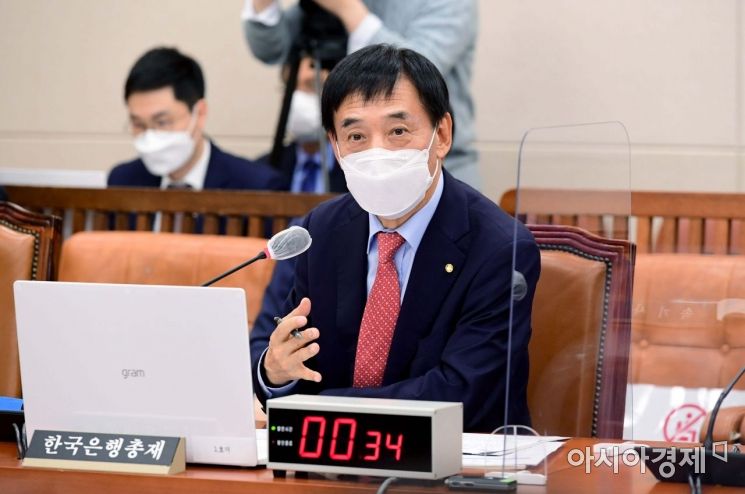
[Asia Economy Reporter Seo So-jeong] As the term of Lee Ju-yeol, Governor of the Bank of Korea, expires at the end of next month, interest in his successor is growing. Although around ten candidates are currently being mentioned as potential successors, the next president will be confirmed in early next month, so the possibility of an unexpected appointment cannot be ruled out.
According to the Bank of Korea on the 2nd, Governor Lee's term expires on March 31. According to Article 33 of the Bank of Korea Act, the governor can be reappointed only once. Governor Lee, who took office in April 2014, was reappointed on April 1, 2018. This is the first time in 44 years that a Bank of Korea governor has been reappointed.
Since joining the Bank of Korea in 1977, Governor Lee has held key positions such as Director of the Research Department, Deputy Governor in charge of Monetary Policy, and Deputy Governor. After leaving the Bank of Korea in 2012, he served as an advisor at Hana Financial Management Research Institute and a special professor at Yonsei University. He returned as Governor of the Bank of Korea in 2014, succeeded in his reappointment in 2018, and now has two months left in his term. The Monetary Policy Committee (MPC) meeting on the 24th of this month will be his last during his term.
President Moon Jae-in, who holds the appointment authority, must announce the nominee by early March. However, since the presidential election will be held on the 9th of next month, it is expected that the appointment will be made after consultations following the confirmation of the next president. Accordingly, the base rate decision meetings on April 14 and May 26 may be held without a governor, who also serves as the chairperson of the MPC.
Currently, internal candidates for the next governor include Lee Seung-heon, Deputy Governor of the Bank of Korea, and Yoon Myeon-sik, former Deputy Governor. Jo Yoon-je, MPC member, Im Ji-won, MPC member whose term ends in May, and Jang Min, senior research fellow at the Korea Institute of Finance and former director of the Bank of Korea’s Research Department, have also been mentioned. Other candidates include Cho Dong-chul, professor at the Graduate School of International Policy at the Korea Development Institute (KDI) and MPC member from 2016 to 2020; Lee Chang-yong, Asia-Pacific director at the International Monetary Fund (IMF); and Shin Hyun-song, director of the Research Department at the Bank for International Settlements (BIS).
Kim So-young, professor of economics at Seoul National University, and Ha Jun-kyung, professor of economics at Hanyang University, have been named as candidates through their participation in the presidential campaigns of Yoon Seok-youl of the People Power Party and Lee Jae-myung of the Democratic Party, respectively. Shin Kwan-ho, professor of economics at Korea University, and Kim Jin-il, professor of economics at Korea University who worked as an economist at the U.S. Federal Reserve (Fed), have also been mentioned.
Meanwhile, a survey conducted within the Bank of Korea revealed a preference for an external candidate as the next governor. According to a survey conducted by the Bank of Korea Labor Union in December last year targeting 716 union members, 57.9% responded that they want an external candidate as the next governor, more than twice the 26.4% who preferred an internal candidate.
The main reason for preferring an external candidate was "great disappointment in internal governors from a management perspective" (53.7%), followed by respondents (35.2%) who emphasized the ability to cope with external pressures from political circles and the government in terms of independence.
© The Asia Business Daily(www.asiae.co.kr). All rights reserved.
![Clutching a Stolen Dior Bag, Saying "I Hate Being Poor but Real"... The Grotesque Con of a "Human Knockoff" [Slate]](https://cwcontent.asiae.co.kr/asiaresize/183/2026021902243444107_1771435474.jpg)















