20,270 New Confirmed Cases... Record High
Severe Cases Rebound After Consecutive Decline
PCR Tests Decreased Due to Holidays but Cases Increased
Last Year's Chuseok Also Saw Surge After Holidays
Omicron Testing System Introduced from 3rd Is a Variable
PCR Testing Limited to Elderly, Epidemiological Links, Positive Self-Diagnosis, etc.
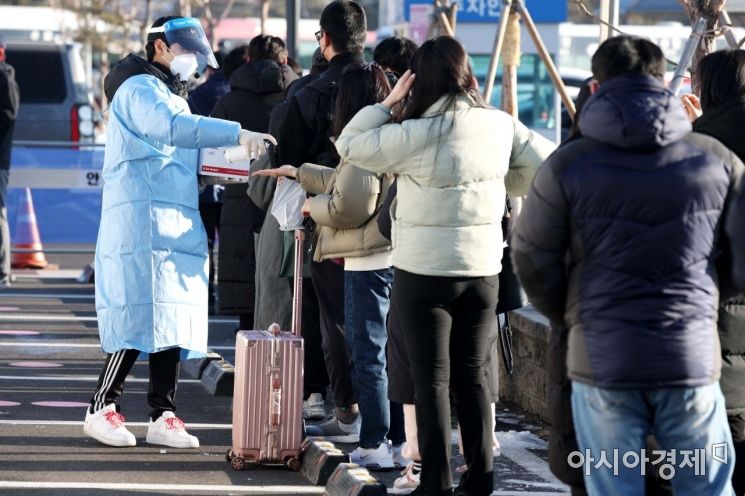 On the last day of the Lunar New Year holiday, the 2nd, citizens are waiting for tests at a temporary COVID-19 screening clinic set up in front of the domestic terminal building at Gimpo Airport in Gangseo-gu, Seoul. Photo by Mun Ho-nam munonam@
[Asia Economy Reporter Lee Chun-hee] For the first time ever, the number of new COVID-19 cases has surpassed 20,000. Especially since the number of polymerase chain reaction (PCR) tests dropped to about two-thirds of the weekday level due to the Lunar New Year holiday, concerns are rising that the nightmare of a surge in cases after the holiday, similar to last year's Chuseok, could be repeated.
According to the Central Disease Control Headquarters (CDCH) on the 2nd, the number of new COVID-19 cases reached 20,270, exceeding 20,000 for the first time since the pandemic began. This is nearly a 10,000 increase just one week after surpassing 10,000 for the first time on the 26th of last month with 13,009 cases. The weekly average of locally transmitted cases also rose to 17,127.9 per day.
The rapid spread of the Omicron variant is cited as the biggest factor behind this surge. According to CDCH analysis, Omicron currently accounts for 80% of domestic cases and 95.8% of imported cases, establishing itself as the dominant strain. Amid the rapid spread of Omicron, concerns are mounting over the healthcare system's capacity, which the government has emphasized. The number of severe cases hospitalized today was 278, up by 6 from 272 the previous day. The number of severe cases, which had been decreasing or plateauing for 34 consecutive days from 1,151 on December 29, last year?the peak of the surge during the 'gradual recovery of daily life (With COVID)' phase?to 272 on the 1st, has turned upward for the first time.
Considering that the trend in new cases and the occurrence of severe cases usually have a time lag of about two weeks, it is assessed that the rebound in cases starting in mid-last month due to the Omicron variant is now leading to an increase in severe cases. Although the severity and fatality rates of Omicron are estimated to be 0.42% and 0.15%, respectively, much lower than those of the Delta variant, the overall scale of infections is rapidly growing compared to the Delta wave, so even with a lower severity rate, the number of severe cases is inevitably increasing.
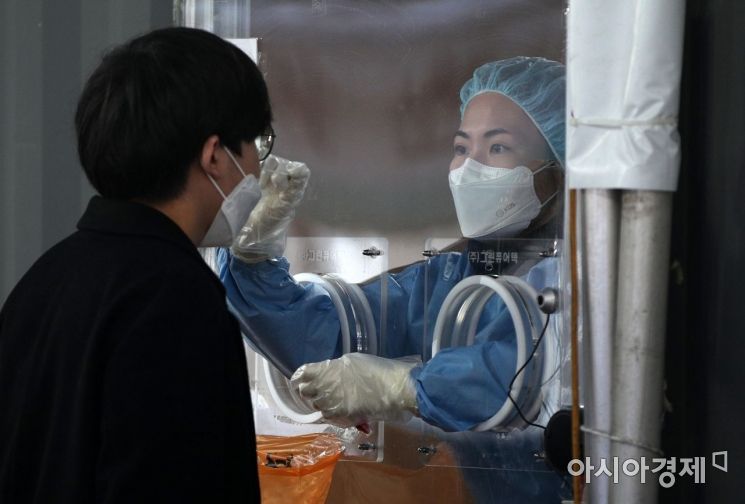 On the 30th of last month, medical staff at the temporary screening clinic at Seoul Station are collecting samples from citizens. Photo by Hyunmin Kim kimhyun81@
The problem is that while the number of cases continued to rise during this Lunar New Year holiday, the number of PCR tests significantly decreased. This raises a high possibility of repeating the 'holiday nightmare' when cases surged to 3,268 on the 25th, right after last year's Chuseok holiday (September 18?22), marking the first time cases exceeded 3,000.
This concern stems from the so-called 'weekend effect.' COVID-19 case numbers vary significantly by day of the week. Without additional holidays, the fewest cases are reported on Mondays and Tuesdays based on the announcement date, with peaks around Wednesdays and Thursdays, followed by slight fluctuations from Friday to Sunday. This phenomenon occurs because PCR testing drops sharply over the weekend and recovers starting Monday, and there is a 1?2 day delay in PCR test results, causing the weekend's reduced testing to affect case numbers on Monday and Tuesday. Therefore, after holidays like this Lunar New Year, cases are likely to surge starting two days after the holiday ends.
In fact, the number of suspected cases and tests at temporary screening clinics was 154,844 on the 17th, just before last year's Chuseok holiday, but dropped to 79,016 on the holiday itself, the 21st, nearly halving. However, after the holiday ended, the number recovered to 117,980 on the 23rd and surged to 262,039 on the 25th. The increase in gatherings during the holiday further contributed to the rapid rise in cases afterward.
This Lunar New Year holiday is also highly likely to see a similar pattern. The number of suspected cases and tests at temporary screening clinics, which was around 300,000 per day, including 344,000 on the 28th of last month before the holiday, dropped to 220,118 on the first day of the holiday, the 29th, and remained low with 220,118 on the 30th, 226,535 on the 31st, and 210,198 on the 1st, compared to the previous week. However, despite this, the test positivity rate steadily rose, reaching 9.3% on the 31st. If PCR testing increases again after the holiday, the number of confirmed cases is also likely to surge.
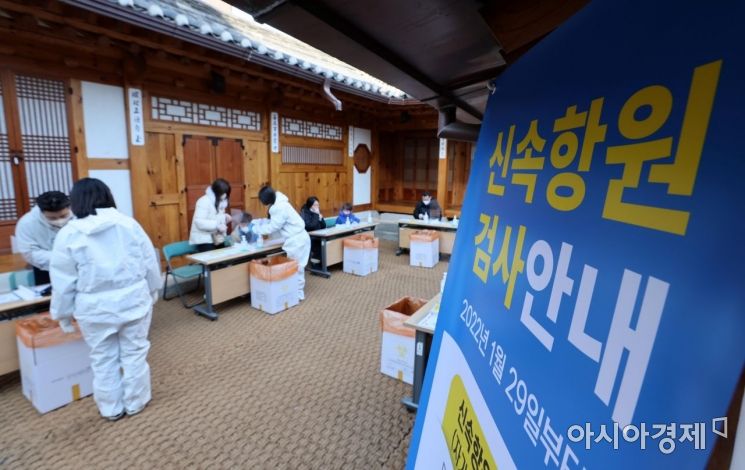 On the 30th of last month, citizens visiting the COVID-19 screening clinic at the Jongno-gu Public Health Center in Seoul are conducting rapid antigen tests using self-test kits. If the test result is positive, they immediately move to the adjacent PCR testing site to undergo a PCR test. Photo by Kim Hyun-min kimhyun81@
However, a major variable in this prediction is the Omicron response testing and treatment system, which will be introduced nationwide starting on the 3rd. Because PCR testing will be significantly restricted from the 3rd, the recovery in the number of PCR tests is expected to be slow.
Currently, anyone who wishes can visit screening clinics and receive free PCR testing. But from the 3rd, even if visiting a screening clinic, PCR tests will only be immediately available for high-risk groups (priority testing groups), including ▲people aged 60 and over ▲those epidemiologically linked ▲those with a doctor's note indicating the need for a COVID-19 test ▲those who tested positive on self-test kits or rapid antigen tests.
If not in the priority testing group, a positive result must come from a self-test rapid antigen kit or a professional rapid antigen test conducted after a doctor's examination at a respiratory clinic to qualify for PCR testing. If these testing restrictions are actually implemented, the number of PCR tests, which already decreased due to the holiday, may not only fail to recover but could even decline further.
© The Asia Business Daily(www.asiae.co.kr). All rights reserved.
![Clutching a Stolen Dior Bag, Saying "I Hate Being Poor but Real"... The Grotesque Con of a "Human Knockoff" [Slate]](https://cwcontent.asiae.co.kr/asiaresize/183/2026021902243444107_1771435474.jpg)

















