KDI Announces '2021 Q4 Real Estate Market Trends'
63% Support Capital Gains Tax Relief... "Tax Relief on Property Holding Needed for Jeonse Market Stability"
[Asia Economy Sejong=Reporter Kwon Haeyoung] Experts have pointed out that to stabilize the soaring housing prices under the Moon Jae-in administration, the so-called "three real estate tax set"?acquisition tax, holding tax, and capital gains tax?should be eased. With some presidential candidates hinting at adjustments to real estate taxation ahead of the March presidential election, the need for comprehensive tax reform is increasing.
According to the "2021 Q4 Real Estate Market Trends" report released on the 29th by the Korea Development Institute (KDI), a survey was conducted among 812 economic and real estate experts regarding the real estate market. About 50% of respondents said that acquisition tax, holding tax, and capital gains tax should all be "eased" to stabilize the real estate sales market in the future, making it the most common response.
In particular, 63% supported easing capital gains tax. Opinions for "maintaining the current system" and "strengthening" were 24% and 13%, respectively. Regarding holding taxes such as property tax and comprehensive real estate tax, 43% favored easing, 32% preferred maintaining the current system, and 25% supported strengthening.
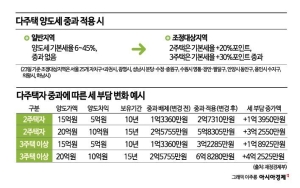
Currently, the highest capital gains tax rate on housing for multiple homeowners is 75%, and including local taxes, it reaches 82.5%. The comprehensive real estate tax is also up to 6% for multiple homeowners. Multiple homeowners face a dilemma: selling means paying capital gains tax, while holding means worrying about holding tax. Many are waiting to sell, hoping for tax relief from the next government. Therefore, there are opinions that easing capital gains tax to open an exit for multiple homeowners and increasing supply will stabilize the housing sales market.
KDI analyzed, "The dominant opinion favoring easing capital gains tax reflects the need to promote market stability through an increase in listings," and added, "The holding tax easing opinion partly reflects recognition of the need for policy consideration for elderly taxpayers who have cash flow difficulties."
Regarding acquisition tax, 53% favored easing, followed by 37% for maintaining the current system, and 9% for strengthening. South Korea has the highest acquisition tax relative to GDP among OECD countries as of 2019, due to frequent transactions.
Notably, many opinions also emphasized the need to ease taxes to stabilize the Jeonse (long-term lease) market. Forty-five percent of all respondents said holding tax should be eased to prevent tax burden pass-through and stabilize the Jeonse market. Recently, in the rental market, the rise in Jeonse prices has led to an increase in "banjeonse" (semi-Jeonse), where part of the increase is converted into monthly rent. This is analyzed as a match between tenants burdened by rising Jeonse loan interest rates and landlords trying to cover taxes by converting to monthly rent due to increased holding tax. Sixty-eight percent supported easing the "Lease 3 Acts" regulations, which guarantee tenants' right to renew contracts, to create an environment where private rental housing providers can sustainably operate their businesses.
Additionally, 43% supported easing financial regulations such as loan-to-value ratio (LTV) and debt service ratio (DSR) to stabilize the real estate sales market. Regarding transaction regulations such as price caps on pre-sale, resale restrictions, eligibility restrictions for subscription, and strengthening of speculative areas, the majority preferred maintaining the current level, with 48% and 46% respectively. Forty-four percent supported establishing a Real Estate Transaction Analysis Institute to strengthen speculation suppression.
Regarding the outlook for this year's real estate market, 51.3% of respondents predicted a "decline," which was higher than the 30.4% who expected a "rise." Eighteen point three percent anticipated a "stable" market.
© The Asia Business Daily(www.asiae.co.kr). All rights reserved.