S-Oil and SK Innovation, KOSPI Listed Companies, Announce Return to Profit
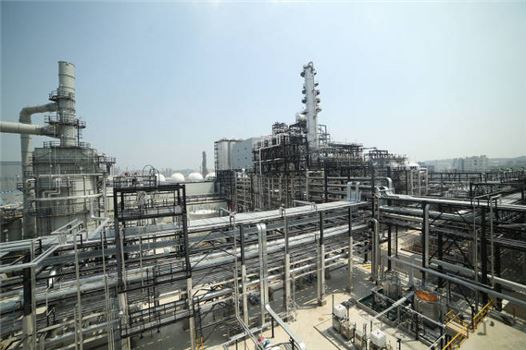 Exterior view of the Nexlene plant within SK Innovation Ulsan Complex. (Photo by SK Inno)
[Asia Economy Reporter Moon Chaeseok] Major domestic oil refiners are expected to turn a profit simultaneously, generating operating profits totaling around 7 trillion won. This is analyzed as a result of a combination of factors, including increased demand for petroleum products due to the accelerating economic recovery and the rise in refining margins, a key profitability indicator.
According to the refining industry and securities firms on the 28th, the estimated operating profits of the four refiners?S-Oil, SK Innovation, GS Caltex, and Hyundai Oilbank?last year total about 7 trillion won. A year ago, all four companies recorded operating losses of about 5 trillion won due to the COVID-19 pandemic, but they have successfully reversed this. The combined operating profit of 7 trillion won for the four companies is the first time in four years since 7.7226 trillion won in 2017.
On the morning of the previous day, S-Oil announced that its operating profit last year turned positive compared to the previous year, reaching 2.3064 trillion won, and sales increased by 63.2% to 27.4639 trillion won. This is the highest operating profit since the company's founding. Net profit also set a record at 1.5001 trillion won. SK Innovation also announced on the same day that its operating profit last year was 1.7656 trillion won, marking a turnaround to profit compared to the previous year. Sales also increased by more than 35% to 46.8429 trillion won. Additionally, GS Caltex is estimated to have recorded about 2 trillion won, and Hyundai Oilbank about 1.2 trillion won in operating profits. If these estimates hold, the combined operating profit of the four refiners will exceed 7 trillion won. This is the first time in four years since 2017's 7.7226 trillion won that the combined operating profit of the four companies has surpassed 7 trillion won. This means they have achieved results that more than make up for last year's slump.
The rise in refining margins, a key profitability indicator, is interpreted as having influenced the performance. Refining margin refers to the amount obtained by subtracting crude oil prices and operating costs from the selling price and is a profitability indicator for refiners. According to the industry, the Singapore complex refining margin has recovered to the breakeven point of $4 to $5 per barrel. The average last year was $3.7, and this month, the first week recorded $5.9, the second week $6.0, and the third week $5.5, all above $5 per barrel.
Refiners reflect the value of crude oil holdings in their performance. This means that as oil prices rise, company profits also increase. According to the Korea National Oil Corporation, the closing price of West Texas Intermediate heavy crude oil on the 26th was $87.35 per barrel. At the end of last year, it was $75.21, up 55% ($26.69) from the closing price of $48.52 at the end of 2020. Accordingly, refiners are expected to see improved performance effects in the evaluation of crude oil inventory assets.
The expansion of profitability in the non-refining sector, such as the lubricants business, is also expected to positively impact performance improvement. In the case of S-Oil, which announced its results on the day, the lubricants division recorded an operating profit of 1.0017 trillion won last year. The industry explains that this item significantly affects company performance as demand for high-quality products increases, improving results. An S-Oil official said, "In addition to refining margins and rising oil prices, the increase in lubricants performance in the non-refining sector is interpreted as having a positive impact on overall performance."
Increasing export performance is also a favorable factor. According to the export performance of the four refiners announced by the Korea Petroleum Association on the day, petroleum product exports amounted to $33.23534 billion, up 54.6% from the previous year. This growth rate was the highest since 64.2% in 2011. The export profitability, calculated by subtracting crude oil import prices from petroleum product export unit prices, recorded $9.1 per barrel, more than double the $3.7 per barrel from the previous year, greatly contributing to improving export structure and refining companies' management performance.
As the business conditions improve, the four refiners are increasing their operating rates. According to the Korea National Oil Corporation, the operating rate in December last year was 78.7%, up 2.5 percentage points from 76.2% a year earlier. An association official said, "Since the second half of last year, as oil demand recovery has become visible, the operating rates of domestic refiners have shown a gradual upward trend," adding, "This year, the refining industry will contribute to increasing national exports by diversifying export regions and exporting high value-added products in line with the global increase in oil demand."
© The Asia Business Daily(www.asiae.co.kr). All rights reserved.