[Asia Economy Reporter Choi Seok-jin, Legal Affairs Specialist] The Supreme Court has ruled that even if the victim consents or agrees, violating a court-issued restraining order or no-contact order is punishable.
The reason is that allowing an individual’s will to effectively nullify a court order could undermine legal stability.
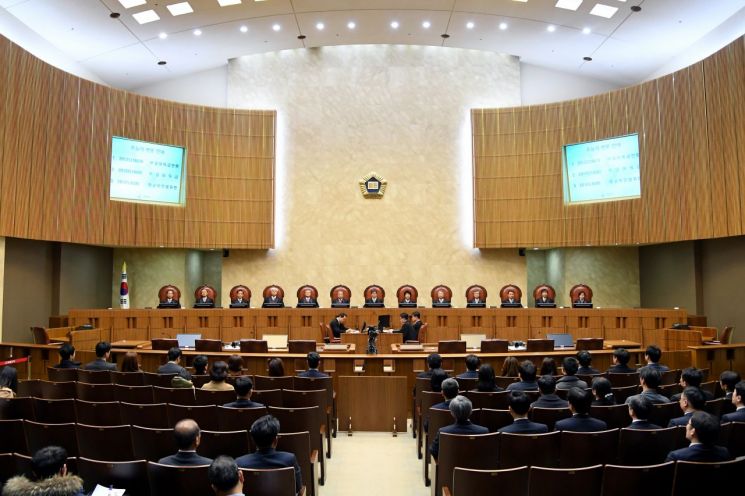
The Supreme Court’s 2nd Division (Presiding Justice Min Yoo-sook) announced on the 28th that it upheld the lower court’s ruling sentencing defendant A to one year in prison with a two-year probation in the appeal trial for violating the Act on the Punishment of Domestic Violence.
The court stated, "There is no error in the lower court’s judgment that violates the rules of logic and experience or exceeds the limits of free evaluation of evidence, nor is there a misinterpretation of the law regarding the victim’s consent or justification."
A, who lived with victim B from March to July 2018, received a temporary protection order from the court in September of the same year, which included ▲ a restraining order prohibiting A from approaching within 100 meters of B’s residence and workplace ▲ a no-contact order prohibiting transmission of codes, words, sounds, or images via B’s cellphone, email address, wired, wireless, optical, or other electronic means. On December 13 of the same year, A also received a victim protection order with the same conditions.
However, A violated these court orders by approaching B’s residence in Paju, Gyeonggi Province, 61 times from October 25 to November 20, 2018, under the pretext of feeding cats, and sent a total of 434 text messages to B’s cellphone during the same period, leading to charges of violating the temporary protection order.
Additionally, on December 16, 2018, at 2 p.m., A violated the victim protection order by slowly driving past the road in front of B’s residence using his vehicle, circling the road several times, and leaving objects at the entrance of B’s residence. On January 31, 2019, at 1:21 a.m., A was also charged with violating the victim protection order by calling B.
In the first trial, the court recognized some of A’s charges for violating the temporary protection order and victim protection order and sentenced him to one year in prison with a two-year probation.
However, the first trial court acquitted A of approaching B’s residence for about a month after the temporary protection order was issued.
According to messages exchanged between the two, B had asked A to take care of the cats around her house, and A inquired about cat care methods, so it was interpreted that B had consented in advance to A’s approach and contact.
However, the second trial overturned this first trial judgment, reasoning that the effect of court orders such as restraining orders cannot be nullified solely by the victim’s personal will. Although some charges that were guilty in the first trial were acquitted, the overall sentence remained unchanged.
The second trial court stated, "The court’s temporary protection order commands the defendant to refrain from approaching and transmitting messages regardless of the victim’s consent. If the elements of the offense could be negated by the victim’s consent or approval rather than the court’s permission, it would mean that a court order could be effectively nullified by an individual’s will, which risks undermining legal stability."
It continued, "Therefore, even if the victim instructed the defendant regarding the care of the cats and allowed contact or approach to the victim’s residence as the defendant claims, this does not negate the elements of the offense under the Act on the Punishment of Domestic Violence."
The court also added, "Considering that the defendant knew about the issuance of the temporary protection order but initiated contact with the victim, and the victim responded; that the exchanged messages included content about their dispute as well as issues regarding cat care, which seemed to be a cause or subject of their conflict; and that the victim repeatedly sent messages asking the defendant to stop contacting her, it is difficult to regard the defendant’s approach or message transmissions as lawful acts not violating social norms."
However, the second trial court acquitted A of acts committed before receiving the temporary or victim protection orders, reasoning that it cannot be considered a failure to comply with the orders.
Regarding the call made at 1:21 a.m. on January 31, 2019, the court acquitted A, accepting his claim that the call was made accidentally while checking message history, and found that the prosecution’s evidence did not prove beyond reasonable doubt that the call was intentional. Since the law does not punish negligence in violation of protection orders, the court ruled not guilty.
The Supreme Court also agreed that the second trial’s judgment was correct.
© The Asia Business Daily(www.asiae.co.kr). All rights reserved.