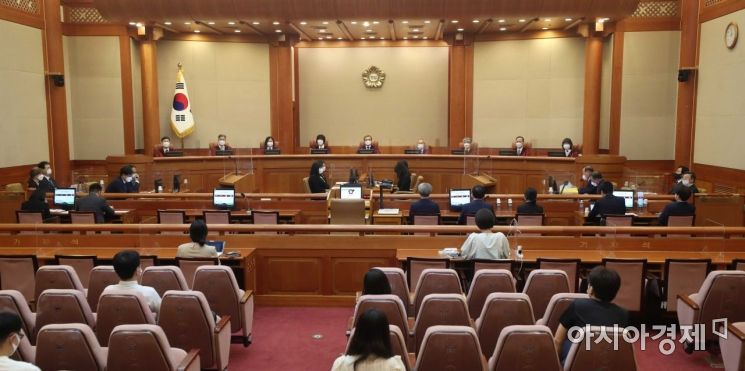
 Chief Justice Yoo Nam-seok of the Constitutional Court and the justices are attending the final arguments for the impeachment trial of former Chief Judge Lim Seong-geun at the Grand Bench of the Constitutional Court in Jongno-gu, Seoul, on the 10th, waiting for the trial to begin. Photo by Moon Ho-nam munonam@
[Asia Economy Reporter Kim Hyung-min] The Constitutional Court has ruled that the Public Officials Pension Act, which prohibits retired public officials elected as local council members from receiving retirement pensions during their term, is unconstitutional.
On the 27th, the Constitutional Court issued a decision of constitutional inconsistency by a 6 to 3 vote in a constitutional complaint case filed by local council member A and others, who argued that the provision suspending retirement pension payments in the Public Officials Pension Act infringes on property rights and other rights.
Constitutional inconsistency acknowledges unconstitutionality but maintains the law until it is amended to prevent confusion that would arise from immediate invalidation of the provision. The Constitutional Court decided to uphold the suspension provision of the Public Officials Pension Act only until June 30, 2023.
The Court stated regarding the problematic provision of the Public Officials Pension Act, "There are various ways to achieve the legislative purpose while restricting fundamental rights less, so the requirement of minimal infringement is not met, and the balance of interests is also not satisfied," adding, "It violates the principle of proportionality and infringes on the property rights of A and others, thus violating the Constitution."
The Public Officials Pension Act, revised and enforced around February 2016, stipulates that if a person receiving a retirement pension assumes an elected public office, the payment of the entire retirement pension shall be suspended during the period of holding that office.
A was elected in the local elections in June 2014 but was unable to continue receiving the retirement pension due to the revised law’s enforcement, leading A to file a lawsuit against the Public Officials Pension Service. After a request for a constitutional review during the lawsuit was dismissed, A filed a constitutional complaint in May 2019.
The Constitutional Court stated, "To suspend pension payments, alternative income must be presumed," and "Among local council members’ remuneration, the activity allowance is intended to cover the expenses of council activities, so the judgment should be based on the fixed monthly allowance."
It further noted, "About three-quarters of local council members receive a fixed monthly allowance less than their retirement pension, and as of 2020, a significant number of local council members receive a fixed monthly allowance more than 1 million won less than the pension amount that was suspended," adding, "The fixed monthly allowance varies greatly depending on the local government and lacks stability."
The Court also pointed out, "If income levels are not considered, it may fail to provide incentives for reemployment, thus failing to achieve the policy objective."
© The Asia Business Daily(www.asiae.co.kr). All rights reserved.