[Seoul District News] Yongsan-gu Forms Active Administration Committee with 15 Members Including Vice Mayor as Chair, Appoints 9 External Experts Including Lawyers and Professors in a Personnel Pool Attending by Agenda... Seongdong-gu and Public Officials Union Commit to Harmonizing Work and Life as Partners in Win-Win, Signing Collective Bargaining Agreement to Improve Welfare and Working Conditions, Laying Foundation for Active Administration... Gangbuk-gu Allocates 2.5 Billion KRW to Support Disaster Relief Blind Spots... Gwangjin-gu Uses 100% Local Funds to Fill Government Support Gaps and Minimize Loss Compensation Blind Spots
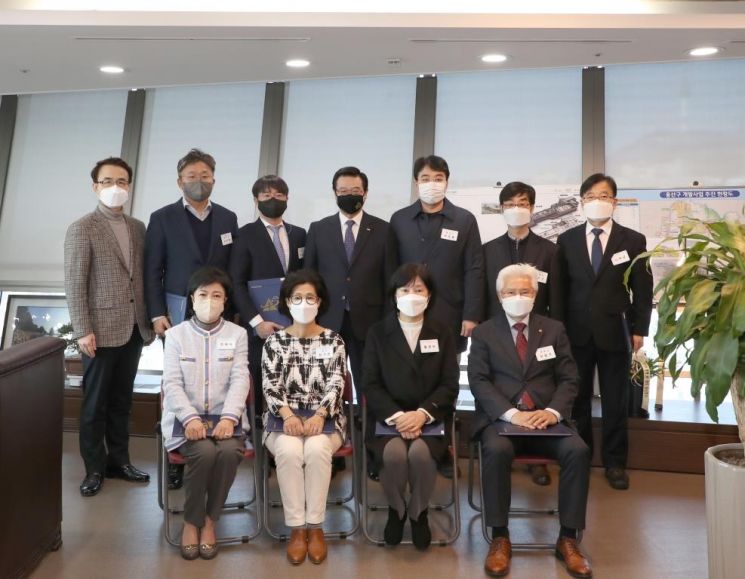
[Asia Economy Reporter Park Jong-il] Yongsan-gu (District Mayor Seong Jang-hyun) established the Active Administration Committee and held its first meeting on the 27th. This is to strengthen the substance of active administration.
Last November, the district revised the Active Administration Ordinance to provide a basis for operating the committee. The committee consists of a total of 15 members, including six internal members, such as the vice district mayor who serves as the chairman, and nine external members appointed to ensure expertise and fairness, including lawyers, professors, engineers, and architects.
The first Active Administration Committee meeting of 2022 held on January 27 proceeded in the order of ▲presentation of appointment letters ▲opening ▲election of vice chairman ▲business report ▲agenda review ▲selection of key tasks.
At the meeting, the committee reviewed the ‘2022 Active Administration Key Task Projects.’
Four projects closely related to residents' lives and requiring proactive responses were selected as key tasks: ▲establishment of a digital-based safety management system for aging and hazardous facilities ▲creation of a village-type dementia-specialized elderly care facility (tentatively named Dementia Safe Village) ▲promotion of reduction in industrial accident rates through active disaster prevention activities ▲promotion of COVID-19 home treatment for safe patient management.
Yongsan District Mayor Seong Jang-hyun said, “We received the Minister’s Commendation as an excellent local government for active administration in the second half of 2021 at the active administration performance inspection hosted by the Ministry of the Interior and Safety announced on the 25th. This is the result of actively striving to resolve residents' inconveniences without settling for existing methods. Together with the newly formed Active Administration Committee, we will continue to promote active administration that residents can feel.”
Last year, Yongsan-gu established the first dedicated active administration team among basic local governments nationwide (January 1, 2021). It was selected as an excellent case in the 2021 anti-corruption and integrity practice competition hosted by Seoul City and received awards in the 2021 first and second half active administration best practice contests.
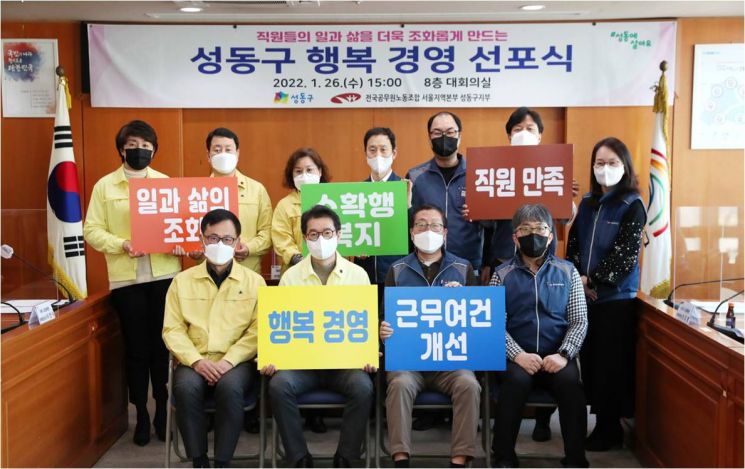
Seongdong-gu (District Mayor Jung Won-oh) strengthened its foundation to provide better administrative services to residents by pledging to practice happy management for a rich balance between work and life through the ‘Seongdong-gu Happy Management Proclamation Ceremony’ held on the 26th.
The proclamation ceremony gathered 15 negotiation representatives, including Jung Won-oh, Seongdong District Mayor, and Lee Hae-il, head of the Seongdong-gu Public Officials Union branch, to pledge that Seongdong-gu and the public officials union will practice happy management to further enrich the harmonious coexistence as partners and the rich balance between work and life.
They also promised to actively strive to discover welfare projects that all employees can enjoy and to cooperate mutually to create a respectful and considerate workplace culture and improve working conditions. Since this was promoted to comfort the hard work of employees exhausted by the prolonged COVID-19 and to boost morale through a rich balance between work and life, a collective bargaining agreement was also pursued based on labor-management practical consultation.
To create a workplace where employees can work with pride, joy, and excitement, employees’ opinions were actively reflected, improving working conditions such as reducing the burden of duty work without weekends and providing differentiated health checkup support according to age, thereby increasing employee consensus and supporting practical welfare.
Having received family-friendly city re-certification last year (initially in 2010) and high evaluations in the interest and will of top management for family-friendly management, the district plans to immediately introduce the total of 10 support projects confirmed through the collective bargaining agreement this year to boost the morale of all Seongdong-gu employees and provide the best administrative services to residents.
An employee who attended the proclamation ceremony said, “During this time when body and mind are exhausted due to various support duties caused by the prolonged COVID-19 situation, it is encouraging to hear that employee welfare and benefits are increasing. Although everyone is going through a difficult time, I will gather my mind in this challenging situation and strive to provide high-quality administrative services to residents.”
Seongdong District Mayor Jung Won-oh said, “Employee happiness can lead to resident satisfaction with administrative services. We will continuously strive to improve working conditions that employees can feel.” He also urged, “Especially in this difficult time with the rapidly increasing COVID-19 situation, I hope employees will take pride and actively engage in their work for our residents.”
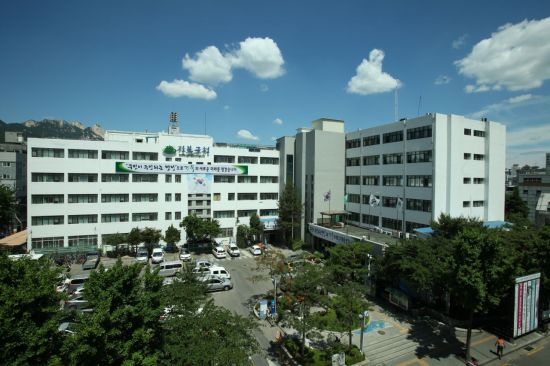
Gangbuk-gu (District Mayor Park Gyeom-su) announced that it will provide approximately 2.5 billion KRW in customized disaster relief funds entirely from the district budget to those in the disaster relief blind spots who are suffering due to the prolonged COVID-19 pandemic.
This is to implement the ‘disaster relief fund payment for nine target groups’ resolved at the Seoul Mayors’ Council temporary meeting held on the 21st. Following the council’s decision, Gangbuk-gu decided to additionally identify and support blind spots excluded from this year’s government and Seoul City disaster relief fund recipients.
Starting from the 28th, support will begin for ▲daycare centers ▲kindergartens ▲elderly care facilities ▲local children’s centers, and later for ▲village bus companies ▲closed small business owners ▲unemployed youth ▲taxi drivers to stabilize management. Religious facilities will receive quarantine supplies to strengthen the local community’s quarantine system.
The approximately 2.5 billion KRW disaster relief fund will be fully supported by Gangbuk-gu’s budget. Detailed support criteria are currently being prepared based on discussions at the Mayors’ Council. Application requirements and periods will be announced by the relevant departments on the Gangbuk-gu website according to each support target.
Gangbuk District Mayor Park Gyeom-su said, “In a situation where all residents are suffering due to the spread of COVID-19, we will promptly provide disaster relief funds to help stabilize households. Gangbuk-gu will continue to implement policies to alleviate the difficulties of residents suffering from COVID-19.”
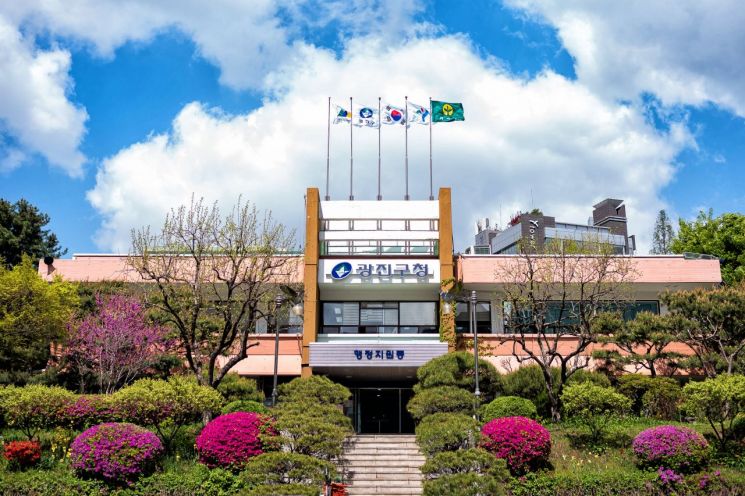
Gwangjin-gu (District Mayor Kim Seon-gap) will provide the ‘2022 Gwangjin-gu Disaster Relief Fund’ to residents suffering from accumulated COVID-19 damages.
This support was prepared to fill the gaps in government support and minimize blind spots in loss compensation, aiming to help stabilize residents’ livelihoods by providing additional funds from Gwangjin-gu.
Based on the results discussed at the Seoul Mayors’ Council on the 21st, Gwangjin-gu set the support targets and scope and will proceed with application and support procedures from the end of January through March in the relevant departments. While considering fairness with other local governments, Gwangjin-gu carefully reviewed and selected targets to ensure no residents are excluded from damage support.
The support targets include ▲closed small business owners (500,000 KRW) ▲unemployed youth (500,000 KRW) ▲corporate and individual taxi drivers (400,000 KRW) ▲freight transport workers for light trucks (under 1 ton) and individual trucks (1?5 tons) (400,000 KRW) ▲village bus companies (10 million KRW) ▲community center instructors (500,000 KRW) ▲religious facilities (500,000 KRW) ▲private kindergartens (1 million KRW) ▲veterans’ institutions (4 million KRW) ▲comprehensive social welfare centers (4?5 million KRW) ▲facilities for the disabled (1 million KRW) ▲self-support enterprises (500,000?1 million KRW) ▲Kiwoom Center (1 million KRW), etc.
Other detailed support requirements and scales can be checked on the Gwangjin-gu website.
At the end of last year, Gwangjin-gu already provided disaster relief funds for elderly care facilities, daycare centers, and local children’s centers, which are common support areas among Seoul’s autonomous districts.
Gwangjin District Mayor Kim Seon-gap said, “We will provide the Gwangjin-gu disaster relief fund to give practical help to individuals and businesses severely affected by the prolonged COVID-19. We will continue to listen closely to voices from the field to minimize blind spots in loss compensation and strive harder for the recovery of many residents’ daily lives and livelihood stabilization.”
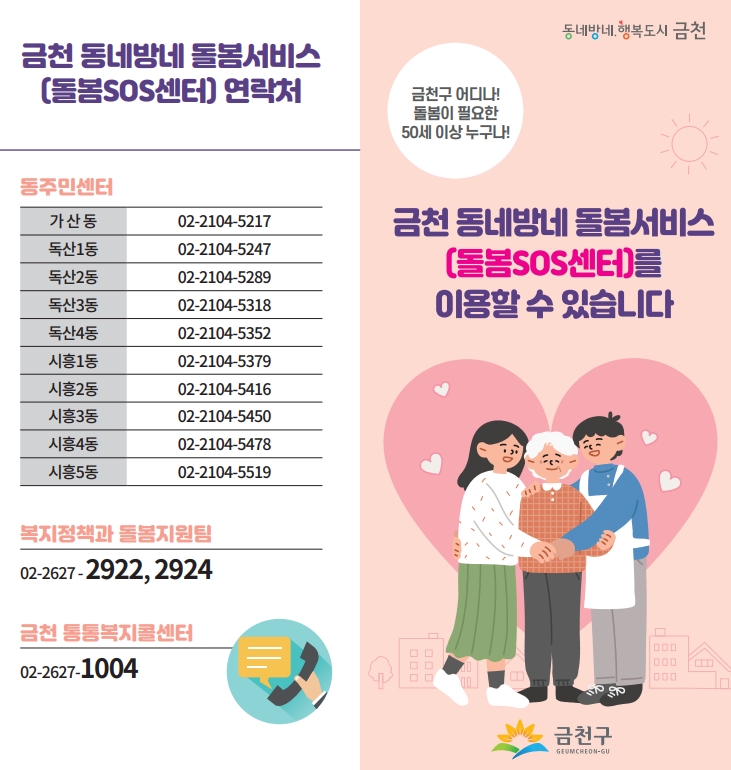
Geumcheon-gu (District Mayor Yoo Seong-hoon) has assigned dedicated personnel to every neighborhood in Geumcheon-gu to improve residents’ accessibility to the ‘Geumcheon Neighborhood Care Service (Care SOS Center).’
Until last year, dedicated personnel were only assigned to two neighborhoods, Doksan 1-dong and Siheung 1-dong, but starting this year, care managers have been placed in every neighborhood of Geumcheon-gu, which is expected to provide faster customized services tailored to each recipient in emergency situations.
The ‘Geumcheon Neighborhood Care Service (Care SOS Center)’ is a project launched in August 2020 to minimize care blind spots caused by the weakening of family care functions. It targets middle-aged and elderly people aged 50 and over and persons with disabilities who require urgent care due to sudden illness or accidents.
When a care manager (social welfare and nursing public officials) from the neighborhood community center promptly visits the site and establishes a care plan suited to the situation, the applicant resident receives the five main care services through 28 service providers contracted with the district: ▲temporary home care ▲short-term facility care ▲accompaniment support ▲meal support ▲housing convenience services (home repair, cleaning and disinfection, bedding laundry).
In 2021, 1,207 Geumcheon-gu residents received 1,642 care services. Especially, home repair services such as installation of door insect screens and LED lights, which started in the second half of last year, received the greatest response from elderly residents.
Geumcheon-gu plans to additionally provide seasonal supplies, special holiday meals, and support for diagnostic certificate issuance fees this year.
Geumcheon District Mayor Yoo Seong-hoon said, “Through the Geumcheon Neighborhood Care Service (Care SOS Center) project, we will do our best to ensure that no Geumcheon-gu resident is excluded from care.”
© The Asia Business Daily(www.asiae.co.kr). All rights reserved.