US Natural Gas Prices Surge as Geopolitical Tensions, Supply Issues, and Increased Demand Overlap
[Asia Economy Reporter Hyunwoo Lee] As military tensions in Ukraine escalate, international oil prices have been rising continuously, with North Sea Brent crude oil breaking the $90 per barrel mark intraday for the first time since 2014. With alternative demand pouring in from Europe, U.S. natural gas prices also surged. Experts predict that the price increase will continue as the geopolitical crisis adds to the deteriorated oil supply and demand caused by the COVID-19 pandemic, and high demand persists despite the spread of the Omicron variant.
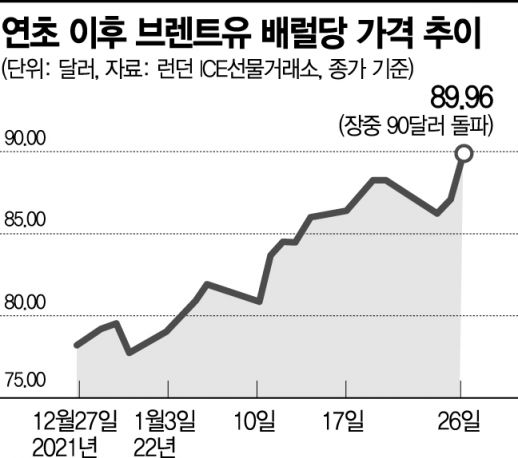
On the 26th (local time), Brent crude oil traded on the London ICE Futures Exchange closed at $89.96 per barrel, up 2.00% from the previous session. On the same day, Brent crude soared to $90.32 intraday, marking the highest price since October 2014. West Texas Intermediate (WTI) crude oil also traded at $87.35, up 2.04% from the previous day.
Due to the escalation of the Ukraine crisis, U.S. natural gas prices, which have been the focus of alternative demand from European countries heavily dependent on Russian gas, also surged sharply. The Henry Hub natural gas futures price, a key North American natural gas benchmark traded on the New York Mercantile Exchange (NYMEX), closed at $4.04 per MMbtu (one million British thermal units), up 3.64% from the previous day.
On the same day, the U.S. delivered a written response to Russia's earlier security guarantee demands, and news that Russia expressed disappointment over this response simultaneously pushed up oil and natural gas prices.
U.S. Secretary of State Antony Blinken said at a press conference regarding the written response, "It contains the positions the U.S. has publicly stated so far, and there will be no change to NATO's open-door policy," adding, "The ball is now in Russia's court, and we are prepared for whichever path Russia chooses."
Russia immediately expressed disappointment. Russian Deputy Foreign Minister Aleksandr Grushenko warned at a press conference, "I want to ask why our proposals cannot be accepted," and said, "We will consider further measures in response to the West's reply."
However, it was confirmed that dialogue and efforts between the West and Russia continue. According to AFP, after an eight-hour marathon meeting in Paris, France, Russia, Ukraine, France, and Germany adopted a joint statement to continue ceasefire efforts in eastern Ukraine. The four countries also included in the joint statement plans to resume talks in Berlin, Germany, within the next two weeks.
Experts forecast that even if the geopolitical crisis in Ukraine somewhat eases in the future, supply and demand issues caused by the COVID-19 pandemic and high demand will continue to push energy prices higher, potentially leading to further increases in oil prices.
According to CNBC, Goldman Sachs, a major U.S. investment bank, analyzed in a note sent to investors that "the oil supply and demand deterioration that began due to the COVID-19 pandemic has yet to be resolved, and the geopolitical crisis has overlapped." British investment bank Barclays also predicted that the upward trend in oil prices will continue, stating, "Despite the impact of the Omicron variant spread, energy demand has not slowed down as much as expected."
© The Asia Business Daily(www.asiae.co.kr). All rights reserved.

![User Who Sold Erroneously Deposited Bitcoins to Repay Debt and Fund Entertainment... What Did the Supreme Court Decide in 2021? [Legal Issue Check]](https://cwcontent.asiae.co.kr/asiaresize/183/2026020910431234020_1770601391.png)