Revealed at the New Year's Press Conference on the 27th
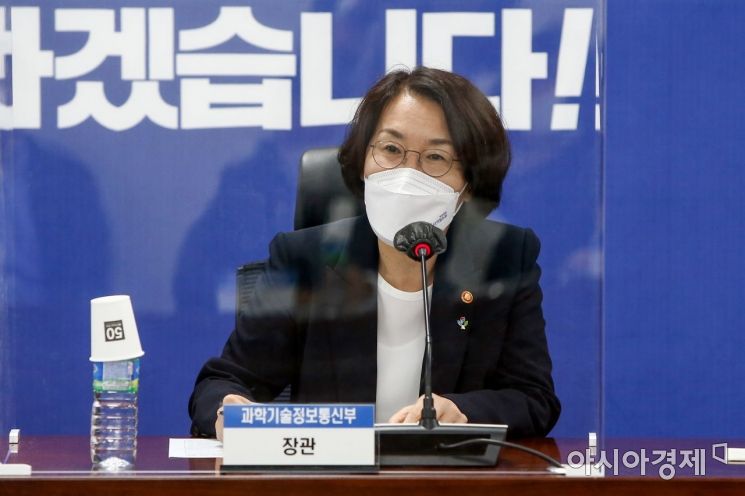 Minister of Science and ICT Hye-sook Lim is delivering opening remarks at the party-government-office consultation held on the 9th at the National Assembly to discuss the status of science and technology implementation and future plans following the Korea-US summit. Photo by Dongju Yoon doso7@
[Asia Economy Reporter Kim Bong-su] On the 27th, Lim Hye-sook, Minister of Science and ICT, announced that she will devote all efforts to fostering essential national strategic technologies such as artificial intelligence (AI), semiconductors, and batteries, as well as future technology development including the second launch of the Nuri rocket.
Minister Lim held a New Year's press briefing in the afternoon at the main auditorium of the Ministry of Science and ICT building in Sejong City to explain policy directions. At this event, she first emphasized, "Even though the momentum of the pandemic has not subsided, the world is fully committed to the competition for technological supremacy, recognizing the fostering of advanced technologies as a core task for the economy, industry, and security," adding, "In the post-COVID era of great technological transformation, South Korea must be fully prepared to take a leading position in global competition."
Minister Lim then stated that through the fostering of essential strategic technologies announced at the end of last year, South Korea aims to secure technological sovereignty. She presented specific methods such as strengthening competitiveness in cross-ministerial strategic technologies including AI, semiconductors, batteries, hydrogen, quantum, and space; enacting special laws; introducing a Korean-style DARPA to promote challenging, future-oriented innovative technology research; and enhancing scientific and technological diplomacy through strengthened Korea-US science and technology exchange and cooperation.
For future technological innovation, she announced plans to promote technology innovation responding to public demands such as climate change and health, advance space development including the second launch of the Nuri rocket, lunar exploration orbiters, and GPS satellite launches, and pursue customized R&D support, unexplored convergence research, and future models for research and development special zones. She also introduced policies for field researchers such as the smooth landing of the Integrated Research Support System (IRIS) across ministries and customized support for women scientists to ensure autonomous, creative, and stable research.
Under the goal of becoming a "digital leading nation," she outlined mid- to long-term policy directions for fostering new hyperconnected industries such as the metaverse, AI, 6G, and blockchain, as well as growth of the digital platform industry. Measures include the ICT regulatory sandbox, deregulation of paid broadcasting, enactment of the Digital Inclusion Act, expansion of digital learning centers, and establishment of systems to prevent cyber threats and network failures.
To enhance youth capabilities, resources that can create synergy for youth growth such as data vouchers and infrastructure of government-funded research institutes will be provided, and a support system in collaboration with the private sector including the Kidari Ajussi Foundation, startup camps, and specialized funds will be established. She also introduced the goal of helping young people advance globally to become the main drivers of the "K-Digital" boom.
© The Asia Business Daily(www.asiae.co.kr). All rights reserved.