Severe and Critical Cases Drop to 300s After 81 Days
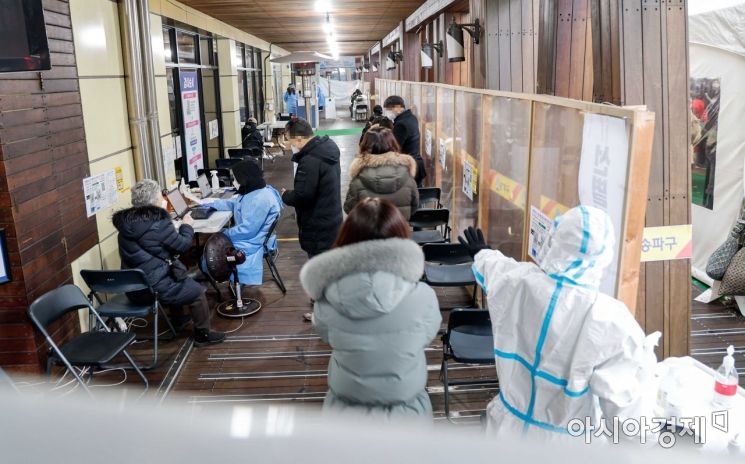 On the 25th, when the highest ever number of 8,571 new COVID-19 cases was recorded, citizens lined up to get tested at a screening clinic set up at the Songpa-gu Public Health Center in Seoul. Photo by Jinhyung Kang aymsdream@
[Asia Economy Reporter Chunhee Lee] As the Omicron COVID-19 variant becomes dominant, the daily new COVID-19 cases reached a record high of 8,571. This marks the first time the number of daily cases has surpassed 8,000.
On the 25th, the Central Disease Control Headquarters announced that as of midnight, 8,751 new COVID-19 cases were reported. This is an increase of 1,059 cases compared to the previous day's 7,512. Compared to 4,070 cases a week ago, this represents a doubling phenomenon, with cases increasing by 2.11 times.
Amid this rapid surge, there are forecasts that the number of new cases will exceed 10,000 on Wednesday the 26th, when the 'weekend effect'?a sharp drop in testing over the weekend?ends. The test positivity rate, which indicates the proportion of positive cases among suspected and temporary screening site tests, rose from 3.1% on the 23rd to 4.0% on the 24th, and further increased to 5.1% on this day. This is more than three times higher than the cumulative positivity rate of 1.5% since the start of the COVID-19 outbreak. If the increase in the number of tests combines with this sharp rise in positivity rate, the upward trend in confirmed cases could accelerate even more steeply.
However, the number of severe cases currently hospitalized decreased by 26 from 418 the previous day to 392, dropping to the 300s for the first time in 81 days. The number of deaths increased by 23, bringing the cumulative total to 6,588. Accordingly, the cumulative fatality rate has fallen to 0.88%. As of 5 p.m. the previous day, the utilization rate of severe COVID-19 hospital beds nationwide was 18.9%, and 18.8% in the metropolitan area, both down to the 10% range, maintaining a stable level. Nevertheless, given the recent rapid increase in confirmed cases, there is a high possibility that severe cases and deaths will surge again after a 2-3 week lag. In fact, this period is likely to be the 'golden time' to prevent an increase in severe cases and deaths caused by the Omicron surge.
The infection routes of new confirmed cases include 8,356 cases from local transmission. In the Seoul metropolitan area, there were 1,674 cases in Seoul, 2,869 in Gyeonggi, and 653 in Incheon, totaling 5,196 cases (62.2%). Non-metropolitan cases totaled 3,160 (37.8%), including 483 in Busan, 483 in Daegu, 315 in Gwangju, 221 in Daejeon, 96 in Ulsan, 69 in Sejong, 153 in Gangwon, 122 in Chungbuk, 304 in Chungnam, 232 in Jeonbuk, 187 in Jeonnam, 275 in Gyeongbuk, 341 in Gyeongnam, and 30 in Jeju. There were 215 imported cases.
The domestic COVID-19 vaccination completion rate as of midnight was 85.4% (a cumulative total of 43,842,568 people). The third dose vaccination rate reached 49.8% of the total population (a cumulative total of 25,542,852 people).
© The Asia Business Daily(www.asiae.co.kr). All rights reserved.