Government Focuses on Responding to Omicron-Dominant Areas While Transitioning to a Healthcare System Centered on General Medical Institutions
[Asia Economy Reporter Lim Cheol-young] As the weekly detection rate of Omicron variant infections has begun to exceed 50%, the government announced plans to shift to a healthcare system centered on general medical institutions.
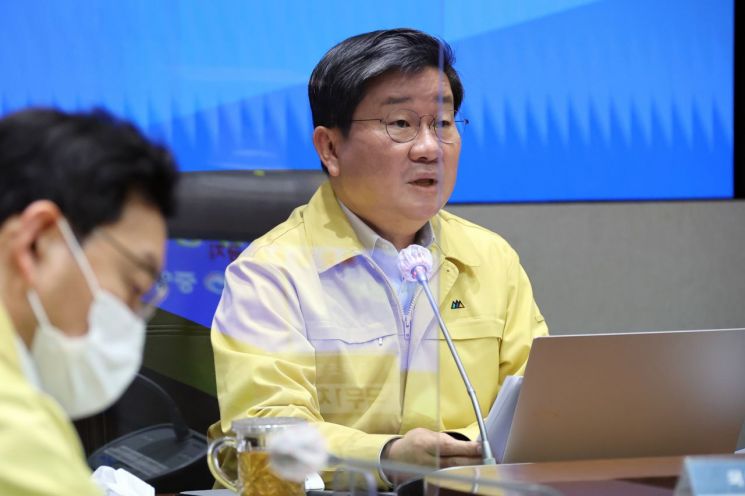
Jeon Hae-cheol, the 2nd Deputy Head of the Central Disaster and Safety Countermeasures Headquarters, stated in his opening remarks on the morning of the 24th, "With a rapid increase in Omicron infections mainly in the Gyeonggi and Honam regions, the domestic detection rate has reached about 50%. Due to the strong transmissibility of Omicron, the average daily number of confirmed cases last week was 5,962, an increase of about 50% compared to the previous week."
He reported that although the number of confirmed cases remains at the 7,000 level, the number of severe and critical patients has decreased. Deputy Head Jeon said, "Today, the number of confirmed cases is expected to be in the 7,500 range. On the other hand, the number of severe and critical patients has dropped to the 410 range, and the intensive care unit bed occupancy rate is below 20%, indicating that the overall medical response system is being managed stably."
Accordingly, the government stated it will focus on responding to Omicron-dominant areas while accelerating the transition to a healthcare system centered on general medical institutions.
Deputy Head Jeon said, "As the increase in confirmed cases may become even greater, the government will strive for effective responses in Omicron-dominant areas and quickly implement the transition to a healthcare system centered on general medical institutions."
First, rather than controlling the scale of confirmed cases, the government will operate PCR testing at public health center screening clinics nationwide focusing on high-risk patients. For the general public with lower risk, expert and self-administered rapid antigen tests using test kits will be conducted at screening clinics.
Deputy Head Jeon explained, "In four regions where Omicron is dominant?Gwangju, Jeonnam, Pyeongtaek, and Anseong?we will prioritize rapid antigen testing through screening clinics and respiratory specialized clinics starting this week. From the 26th, the management period for fully vaccinated individuals will be shortened from the current 10 days to 7 days, and the frequency of health monitoring will be reduced."
He also mentioned preparations for situations where daily confirmed cases increase significantly. He said, "We will expand local government ‘management medical institutions’ to about 400 by the end of January to accommodate up to 60,000 home treatment patients at 369 sites, and outpatient treatment centers will be expanded to twice their current size by mid-February. We will prepare a plan to transition the testing and treatment system so that COVID-19 testing, treatment, prescription, and home treatment management can all be conducted at local clinics and hospitals."
Meanwhile, the government will set up temporary screening clinics at major highway rest areas, train stations, and terminals in response to the Lunar New Year holiday.
Deputy Head Jeon said, "We will install temporary screening clinics at seven major highway rest areas nationwide and two KTX stations and bus terminals, and conduct proactive testing for the next month."
© The Asia Business Daily(www.asiae.co.kr). All rights reserved.