February Move-in Volume Decreases by 24% Compared to This Month
[Asia Economy Reporter Minyoung Kim] The nationwide apartment move-in volume in February this year is expected to decrease by 24% compared to this month. Due to loan regulations, interest rate hikes, and the presidential election, the housing market has been in a wait-and-see mode recently, so the impact of the supply reduction on the market is expected to be limited.
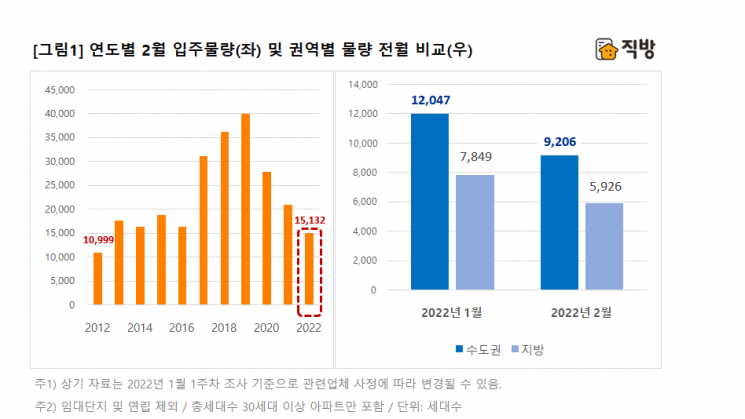
According to Zigbang on the 24th, the apartment move-in volume in February is expected to be a total of 15,132 households, a 24% decrease compared to January, when 19,896 households moved in. By year, this is the lowest for the same month since February 2012 (10,999 households).
The move-in volume in the metropolitan area is 9,206 households, a 24% decrease from January's 12,047 households. In particular, while the January move-in volume in Seoul (5,107 households) was relatively high, only four small to medium-sized complexes (1,855 households) will move in during February, so the decrease in volume compared to the previous month is expected to be significant. In the provinces, new apartment move-ins are taking place in Gwangju, Busan, Jeonnam, etc., with a total of 5,926 households moving in, about 24% less than the previous month.
A total of 30 complexes nationwide are scheduled to move in during February. Among them, 16 complexes will move in within the metropolitan area. Four in Seoul, and six each in Gyeonggi and Incheon. In the provinces, 14 complexes will start moving in, including four in Busan, four in Gwangju, and two in Ulsan.
Although the move-in volume in February is somewhat low, the impact on the housing market due to the supply reduction is expected to be limited. A Zigbang official said, "Due to external factors such as loan regulations and interest rate hikes, as well as the spread of recognition of the market peak, the recent housing transaction market has been in a wait-and-see mode and appears to have entered a stabilization phase."
The total move-in volume this year is 260,657 households, with 41% (108,144 households) moving in during the first half of the year and 59% (152,513 households) in the second half, with supply and demand expected to be more concentrated after the second half.
A Zigbang official explained, "Since the move-in volume is increasing compared to the previous year, the housing market burden caused by supply shortages, such as rising jeonse prices, is not expected to be significant. However, since there are regional differences in volume, it is necessary to view market trends differently according to the supply and demand of move-in volumes by region."
© The Asia Business Daily(www.asiae.co.kr). All rights reserved.