"Gwangju Hwajeong I-Park Collapse Accident Sparks Calls for 'Post-Sale'
Consumers Can See and Buy Directly, Reducing Damage
However, Experts Say 'Post-Sale Does Not Guarantee High Quality'
Government Also States 'Pre-Sale Is Not an Absolute Evil... Flexible Response'"
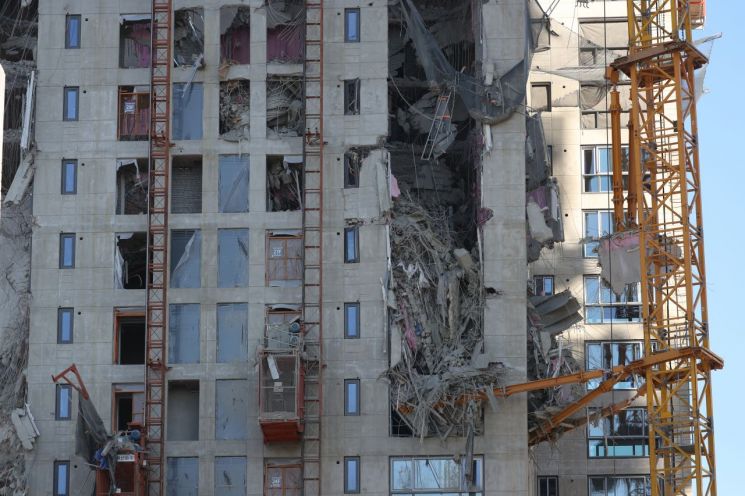
Following the collapse accident at Hwajeong I-Park in Seo-gu, Gwangju, consumer dissatisfaction with apartment defects has grown, leading to increasing calls for the adoption of the 'post-sale' method. However, experts largely express concerns that the side effects of introducing post-sale may outweigh the reduction in defects, and the Ministry of Land, Infrastructure and Transport, the main government body, currently has no plans to promote post-sale, so actual expansion of post-sale is expected to be difficult for the time being.
According to the real estate industry on the 21st, the number of consumers demanding the expansion of post-sale in the recent sales market is increasing. The post-sale system is a method of selling houses when the construction progress rate is 60-80% or higher. Unlike the pre-sale system, which sells before the house is built, consumers can decide whether to purchase after directly checking defects and the condition of a largely completed apartment.
Under the current Housing Act system, post-sale is the principle, and pre-sale is only permitted as an exception if requirements such as ownership acquisition and sales guarantees are met. However, since the 1970s and 1980s, to speed up housing supply, the pre-sale system began to expand and has effectively become the dominant order in the sales market.
Some argue that the Gwangju Hwajeong I-Park collapse accident is a representative case demonstrating the necessity of the post-sale system. Kim Heon-dong, president of Seoul Housing and Communities Corporation (SH), said at a press briefing on the 17th regarding the Gwangju apartment collapse accident, "If post-sale is implemented, problems caused by poor construction like the Gwangju I-Park incident would not occur, and there would be no forced construction during winter due to tight schedules."
There are many calls for expanding post-sale on real estate-related online communities as well. Mr. A, who is waiting to move into an apartment in Gyeonggi Province, said, "I was shocked to see an apartment by a major construction company collapse during construction," adding, "Since safety is the most important, I think we should gradually switch to the post-sale system in the future." One netizen pointed out, "Unless post-sale is implemented, it will be difficult to resolve defects and poor construction practices."
However, experts explain that post-sale may not be a viable alternative. Doo Seong-gyu, senior research fellow at the Korea Research Institute for Construction Industry, said, "Although post-sale allows consumers to check for defects visually before moving in, structural defects are practically impossible to detect," emphasizing, "It is important to establish thorough recurrence prevention measures so that such accidents do not happen again, regardless of the sales system."
There are also many criticisms that post-sale may only increase consumers' burdens rather than improve quality. Doo said, "Pre-sale involves paying the contract deposit and interim payments in installments and paying the balance upon moving in, allowing consumers to prepare the sales payment gradually over 2-3 years," adding, "however, post-sale is basically selling after completion, which increases consumers' financial burden and may lead to higher sales prices."
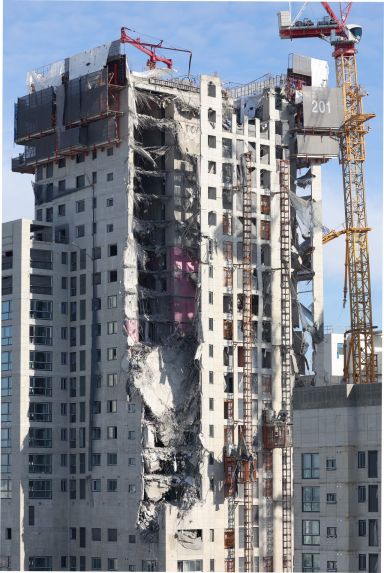
Lee Eun-hyung, senior researcher at the Korea Institute of Construction Policy, said, "Most defects are discovered after moving in, so even if post-sale is done at about 80% construction progress, it is practically impossible to detect defects," adding, "Therefore, claiming that post-sale can secure building quality is not accurate." The researcher added, "The key issue is the increased cost to carry out construction according to principles."
The government also has no plans to promote post-sale. Initially, the government stated that pre-sale-driven speculative gains could fuel rapid house price increases and announced plans to gradually expand post-sale, but later changed the policy to pre-sale with preliminary subscription due to a shortage of housing supply and soaring prices.
A Ministry of Land, Infrastructure and Transport official said, "We are aware of discussions like 'What if it had been post-sale?' regarding the recent Gwangju accident," but added, "Not all general applicants want post-sale, and safety accidents require institutional improvements regardless." The official continued, "There are no immediate plans to expand post-sale," explaining, "While maintaining a policy of providing incentives for post-sale to increase options available to consumers, responses will be flexible depending on housing supply and demand conditions."
© The Asia Business Daily(www.asiae.co.kr). All rights reserved.