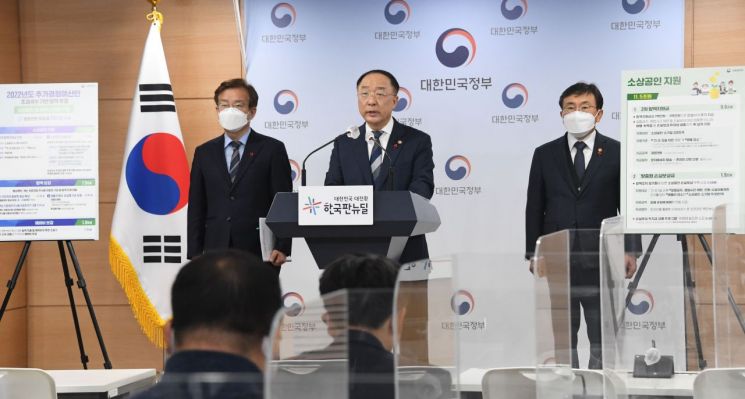
 Hong Nam-ki, Deputy Prime Minister and Minister of Economy and Finance (center), is briefing on the 2022 supplementary budget at the Government Seoul Office on the 21st, attended by Kwon Deok-cheol, Minister of Health and Welfare (right), and Kang Sung-chun, Vice Minister of the Ministry of SMEs and Startups. 2022.1.21 Photo by Yonhap News
[Sejong=Asia Economy Reporter Son Sun-hee] The supplementary budget (supplementary budget) prepared ahead of the presidential election scheduled for March will be submitted to the National Assembly on the 24th. Although the government sent a message asking to respect the government's plan of '14 trillion won scale,' the political circles, regardless of ruling or opposition parties, are already unanimously calling for an 'increase.'
On the 21st, the government held an extraordinary cabinet meeting presided over by Prime Minister Kim Boo-kyum and approved a supplementary budget plan worth 14 trillion won. It is the first January supplementary budget plan prepared in 71 years since 1951 during the Korean War. At that time, it was a wartime situation, and there are many differences from the current fiscal management system, so it is virtually the first 'snowflake supplementary budget.'
However, even before the government submitted the supplementary budget plan to the National Assembly, both ruling and opposition parties began to demand an increase. Lee Jae-myung, the Democratic Party presidential candidate, held an unscheduled press conference immediately after the government's announcement of the supplementary budget plan and proposed a meeting of presidential candidates from both parties, saying, "Let's prepare 35 trillion won as the next government's resources." He suggested more than doubling the size of the supplementary budget plan.
Yoon Seok-youl, the People Power Party presidential candidate, also said in the afternoon of the same day, "At least 50 trillion won is needed." The Justice Party, classified as a pro-government party, also supported this, saying, "The 14 trillion won supplementary budget is excessively passive and insufficient."
As the presidential candidates from both ruling and opposition parties are competing to demand an increase in the supplementary budget plan, there is a view that it will be difficult for the government to withstand this during the National Assembly review process scheduled immediately after the Lunar New Year holiday.
Hong Nam-ki, Deputy Prime Minister and Minister of Economy and Finance, said, "I hope the National Assembly will respect the scale and content of the supplementary budget submitted by the government as much as possible," expressing concern that "if the supplementary budget size increases and acts as liquidity, concerns about inflation cannot be avoided."
Last year, the annual consumer price index recorded 2.5%, the highest level in 10 years since 2011. In a situation where global fears of inflation are already rising, the government's large-scale fiscal input could further fuel price increases.
Furthermore, to increase the size of the supplementary budget plan, the only option currently is to increase the issuance of deficit bonds, which raises concerns that it could further stimulate bond market interest rates, overlapping with the period of interest rate hikes. Regarding this, Ando Geol, the 2nd Vice Minister of the Ministry of Economy and Finance, said, "We plan to spread out the timing of additional government bond issuance throughout the year as much as possible and will do our best to prevent deterioration in supply and demand conditions."
© The Asia Business Daily(www.asiae.co.kr). All rights reserved.