The 6th Largest Iceberg Ever... Once the Largest on Earth
Concerns Over Disruption to Antarctic Animal Movement, but Rapidly Melts in Warm Climate
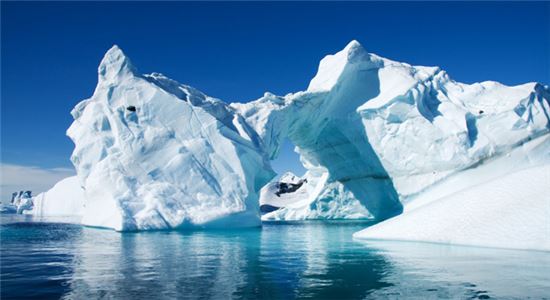 The world's largest iceberg melted, releasing a massive amount of freshwater into the ocean. Photo by NASA.
[Asia Economy Reporter Yoon Seul-gi] A study has revealed that the world's largest iceberg, once 3.5 times the size of London, the capital of the United Kingdom, melted, releasing freshwater equivalent to 60 million swimming pools into the ocean.
AFP reported on the 20th (local time), citing the environmental exploration academic journal Remote Sensing of Environment (RSE), that the world's largest iceberg has disappeared.
This iceberg separated from the Larsen Ice Shelf in the northwestern peninsula of Antarctica, where temperatures rose the fastest in 2017, drifted inside the Weddell Sea for two years, and gradually moved northward. By the end of 2020, it had moved 4,000 km from its original detachment point to South Georgia Island, a British Overseas Territory south of Argentina, and eventually disappeared last year.
The initial size of the iceberg when it broke off was 5,719 km², making it the largest in the world and the sixth largest iceberg ever recorded.
The British Antarctic Survey (BAS) team, which tracked the iceberg's movement via satellite, estimated that from the end of 2020 until the iceberg's disappearance last year, 152 billion tons of nutrient-rich freshwater melted and flowed into the ocean.
This volume is 3.5 times that of London and enough to fill 61 million Olympic-sized swimming pools.
When the iceberg broke off from the Larsen Ice Shelf, it was called A-68, and after a corner broke off, it was referred to as A-68a. Experts feared that as it moved toward South Georgia Island, the iceberg could become lodged on the seabed, blocking currents and hindering the movement of thousands of penguins and seals.
However, the iceberg brushed past the seabed near the island and encountered the warm climate of South Georgia Island, causing it to melt rapidly. By the time the iceberg reached the shallow waters, its volume had significantly decreased.
Ann Brakman-Polkman, a researcher at the Centre for Polar Observation and Modelling (CPOM) who led the study and the report published in the RSE journal, said, "The amount of water released is enormous," adding, "We are trying to determine whether the impact on the island will be positive or negative."
© The Asia Business Daily(www.asiae.co.kr). All rights reserved.