Preparing One-Stop Service for Urban Air Mobility and KakaoT
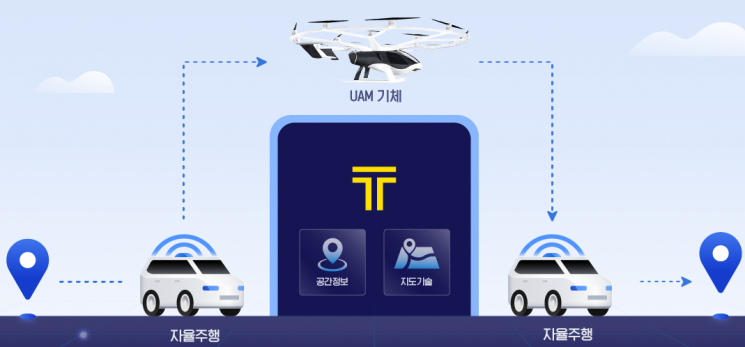
[Asia Economy Reporter Kang Nahum] After returning from a business trip to Japan and arriving at Gimpo Airport, office worker Jeon Seongmin (alias) opened the KakaoT application (app) to get to his home in Jamsil, Seoul. After checking the departure time of the available Kakao UAM (Urban Air Mobility) and completing the reservation, he selected Kakao Taxi as the connecting transportation linked to the pre-designated ‘home’ address. As soon as Jeon got off the airport, he headed to the vertiport (vertical takeoff and landing facility). He boarded a waiting UAM and flew over the city sky, arriving at the Jamsil vertiport in just 15 minutes. After getting off the UAM, Jeon headed to the nearby connected taxi stand, where a Kakao Taxi was waiting for him. The taxi ride home took 5 minutes, and since there was no waiting time to catch a taxi, the usual travel time of about an hour was reduced to 20 minutes, one-third of the usual time.
On the 21st, Kakao Mobility introduced a one-stop service scenario that connects public transportation and Kakao Taxi based on the next-generation mobility service UAM, known as the ‘flying taxi,’ and the KakaoT app. Kakao Mobility is developing related technologies and services to enable users to use various transportation modes, including UAM, through the KakaoT app along the entire travel route from departure point to vertiport1, vertiport2, and destination. Furthermore, as a mid-to-long-term plan for the UAM era, Kakao Mobility intends to expand KakaoT functions as a platform capable of operating UAM services, similar to the ‘Kakao Taxi’ service.
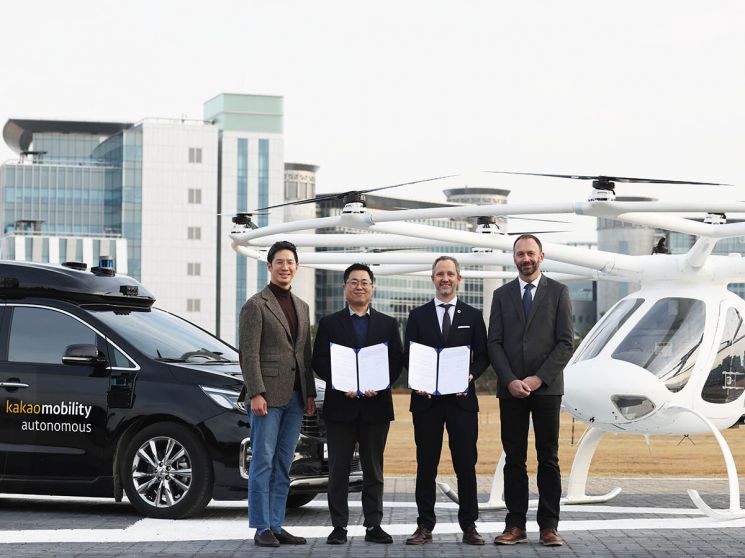
◆ ‘One-stop’ service with KakaoT = Kakao Mobility is advancing the KakaoT platform to realize the UAM mobility scenario. It is leveraging its experience operating Kakao Taxi services along with autonomous driving, spatial information, and mapping technologies. From July to November last year, Kakao Mobility conducted joint research with German UAM aircraft manufacturer Volocopter. Volocopter possesses diverse technologies and experience in UAM, including aircraft operation and safety certification know-how.
Kakao Mobility plans to analyze the research results by next month and, based on the analysis, propose a UAM operation model optimized for the Korean market and begin preparations for commercialization. Specific research topics include ▲ domestic UAM service market demand ▲ expected UAM routes and vertiport location selection ▲ business and service models ▲ ‘safety and certification evaluation criteria’ for UAM aircraft and service operation.
Kakao Mobility also plans to select and propose optimized vertiport locations based on the big mobility data of KakaoT, which has accumulated 30 million users. It will propose a ‘multimodal’ service connecting ground transportation such as subway, bus, and taxi with UAM for travel between departure point and vertiport, and vertiport and destination. The goal is to unify route setting, service reservation, and payment into a single KakaoT platform.
◆ Commercialization in 2025 with government and private sector collaboration = The government and local governments are advancing related projects to commercialize UAM by 2025. Challenges remain, such as expanding infrastructure including vertiport construction and selecting UAM routes within the metropolitan area, which is designated as a no-fly zone. Vertiport construction is essential for UAM commercialization.
However, in major urban areas like Seoul, where there are many high-rise buildings and high population density, there is a lack of available space to build vertiports. Although building vertiports on rooftops of high-rise buildings through legal amendments or using heliports is being considered, the need to descend from buildings to use ground transportation could hinder Kakao Mobility’s vision of seamless travel.
Airspace issues and the absence of an urban air traffic control system are also preconditions to be resolved. The metropolitan area is designated as a no-fly zone, requiring Ministry of National Defense approval even to operate drones. Additionally, a city-based air traffic control system to prevent collisions and guide dozens of UAMs has yet to be established.
To address these issues, the government is jointly developing the ‘K-UAM’ technology roadmap across ministries. It is establishing a phased change scenario for the UAM market and preparing investment targets and strategies accordingly.
Yoo Seungil, Chief Technology Officer (CTO) of Kakao Mobility, said, “The UAM market will become full-fledged from 2025. We will implement UAM services optimized for the Korean market in collaboration with Volocopter and build the K-UAM business model through cooperation with various domestic companies, expanding into the global market.”
© The Asia Business Daily(www.asiae.co.kr). All rights reserved.
![User Who Sold Erroneously Deposited Bitcoins to Repay Debt and Fund Entertainment... What Did the Supreme Court Decide in 2021? [Legal Issue Check]](https://cwcontent.asiae.co.kr/asiaresize/183/2026020910431234020_1770601391.png)