Passed 'Regional Small and Medium Enterprise Act' at Cabinet Meeting on 18th
Support of 140.5 Billion KRW for Technology Development, 137.8 Billion KRW for Commercialization
Private Contribution Reduced to 20%, Cash Burden to 10%
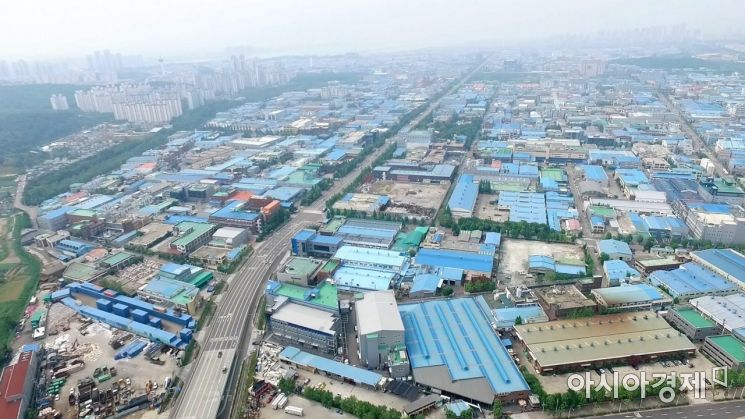 A view of Namdong National Industrial Complex located in Incheon. The photo is unrelated to specific expressions in the article.
 Photo by Asia Economy DB
[Asia Economy Reporter Lee Junhyung] The Ministry of SMEs and Startups will invest 297 billion KRW to foster local small and medium-sized enterprises (SMEs).
On the 20th, the Ministry announced the public notice of major projects related to supporting local SMEs, including the '2022 Local Specialized Industry Promotion,' and began recruiting supported companies and institutions. This follows the passage of the 'Act on the Promotion and Innovation of Local SMEs (Local SMEs Act),' enacted last July, at the Cabinet meeting on the 18th. To foster local SMEs, the Ministry will invest 297 billion KRW this year to support 1,139 projects including technology development and commercialization. The Ministry’s key focus projects this year include ▲ fostering local specialized industries ▲ establishing crisis response infrastructure in SME-dense areas and supporting scale-up technology development ▲ and technology development projects for local companies in industrial complex redevelopment areas.
The Local Specialized Industry Promotion project targets SMEs located in 14 non-capital metropolitan cities and provinces this year. The Ministry will invest 140.5 billion KRW and 137.8 billion KRW respectively to support technology development and commercialization of SMEs in these regions. This project is a key task of the government’s 'Regional Balanced New Deal.' According to the Korea Institute for Advancement of Technology, from 2017 to 2020, the government supported SMEs in regional core industries with 816.2 billion KRW, achieving 10,229 new jobs and 1.3 trillion KRW in commercialization sales.
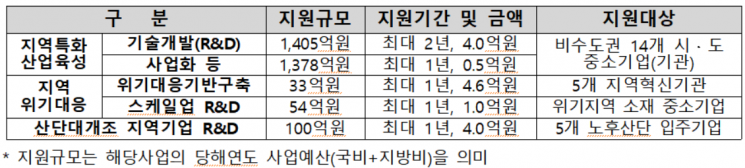 2022 Regional Small and Medium Business Priority Support Project.
 [Photo by Ministry of SMEs and Startups]
Priority Support for Carbon Neutrality... Cash Burden Reduced to 10%
This year, the Ministry prioritizes support for core carbon neutrality items. The support budget was set at approximately 13.2 billion KRW, a 40% increase from the previous year. The private burden ratio for companies on technology development support projects has been lowered from 25% to 20%, and the cash burden ratio reduced from 40% to 10%. The technology fee payment period has been extended up to two years. This is to alleviate the burden on local SMEs caused by the prolonged COVID-19 pandemic.
The 'Crisis Response Infrastructure Establishment Project for SME-Dense Areas' was newly established this year with a budget of 3.3 billion KRW. The Ministry will establish local SME crisis support centers in five non-capital metropolitan cities and provinces to monitor the economic situation of SME-dense areas. Based on monitoring results, crisis warning levels will be classified, and customized consulting will be provided for each stage. If the crisis in an SME-dense area reaches a 'severe' stage, support will be provided for preparing applications for designation as a Special SME Support Area. Designation as a Special SME Support Area offers tax benefits and other incentives.
 Crisis Level in Areas Dense with Small and Medium Enterprises.
 [Photo by Ministry of SMEs and Startups]
Support for Aging Industrial Complexes... Strengthened Collaboration with Research Institutes and Other Organizations
The budget for the 'Crisis Area Scale-up Technology Development Project' is set at 5.4 billion KRW to support SMEs in special industrial crisis response areas and those within Special SME Support Areas. One hundred field-demand-oriented projects and 50 scale-up projects will be selected and supported according to technology development stages. To expedite support, the Ministry allows companies that have successfully completed the project to skip stage 1 and proceed directly to stage 2 support.
The 'Industrial Complex Redevelopment Local Company Technology Development Project' will be promoted with a budget of 10 billion KRW. This project supports the development of technologies jointly used in major industries of each region’s industrial complexes or convergence technologies among SMEs in different industries. Forty-four technology development projects will be supported for SMEs located in aging industrial complexes in five regions including Daegu, Incheon, and Gwangju. The Ministry plans to strengthen collaboration between universities, research institutes, and support organizations with companies this year to focus on technologies with significant regional economic impact.
Kim Seongseop, Director of Regional Enterprise Policy at the Ministry of SMEs and Startups, said, “With the Local SMEs Act and its enforcement decree coming into effect on the 28th of this month, a systematic foundation to accelerate the fostering of local SMEs has been established.” He added, “Through the Local SMEs Policy Council, we will continue to cooperate with 14 non-capital metropolitan cities and provinces and regional innovation institutions to expand support that promotes the growth of local SMEs.”
© The Asia Business Daily(www.asiae.co.kr). All rights reserved.