[Asia Economy Reporter Jeong Hyunjin] The ‘super Eul’ of the semiconductor industry, Dutch company ASML, continues to receive love calls for its extreme ultraviolet (EUV) lithography equipment this year as well. As the importance of advanced processes grows not only in foundry (semiconductor contract manufacturing) but also in memory semiconductors, the EUV battle among major global semiconductor companies including Samsung Electronics, SK Hynix, TSMC, and Intel is expected to intensify further.
According to business circles and foreign media on the 20th, Peter Wennink, CEO of ASML, announced last year’s performance yesterday and said, "EUV demand exceeds the maximum possible production by 40-50%," adding, "It will take 2-3 years to balance supply and demand." The production plan revealed by CEO Wennink for this year is 55 units.
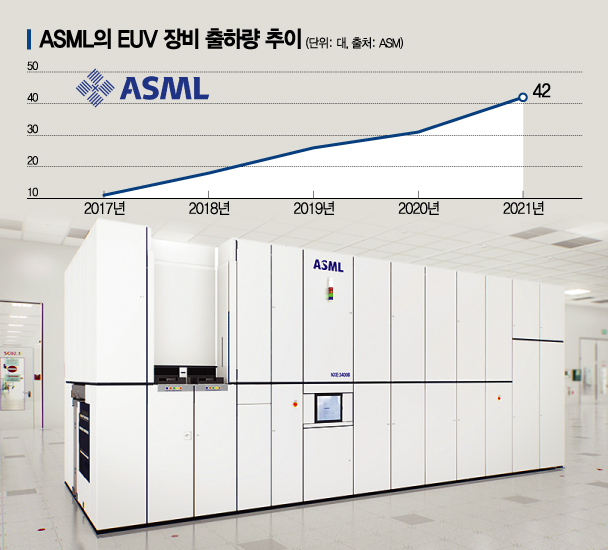
EUV equipment has a shorter wavelength than conventional argon fluoride (ArF) lithography, making it advantageous for implementing semiconductor microcircuits and thus is called a core device for advanced semiconductor processes. Initially, EUV equipment began to be used in foundry, where advanced process importance was high, starting in 2017. Since last year, it has been introduced into memory semiconductor manufacturing processes such as DRAM, greatly expanding demand. ASML, which monopolizes EUV production worldwide, sells each unit for over 200 billion KRW, but the cost and time savings in the process are significant. This is why major global semiconductor companies are fiercely competing for it.
Leading the EUV acquisition race are the top two foundry companies, TSMC and Samsung Electronics. The cumulative number of EUV equipment secured by TSMC and Samsung Electronics is estimated to be about 50 units and 20 units, respectively. TSMC, which purchases the most EUV equipment from ASML, plans to invest 70-80% of its record-high 52 trillion KRW investment this year in developing 2, 3, 5, and 7 nm (1 nm is one-billionth of a meter) processes. Accordingly, it is expected to focus more on securing additional EUV equipment.
The ‘challenger’ Samsung Electronics is putting its life on securing EUV equipment as it significantly increases the proportion of advanced processes to narrow the market share gap with TSMC in the foundry market. Lee Jae-yong, Vice Chairman of Samsung Electronics, who set the goal of becoming the ‘No. 1 system semiconductor company by 2030,’ personally visited ASML headquarters in the Netherlands in October 2020, during the height of the COVID-19 pandemic, to request EUV equipment supply. Samsung Electronics is introducing EUV equipment not only in foundry but also in memory semiconductor processes such as DRAM, where it holds the No. 1 market share. The market estimates that Samsung Electronics requires 12-13 EUV units for its DRAM process. Taiwan’s Digitimes forecasted that "Samsung Electronics will secure 18 EUV units this year, reaching 60% of the number of EUV units held by TSMC."
Intel, which belatedly announced its re-entry into the foundry market last year, is also strengthening cooperation with ASML. Along with the earnings announcement yesterday, ASML revealed that Intel has become the first company to order High-NA (numerical aperture) EUV mass production equipment. The application is scheduled for 2025. Intel is focusing on securing ultra-high-level EUV equipment first to implement finer processes that surpass TSMC and Samsung Electronics.
In the memory semiconductor industry, efforts are also being made to communicate with ASML to introduce EUV equipment. SK Hynix has been mass-producing 10-nanometer-class 4th generation DRAM using EUV equipment at its new factory M16 in Icheon, Gyeonggi Province since last year and plans to gradually expand the EUV production line. SK Hynix is known to currently possess about two EUV units. U.S. Micron has also decided to introduce EUV equipment starting in 2024 and included EUV equipment costs in its fiscal year last year.
© The Asia Business Daily(www.asiae.co.kr). All rights reserved.