[Sejong=Asia Economy Reporter Son Sun-hee] The Korean Composite Leading Index (CLI), published by the Organisation for Economic Co-operation and Development (OECD), has shown a decline for five consecutive months. This indicates that the economic recovery, which had strongly rebounded after the COVID-19 shock last year, has already passed its peak and is slowing down.
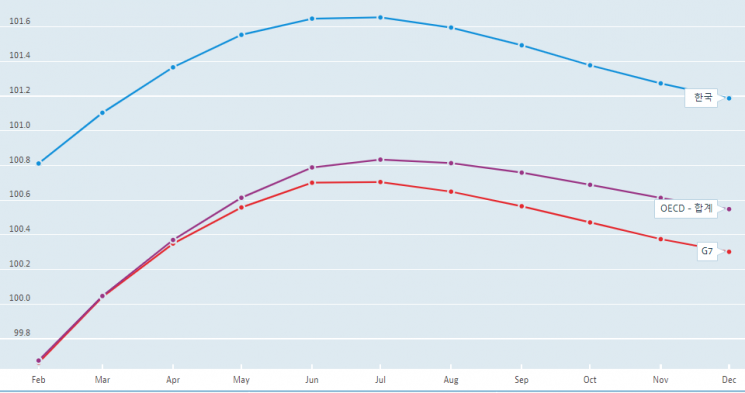
According to OECD statistics on the 20th, Korea's CLI stood at 101.2 as of December last year, down 0.01 points from the previous month (101.3). Korea's CLI had steadily risen since May 2020 (98.5), reaching 101.7 in July last year, but it turned downward from that point and has fallen for five consecutive months.
The CLI, compiled by the OECD, is designed to quickly detect turning points in the economic cycle and is used to gauge economic trends 6 to 9 months ahead. A decline in the CLI compared to the previous month suggests a potential slowdown in economic growth. Conversely, an increase indicates that the pace of economic growth is expected to accelerate.
This trend is similar not only in Korea but also among major advanced countries and OECD member states. The aggregate CLI for OECD member countries showed a decline after June to August last year (100.8), and the CLI for the Group of Seven (G7) countries has been falling since July last year (100.7).
In its recent release on CLI trends, the OECD stated, "This suggests that the peak of post-pandemic growth has passed in some major countries," and assessed that "the strong economic rebound following the COVID-19 crisis may soon ease in several major countries."
The emergence of the Omicron variant and other factors causing a slowdown in global economic growth could negatively impact exports and pose risks to the Korean economy. However, since the index remains above the baseline (100), the economic recovery itself is still considered to be ongoing.
Jung Kyu-chul, head of the Economic Outlook Department at the Korea Development Institute (KDI), said, "Since the economic growth rate is forecasted at 3% this year, we expect the recovery to continue above the potential growth rate." He added, "Disruptions in the global supply chain, such as those affecting automotive semiconductors, are constraining the recovery, but if these issues ease and COVID-19 containment improves, there is room for a rebound."
© The Asia Business Daily(www.asiae.co.kr). All rights reserved.

![User Who Sold Erroneously Deposited Bitcoins to Repay Debt and Fund Entertainment... What Did the Supreme Court Decide in 2021? [Legal Issue Check]](https://cwcontent.asiae.co.kr/asiaresize/183/2026020910431234020_1770601391.png)