Predicting 'Harmful Cyanobacteria' Occurrence at Water Intake Sites
Pilot Operation from June for Algae Bloom Vulnerability
[Asia Economy Reporter Lim Cheol-young] On the 20th, the Seoul Metropolitan Government announced that it has completed the establishment of an "Algae Bloom Prediction System" that can predict the occurrence of "harmful cyanobacteria" in the Han River water intake, which serves as the drinking water source for citizens of Seoul and the metropolitan area.
When cyanobacteria excessively grow, a phenomenon called algal bloom occurs, turning the water a dark green color. Some cyanobacteria (harmful cyanobacteria) are toxic and compromise the safety of tap water. Due to rising temperatures caused by climate change, the likelihood of algal blooms is gradually increasing.
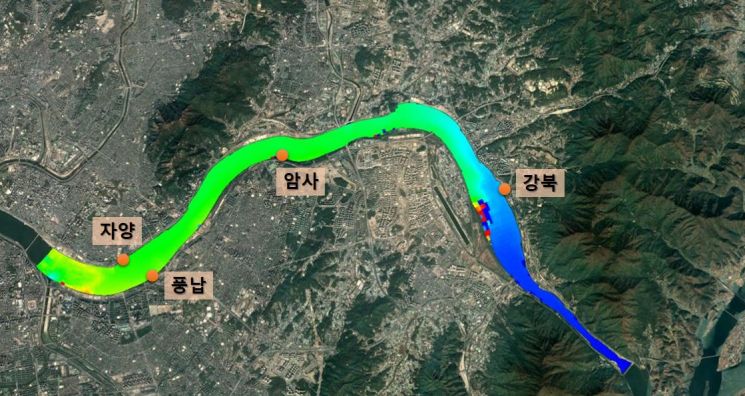
The "Algae Bloom Prediction System" established by Seoul is a water quality prediction system utilizing a three-dimensional numerical model. Using accumulated water quality data from Seoul and national water quality monitoring networks over the past eight years (2014?2021), along with hydrological data, meteorological data, and topographical data, a model capable of predicting algae cell concentration was developed. It mathematically represents physical, biological, and chemical phenomena occurring in rivers and predicts algae occurrence through computer analysis.
By inputting meteorological observation and forecast data, as well as water quality data, into the numerical model, changes in harmful cyanobacteria cell concentrations at four Seoul water intake facilities (Gangbuk, Amsa, Jayang, and Pungnap) can be predicted. Algae blooms can be forecasted up to two weeks in advance, with results presented in visualized and quantified formats.
The predicted results will be promptly disseminated to the four Seoul water intake facilities (Gangbuk, Amsa, Jayang, and Pungnap) to secure high-quality raw water and optimize the operation of water treatment facilities. By proactively responding, such as adjusting the amount of chemicals used based on the results, the goal is to establish a safer and optimal tap water supply foundation.
Currently, the Ministry of Environment predicts algae blooms, but this is only conducted at Paldang Lake and Icheon (Namhan River) points, which are distant from Seoul’s water intake facilities, making the prediction information insufficient for rapid response. Seoul is currently undergoing a process to verify the accuracy of the established system’s predictions. Subsequently, pilot operation will begin in June this year, a vulnerable period for algal blooms. Algae will be predicted on a weekly basis until October.
In 2023, Seoul aims to develop a model that predicts the concentration of taste and odor substances in raw water at intake facilities based on big data learning using artificial intelligence (AI) technology. Due to climate change, the possibility of high concentrations of taste and odor substances (2-MIB, geosmin) causing off-flavors (unusual smells and tastes) in tap water from water sources has increased, and this will be utilized for proactive water treatment.
Previously, Seoul established and has been operating since 2017 a "Water Pollution Accident Impact Prediction System" that predicts the time and concentration of pollutants reaching water intake facilities when water quality accidents occur in Han River tributaries or water sources. This system is used for safe and prompt proactive water treatment.
Son Jeong-su, Director of the Seoul Water Institute, said, "The occurrence of algal blooms in water sources due to climate change and the consequent safe water quality management will become increasingly important in the future." He added, "Seoul will do its best to always supply reliable, high-quality tap water Arisu by predicting algal blooms in advance through the operation of the water quality prediction system and ensuring safe advanced water treatment."
© The Asia Business Daily(www.asiae.co.kr). All rights reserved.