Announcement of Survey on Employment and Working Environment Changes in Busan Manufacturing Industry
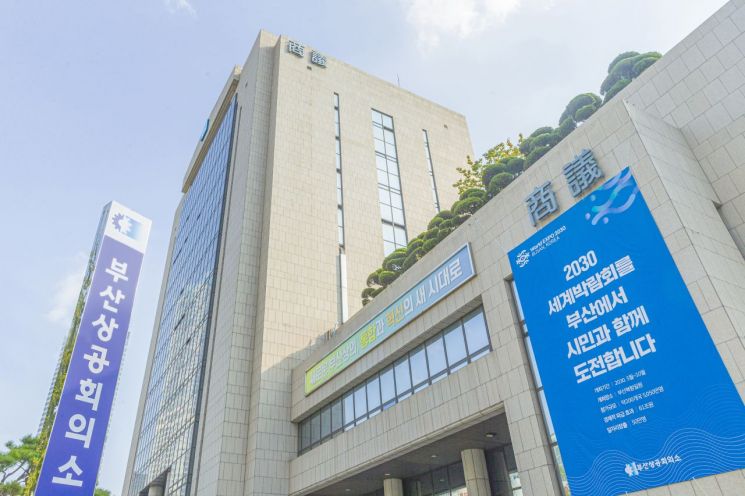
[Asia Economy Yeongnam Reporting Headquarters Reporter Lee Seryeong] The Busan Chamber of Commerce and Industry announced the results of the survey titled "Two Years of COVID-19, Changes in Employment and Working Conditions in Busan's Manufacturing Industry" on the 19th.
Exactly two years after the first confirmed domestic case of COVID-19, a survey was conducted targeting 300 major manufacturing companies in Busan.
Over the past two years, COVID-19 has forced many changes across society, with numerous companies rapidly shifting a significant portion of their work to non-face-to-face methods, resulting in unprecedented changes in employment and working conditions.
According to the survey, 68.7% of the responding companies cited the shift to non-face-to-face work methods as the biggest change in the labor environment brought about by COVID-19.
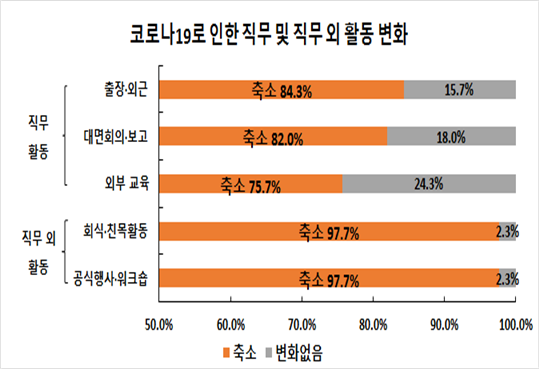
Business trips, fieldwork, face-to-face meetings and reports, and external training were significantly reduced compared to before the spread of COVID-19, and typical offline activities such as company dinners, social gatherings, and workshops were virtually halted.
The job group most affected by COVID-19 in terms of job performance was sales and marketing, with 61.3% of surveyed companies reporting a reduction in face-to-face sales and marketing activities.
In the production sector, 20.7% reported a contraction in production activities, while research and development and general affairs management sectors were only 8.0% and 5.3%, respectively.
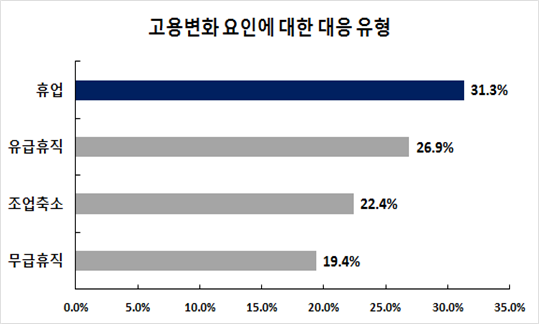
Despite factors such as decreased sales and production contraction affecting employment, 77.7% of surveyed companies maintained employment without taking special measures.
Only 22.3% of companies took related actions, with the most common responses being temporary closure and paid leave at 31.3% and 26.9%, respectively, followed by reduced operations at 22.4% and unpaid leave at 19.4%.
Since the large-scale spread of COVID-19, only 9.3% of surveyed companies introduced new work styles such as flexible work hours or remote work, and the majority rated efficiency and employee satisfaction as low.
The Busan Chamber of Commerce and Industry speculated that this is because most responding companies are regional manufacturers that find it difficult to establish organizational management or evaluation systems related to securing replacement personnel or introducing new work styles.
An official from the Economic Trend Analysis Center stated, "Regional companies have not responded smoothly to the introduction of new work systems," and added, "We need to consider various policy supports for the introduction of systems that can enhance the efficiency of non-face-to-face work in line with changing trends."
© The Asia Business Daily(www.asiae.co.kr). All rights reserved.