[Asia Economy New York=Special Correspondent Seolgina Jo, Reporter Sehee Jang] The U.S. Treasury yields hit a two-year high amid expectations that the Federal Reserve (Fed), the U.S. central bank, may sharply raise benchmark interest rates. Geopolitical tensions in the Middle East pushed international oil prices to a seven-year high. Meanwhile, concerns over a hard landing of China’s economy, South Korea’s largest export market, are growing. These factors have led to warnings that the South Korean economy, fully exposed to global risks, could be caught in a so-called ‘perfect storm.’
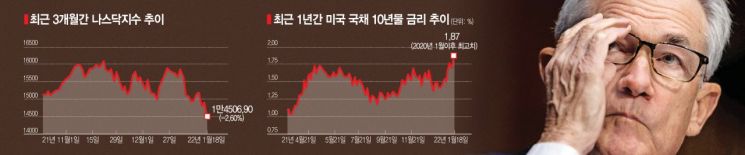
On the 18th (local time) in the New York bond market, the yield on the U.S. 10-year Treasury note reached 1.87%, the highest level since January 2020. The 2-year Treasury yield, which is sensitive to monetary policy, also entered the 1% range at 1.05% for the first time since February 2020.
This is due to growing speculation that the Fed will accelerate early tightening. On Wall Street, there are even forecasts that the Fed will pull out a 0.5 percentage point rate hike card at the upcoming Federal Open Market Committee (FOMC) meeting in March to curb soaring inflation. The last time the Fed raised rates by 0.5 percentage points was in May 2000 during the dot-com bubble, and for the past 20 years, the Fed has maintained a 0.25 percentage point increase per rate hike.
If the U.S., which has been suffering from high inflation, moves to tighten monetary policy rapidly, market shocks such as domestic capital outflows, currency depreciation, and sharp exchange rate increases are inevitable. Professor Inho Lee of Seoul National University’s Department of Economics said, "With the impact of U.S. tightening causing Korean interest rates to rise as well, there could be a situation where assets obtained through leverage (borrowed investment) are sold off," adding, "If interest rates remain low amid unfavorable exchange rates, capital outflows will worsen."
Another risk to the South Korean economy is the forecast that China’s economic growth rate, its largest export market, will remain in the 4% range this year. International oil prices also reached their highest level in about seven years amid growing concerns over geopolitical tensions in the Middle East. On the New York Mercantile Exchange (NYMEX), the February West Texas Intermediate (WTI) crude oil price closed at $85.43 per barrel, up 1.92% from the previous session. This is the highest price since October 13, 2014.
Global stock markets simultaneously showed weakness. On this day, the three major indices in the New York stock market?the Dow Jones Industrial Average (-1.51%), S&P 500 (-1.84%), and Nasdaq (-2.60%)?all closed lower. On the morning of the 19th, the Nikkei 225 index in Tokyo slipped below the 28,000 mark, and South Korea’s KOSPI also showed a downward trend due to net selling by individual investors. In the Seoul foreign exchange market, the won-dollar exchange rate opened at 1,195 won, up 4.9 won.
© The Asia Business Daily(www.asiae.co.kr). All rights reserved.

![User Who Sold Erroneously Deposited Bitcoins to Repay Debt and Fund Entertainment... What Did the Supreme Court Decide in 2021? [Legal Issue Check]](https://cwcontent.asiae.co.kr/asiaresize/183/2026020910431234020_1770601391.png)