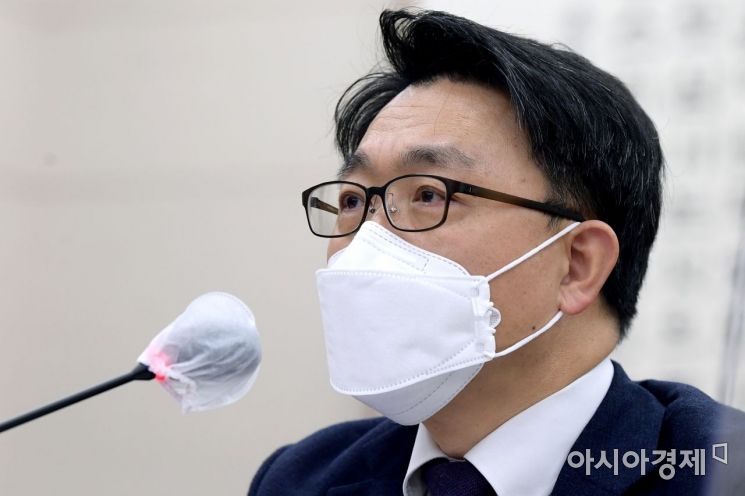
 Kim Jin-wook, Chief of the High-ranking Officials' Crime Investigation Agency, is attending the plenary meeting of the Legislation and Judiciary Committee held at the National Assembly on December 30 last year, responding to questions from lawmakers. Photo by Yoon Dong-joo doso7@
[Asia Economy Choi Seok-jin, Legal Affairs Specialist Reporter] The High-ranking Officials' Crime Investigation Unit (HOCI), which marks its first anniversary on the 21st, is facing controversy as it continues investigations without reaching conclusions on major cases such as the 'accusation solicitation' allegations and the 'Lee Seong-yoon indictment leak.'
In particular, with skeptical prospects emerging regarding the establishment of core charges such as abuse of authority or official secret leakage in both cases, there are even criticisms that HOCI is deliberately delaying the conclusion of investigations.
As of the 19th, among the approximately 20 cases formally assigned case numbers and investigated by HOCI, the only case that has been concluded is the abuse of authority (Case No. 1) and violation of the State Public Officials Act (Case No. 2) related to the special hiring of dismissed teachers by Cho Hee-yeon, the Superintendent of Education of Seoul.
Since this case does not have prosecution rights, HOCI requested the prosecution to indict Superintendent Cho on September 3 last year and closed the investigation. Four months have passed since then, but HOCI has neither prosecuted a single case nor reached any investigative conclusions.
HOCI also faced criticism for handing back the case of Prosecutor Lee Gyu-won’s ‘false preparation and leakage of the Yoon Joong-chun meeting report’ to the prosecution after nine months without concluding the investigation, having taken over the case from the prosecution in March last year.
Especially in the ‘accusation solicitation’ case, investigations of key suspects such as Prosecutor Son Jun-sung and People Power Party lawmaker Kim Woong have already been completed, and through extensive communication data inquiries, verification of additional related persons has also been conducted. Many evaluations suggest that it is time to select targets for judicial action and conclude the case. However, HOCI has not concluded the investigation of the ‘accusation solicitation’ case, citing the need to investigate Prosecutor Son regarding the separate ‘judge surveillance document’ allegations.
Since Yoon Seok-yeol, the People Power Party’s presidential candidate, is also registered as a suspect in the ‘accusation solicitation’ case, it is a situation where a swift conclusion before the presidential election is more necessary than any other case. However, Kim Jin-wook, the head of HOCI, who had pledged to “minimize the election impact through prompt investigation,” changed his stance at the National Assembly at the end of last year, stating, “There are various ways to avoid influencing the election.”
In the ‘accusation solicitation’ case, even if Prosecutor Son delivered the accusation documents to the opposition party and requested that they be submitted to the prosecution, many predict that it will be difficult to establish the abuse of authority charge, which Kim described as the ‘core’ of this case. This is because instructing the preparation or submission of accusation documents is hard to consider within the scope of a prosecutor’s official duties.
A lawyer in Seocho-dong said, “For abuse of authority to be established, an illegal act concerning matters within the general official duties of the public official must first be presumed. Moreover, wasn’t lawmaker Choi Kang-wook, included in the problematic accusation documents, acquitted in court? If it is not a case of filing accusations based on false facts, I don’t see what the legal issue would be.”
Another lawyer analyzed, “If HOCI is not in a position to indict former Prosecutor General Yoon Seok-yeol, it is likely that they are unable to reach a conclusion because indicting Prosecutor Son would invite criticism of ‘poor investigation’ or ‘excessive investigation.’”
Meanwhile, the investigation into the ‘Lee Seong-yoon indictment leak’ case, which HOCI has been investigating since May last year, is also facing difficulties. HOCI conducted forced searches, including raids, on the suspicion that the indictment was leaked from the Suwon District Prosecutors’ Office investigation team that indicted Lee, but has failed to achieve significant results and only sparked controversy over legality.
According to the investigation by the Supreme Prosecutors’ Office Inspection Department, none of the Suwon District Prosecutors’ Office investigation team members accessed Lee’s indictment through the Criminal Justice Information System (KICS), and instead, a temporary file resembling an edited version of the indictment leaked from Lee’s close aide’s PC was found.
Within the prosecution, the prevailing view is that all prosecutors except the investigating prosecutor can easily access and verify the indictment contents, which are disclosed in court anyway, and thus it is not considered an ‘official secret.’ The crime of official secret leakage is intended to protect the ‘functions of the state threatened by secret leakage,’ not the ‘confidential information’ itself, leading to criticism that HOCI has overreached in establishing charges.
Meanwhile, on the same day, HOCI denied media reports claiming that “the HOCI leadership, burdened by the ‘subcontracted inspection’ controversy over the investigation team’s raid to secure materials from the Supreme Prosecutors’ Office Inspection Department’s fact-finding investigation, put a stop to the investigation, effectively halting related investigations,” stating, “This is not true.”
© The Asia Business Daily(www.asiae.co.kr). All rights reserved.