Ministry of Science and ICT Holds the 2nd 'AI High-Level Strategic Dialogue'
[Asia Economy Reporter Eunmo Koo] The government is launching a new investment support program worth 400 billion KRW to strengthen the competitiveness of domestically produced artificial intelligence (AI) semiconductors. Additionally, various demonstration projects will be promoted to ensure the developed AI semiconductors can smoothly enter the market.
Strengthening Competitiveness of Domestic AI Semiconductors through PIM Development... Additional 400 Billion KRW Investment
The Ministry of Science and ICT (MSIT) announced on the 19th that it held the "2nd AI Strategy Summit" to share visions between the public and private sectors in the AI field and discuss strategic cooperation plans. Based on industry feedback, it prepared the "AI Semiconductor Competitiveness Enhancement Plan." This meeting was held as a follow-up to the "1st AI Strategy Summit" held on September 7 last year, where major AI industry leaders, academia, and research representatives gathered to discuss ways to strengthen South Korea's global AI competitiveness.
To enhance the competitiveness of domestic AI semiconductors, the government will invest a total of 402.7 billion KRW by 2028 in the development of "Process In Memory (PIM)" intelligent semiconductors. This is an additional investment following the decision made in October 2020 to allocate a total of 1 trillion KRW in research and development (R&D) funds by 2029 as part of the "AI Semiconductor Industry Development Strategy."
Intelligent semiconductors are chips that simultaneously perform the roles of memory semiconductors, which store data, and system semiconductors, which handle computation. Since processors performing computational functions are embedded within the memory, data processing speeds can be improved compared to existing technologies, making them products that can revolutionize the paradigm of next-generation AI semiconductors.
As AI spreads across all sectors of industry, the AI semiconductor market continues to grow steadily. According to market research firm Gartner, the share of AI semiconductors within the system semiconductor market is expected to expand from 8% in 2020 to 31.3% by 2030. South Korea has launched large-scale investments, including the AI Semiconductor Industry Development Strategy and the "K-Semiconductor Strategy," to secure leadership in the AI semiconductor market. However, its global system semiconductor market share was only 2.9% as of 2020, indicating a lack of competitiveness.
Alongside the development of intelligent semiconductors, the government will secure design technology for AI semiconductor neural processing unit (NPU) chips, which have recently shown remarkable growth, and continue to support the development of packaged products. Furthermore, it plans to promote the "AI Semiconductor Software Development Project" to provide a convenient development environment for AI services.
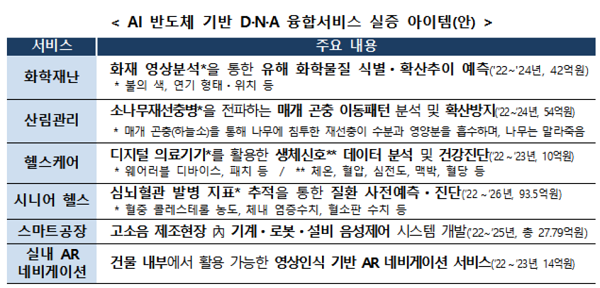
Moreover, the government will support the creation of initial markets for the developed AI semiconductors. It plans to apply the developed AI semiconductors to various national R&D and demonstration projects to support performance verification. Additionally, it will introduce them into the Gwangju AI Direct Complex data center and support their expansion to private data centers in the future.
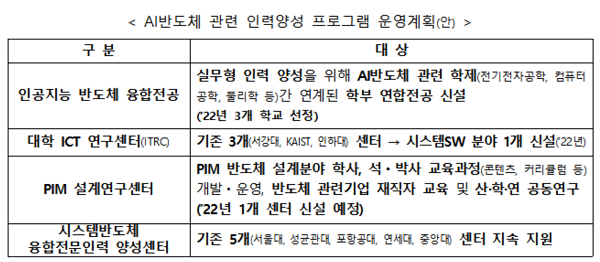
To address the shortage of specialized personnel related to AI semiconductors, the government will cultivate experts at various levels from bachelor's to master's and doctoral degrees, while also enhancing the capabilities of current workers. Within the year, a university ICT research center (ITRC) specializing in system software will be established, and three universities will open AI semiconductor convergence majors. To nurture specialized researchers, the PIM Design Research Center education program will also be operated.
Roadmap for Building AI Training Data Presented... Support Measures to Activate the Super-large AI Ecosystem
At the strategy dialogue, a roadmap for building large-scale AI training data, one of the core projects of the "Digital New Deal," was presented along with plans to enhance the usability and value of the data.
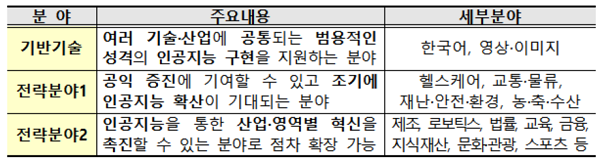
First, to strategically accumulate and open data, "foundation technologies" and "two strategic fields" were set as axes to expand AI training data both vertically and horizontally. Foundation technologies support AI implementation with a universal nature common to various technologies and industries such as Korean language, video, and images. The strategic fields are divided into areas that can contribute to public welfare and where early AI diffusion is expected, and areas that can promote innovation in industries and sectors through AI.
Furthermore, the plan is to improve the convenience and quality of the constructed and opened data and create a user-centered data utilization environment. Improvements will be made to allow large-scale data, which is difficult to download all at once, to be provided in divided and selectable formats. Efforts will be made to transform "AI Hub" into a core platform for AI and data utilization by linking various public and private data platforms and supplementing education and practice functions. Additionally, quality verification and consultation will be supported from the data construction stage, and support scale and duration will be diversified according to the nature of the data.
Government support measures to activate the super-large AI ecosystem, which was the theme of the 1st strategy dialogue, were also prepared. First, 8.5 billion KRW worth of API usage costs will be supported for domestic small and medium enterprises (SMEs) aiming to develop AI solutions and services using super-large AI models developed by large corporations. Suppliers will provide various API products to demand organizations depending on the scale and purpose of the super-large AI models, and demand organizations will selectively use appropriate APIs and receive cost support through vouchers. Support for medium- and large-capacity graphics processing unit (GPU) computing resources will also be gradually expanded for SMEs, research institutes, and universities.
Additionally, legal foundations are being pursued to apply copyright use exemption regulations when publicly available data on the internet is used for AI training purposes. A bill including copyright use exemption regulations for the use of publicly available information for AI development and utilization purposes has been proposed, and industry opinions will be collected to actively participate in the legislative and amendment process.
Minister Hyesook Lim of MSIT said, "It is significant that companies and the government concretized policy implementation plans through strategic dialogue." She added, "Going forward, the public and private sectors will continue to collaborate to secure South Korea's AI competitiveness, and we will do our best to provide policy support so that our companies can stand tall on the global stage."
© The Asia Business Daily(www.asiae.co.kr). All rights reserved.