Signals of Supply Shortage Easing Emerged Late Last Year but Returned to Square One
Improvement Expected from Second Half of the Year
[Asia Economy Reporter Changhwan Lee] As the shortage of automotive semiconductors prolongs, the Hyundai Motor production lines, which briefly showed signs of recovery at the end of last year, are becoming unstable again.
Production disruptions continue, with weekend special overtime (weekend work) decreasing and "gongpichi" occurring, meaning conveyor belts run without vehicles to assemble. The industry expects this situation to persist throughout the first half of this year.
Hyundai Motor's Weekend Overtime Decreases Again
According to the automotive industry on the 18th, most production lines at Hyundai Motor's Ulsan plant have decided not to conduct weekend overtime this week. Weekend overtime has significantly decreased due to reduced supply of some semiconductor components, such as electronic control unit (ECU) semiconductors and radar semiconductors.
Weekend overtime refers to vehicle production on weekends or holidays to meet demand for popular models. Before COVID-19, in 2019, Hyundai Motor regularly conducted weekend overtime, making the absence of weekend work rather unusual. However, since the semiconductor shortage began after the COVID-19 outbreak, weekend overtime has sharply declined.
However, in early last month, Hyundai Motor's Ulsan plant showed signs of easing semiconductor shortages by resuming weekend overtime across all plants. But within a month, the situation returned to square one. It is also reported that some lines are experiencing gongpichi.
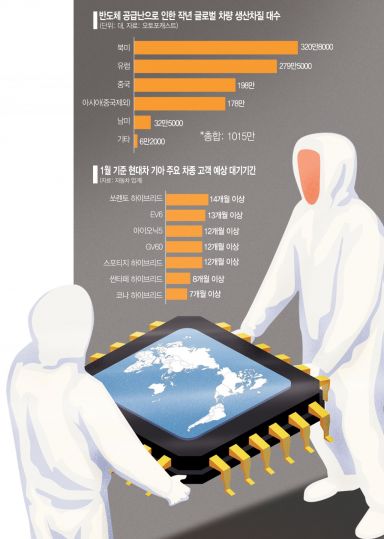
As the semiconductor shortage continues, the waiting period from vehicle order to actual delivery has lengthened. For Hyundai Motor's flagship electric vehicle, the Ioniq 5, it is expected to take at least 12 months to receive the vehicle if ordered now.
Kia's EV6 and Genesis GV60 also require 13 months and 12 months or more, respectively. Considering the receipt of national subsidies for these electric vehicles, the actual delivery may be even later.
Models such as the Sorento Hybrid, Sportage Hybrid, and Santa Fe Hybrid are also estimated to have waiting periods ranging from a minimum of 8 months to a maximum of 14 months.
Prolonged Semiconductor Shortage Expected
The problem lies in the difficulty of predicting when the supply of automotive semiconductors will normalize. The industry expects some improvement in the second half of this year, but full normalization will take much longer.
Dongheon Lee, Executive Director and Head of the Automotive Industry Research Office at Hyundai Motor Group's Economic and Industrial Research Center, stated, "A recovery to the 2019 sales level before COVID-19 is expected only in 2023." He also predicted that the supplier's market dominance in the automotive market due to the semiconductor crisis will continue this year, following last year.
Automotive market research firm LMC Automotive also forecasts that the shortage of automotive semiconductors will persist this year, with demand recovering to 2019 levels only in the second half of 2023.
As the semiconductor shortage prolongs, the global automotive industry's efforts to internalize automotive semiconductors are expected to accelerate. Major automakers are taking measures such as directly developing automotive semiconductors through collaboration with semiconductor companies.
Hyundai Motor Group is cooperating with major semiconductor companies such as Samsung Electronics and Nvidia to develop high-performance automotive semiconductors. In this regard, in December last year, President Moon Jae-in personally urged Hyundai Motor Group Chairman Chung Euisun and Samsung Electronics Vice Chairman Lee Jae-yong to collaborate on automotive semiconductors at a Blue House event.
Major automakers such as Mercedes-Benz, BMW, and GM (General Motors) are also collaborating with leading semiconductor companies like Intel and Nvidia on semiconductor development.
An industry official said, "As vehicle electrification accelerates with electric vehicles, hydrogen vehicles, and autonomous vehicles, the importance of automotive semiconductors will continue to grow," adding, "Automakers' direct development of automotive semiconductors will also proceed more rapidly."
© The Asia Business Daily(www.asiae.co.kr). All rights reserved.

![User Who Sold Erroneously Deposited Bitcoins to Repay Debt and Fund Entertainment... What Did the Supreme Court Decide in 2021? [Legal Issue Check]](https://cwcontent.asiae.co.kr/asiaresize/183/2026020910431234020_1770601391.png)