Everything Except Fruit Is Up
Hanwoo Beef Still Expensive Despite Discounts, US Frozen Ribs Up 22%
"The ceremonial table only needs to show sincerity, and since the children will visit one after another, we should prepare some food to eat."
With Lunar New Year just around the corner, soaring prices are showing no signs of easing. Food prices have risen so much that it is expected to cost at least 100,000 won more than last year to prepare meals for family gatherings during the holiday.
On the 17th, Kim Suk-young, a housewife in her 60s living in Dongtan, Hwaseong-si, Gyeonggi Province, visited a nearby large supermarket and was taken aback by the food prices. She wondered if there was a place where meat and vegetables were a bit cheaper and fresher, or if it might be better to buy pre-cooked side dishes instead of making them at home, as she felt the impact of the rising prices since the new year.
Kim said, "Except for apples and pears, everything seems expensive this year," adding, "It's not a fancy meal, just beef soup, japchae, a few vegetable side dishes, and some pan-fried pollock, but it looks like it will cost about 200,000 won," she sighed.
Looking at Kim's shopping basket that day, 300g of beef soup meat was 13,860 won after a 30% discount, and a radish was 1,130 won after a 40% discount. Although sirloin beef (300g, 47,800 won) and bulgogi (16,640 won) were also on sale, the prices had already risen so much that she decided not to buy them this Lunar New Year, thinking it would be too expensive to feed the whole family.
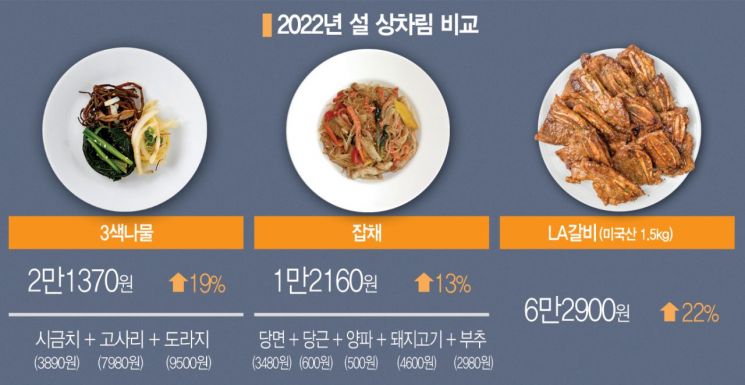
Spinach (3,890 won) was cheaper than usual, but domestic boiled bracken (7,980 won) and peeled balloon flower root (9,500 won) were not much different from those sold at side dish stores. Kim said, "Most of the ones sold are Chinese and probably don't use good seasonings, so I plan to buy cleaned ones and season them myself." She also picked up two each of squid (4,490 won per piece) and yellow croaker (5,980 won), one bag each of apples and pears containing 7 (7,900 won) and 3 (12,800 won) respectively, minced meat (4,680 won) and tofu (4,980 won) for making Donggeurangttaeng (Korean meat patties), a carton of eggs (5,830 won), ham (5,480 won), zucchini (1,290 won), flour (1,560 won), and glass noodles (3,480 won). She planned to buy the minimum quantities of napa cabbage for kimchi (3,180 won each, 2 heads), peeled garlic, and soy sauce (6,080 won). The total came to 176,800 won.
Instead of Korean beef, Kim ordered two packs of 1.5kg U.S. LA galbi (short ribs) for 125,800 won from a nearby food supply mart. Frozen ribs, which cost about 103,000 won last Lunar New Year, have risen more than 20% in a year. Adding a small amount of sliced pollock (7,000 won) and yakgwa (traditional Korean honey cookies, 5,000 won) brings the total with the supermarket basket to about 300,000 won. Compared to last year’s Lunar New Year preparations, when she spent around 230,000 to 240,000 won buying similar items at marts and traditional markets, she will need to spend at least 100,000 won more this year.
Kim said, "On the day before the holiday, I will need to buy some rice cakes, and I want to buy plenty of strawberries that the grandchildren like, but I worry that prices will rise even more during the peak season."
© The Asia Business Daily(www.asiae.co.kr). All rights reserved.