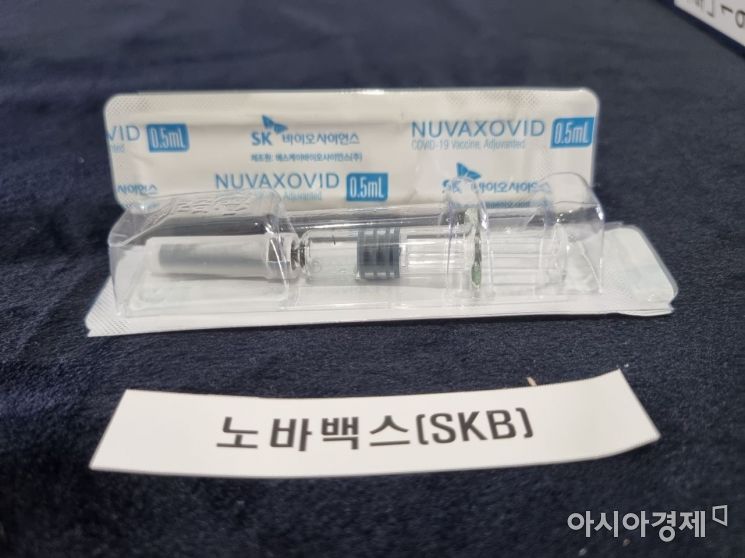
 SK Bioscience's contract development and manufacturing organization (CDMO) product, Novavax COVID-19 vaccine 'Nuvaxovid Prefilled Syringe'. / Photo by Lee Chunhee.jpg
[Asia Economy Reporter Lee Chun-hee] Following virus vector (AstraZeneca (AZ)·Janssen) and messenger ribonucleic acid (mRNA, Pfizer·Moderna) vaccines, the Novavax COVID-19 vaccine, a recombinant protein (synthetic antigen) vaccine, is expected to be used for actual vaccinations in South Korea as early as next month. Since it is developed using a traditional vaccine manufacturing method, it is anticipated to be an alternative for unvaccinated individuals who have delayed vaccination due to concerns about side effects.
According to authorities on the 16th, the Novavax vaccine, which recently received approval from the Ministry of Food and Drug Safety (MFDS), is predicted to be used for actual vaccinations domestically around mid-next month. On the 12th, the MFDS decided on the approval and noted that preparations for national lot release approval were complete, making domestic introduction possible in early next month. The Korea Disease Control and Prevention Agency (KDCA) plans to deploy the vaccine for frontline vaccinations from mid-next month, considering this timeline.
The biggest advantage of the Novavax vaccine lies in its manufacturing method. As a recombinant protein vaccine, it is made by directly injecting antigen proteins produced using recombinant technology to induce antibody production in the body. This method has been traditionally used in various vaccines such as influenza, hepatitis B, and cervical cancer. Currently, virus vector vaccines are associated with thrombocytopenic thrombosis syndrome (TTS), and mRNA vaccines with myocarditis and pericarditis as representative side effects, leading some unvaccinated individuals to delay vaccination due to these concerns. The Novavax vaccine is evaluated as a potential alternative for these individuals.
According to phase 3 clinical trial data conducted in the UK (15,139 participants) and the US (29,582 participants), submitted by SK Bioscience, which holds domestic production and commercialization rights for the Novavax vaccine, concerns about side effects are minimal. The final review committee that examined these data for approval stated, "Most reported adverse events related to safety were predictable and generally mild. Common adverse events included tenderness, injection site pain, erythema, and swelling, with symptoms mostly mild to moderate and resolving within 1 to 3 days."
However, cases of myocarditis were reported in the clinical trials of the Novavax vaccine. "Serious adverse drug reactions that could not exclude a causal relationship with vaccination included one case of myocarditis in the UK trial, and four cases in the US trial: angioedema, central nervous system inflammation/facial nerve palsy/peripheral neuropathy, Graves' disease/hyperthyroidism, and thrombocytopenia. All had recovered or were recovering at the time of clinical trial data submission. Since myocarditis and thrombocytopenia are not diseases caused solely by vaccination, a definitive causal relationship between vaccination and side effects has not been established."
The final review committee decided that post-approval safety measures would include a 'Risk Management Plan' to monitor myocarditis and other safety concerns preventively, and to collect and evaluate adverse events occurring during ongoing clinical trials and post-marketing use.
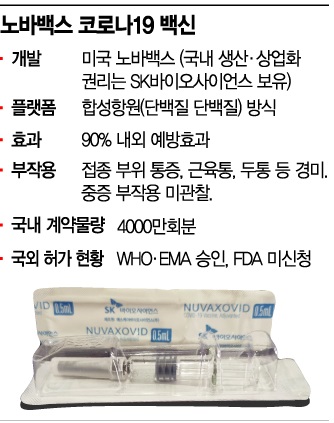
High supply stability is another advantage of the Novavax vaccine. The Novavax vaccine approved domestically is not the general Novavax vaccine but the 'New Nuvaxovid Prefilled Syringe' manufactured entirely by SK Bioscience from bulk substance to finished product. SK Bioscience signed a contract for contract development and manufacturing organization (CDMO) with Novavax in August 2020, and in February last year, also signed a technology transfer contract to produce both bulk and finished pharmaceuticals, enabling in-house production of the Novavax vaccine.
Notably, the Novavax vaccine is mostly distributed overseas in vials containing 10 doses. However, the New Nuvaxovid Prefilled Syringe has been improved through additional research and development (R&D) by SK Bioscience into a single-dose prefilled syringe form containing one dose per syringe. This eliminates the need for dilution or aliquoting procedures, reducing contamination risk and easing the workload of healthcare workers. This is the only COVID-19 vaccine approved domestically with such a format. Other vaccines are all packaged in multi-dose vials and require aliquoting before administration.
However, as of this date, 94.5% of the population aged 12 and over have completed the first dose, and the vaccine cannot be used for the third dose, which poses a hurdle. COVID-19 vaccines approved for first and second doses must undergo approval changes or sufficient third-dose clinical trials to be used for the third dose. Pfizer, Moderna, and Janssen vaccines have not undergone approval changes but are used for the third dose based on sufficient clinical data, whereas it is still too early to make such a judgment for Novavax. However, SK Bioscience explained, "According to Novavax, after two doses of New Nuvaxovid and a booster shot six months later, antibody titers increased 4.6-fold."
The efficacy against the Omicron COVID-19 variant, predicted to become dominant domestically within a month or two, remains uncertain. The MFDS explained that since the clinical data used as the basis for approval were conducted before the Omicron surge, additional data are needed. SK Bioscience also stated, "After two doses of New Nuvaxovid and a booster shot six months later, antibody titers responding to the Omicron variant were 9.3 times higher compared to after two doses."
© The Asia Business Daily(www.asiae.co.kr). All rights reserved.

![User Who Sold Erroneously Deposited Bitcoins to Repay Debt and Fund Entertainment... What Did the Supreme Court Decide in 2021? [Legal Issue Check]](https://cwcontent.asiae.co.kr/asiaresize/183/2026020910431234020_1770601391.png)