43.7% of Savings Bank Borrowers Face 16-20% Interest Rates
7 Companies Have Over 90% High-Interest Loans
Small Loans, Delinquencies, and Multiple Debtors Also Pose Risks
"Second-Tier Financial Borrowers Hit Harder by Rate Hikes"
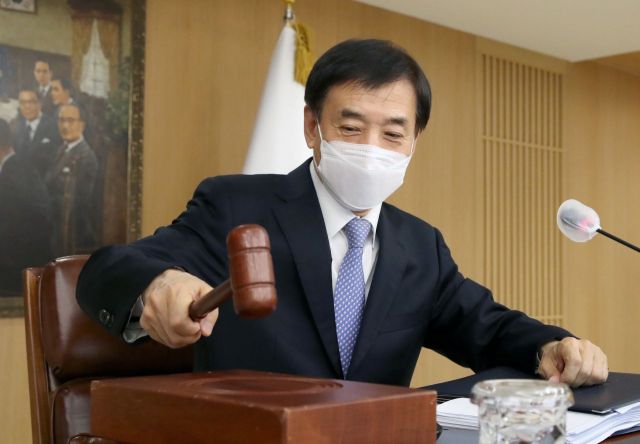 Lee Ju-yeol, Governor of the Bank of Korea, is striking the gavel at the Monetary Policy Committee plenary meeting held at the Bank of Korea in Jung-gu, Seoul, on the morning of the 14th.
 [Photo by Yonhap News]
[Asia Economy Reporter Song Seung-seop] The burden on savings bank borrowers is expected to increase significantly due to the Bank of Korea's base interest rate hike. This is because a considerable number of savings bank credit loan borrowers have taken loans at interest rates of 16% or higher. Many of them are classified as vulnerable borrowers, including small business owners and multiple debtors, raising calls for thorough risk management.
According to the Korea Federation of Savings Banks on the 15th, 43.7% of those who took out credit loans from savings banks last month borrowed money at interest rates of 16% or higher. This means that 4 out of 10 people took loans at rates close to the maximum interest rate. Borrowers with loans at 16-18% or higher accounted for 16.6%, and those who borrowed between 18% and the legal maximum interest rate of 20% accounted for 27.0%.
There were seven savings banks (Korea Investment, SangSangIn Plus, Cheongju, Inseong, MS, Samho, Yungchang) where the proportion of high-interest loans exceeded 90%. MS Savings Bank and Yungchang Savings Bank executed all disclosed loans at interest rates of 16% or higher.
Loan interest rates are calculated by adding a margin rate set by financial companies according to the borrower to the Bank of Korea’s base rate, then subtracting preferential rates. The Bank of Korea raised the base rate by 0.25 percentage points from 1% to 1.25% at the Financial Monetary Policy Committee meeting held the previous day. Considering that financially vulnerable groups who have already taken out high-interest loans effectively receive no preferential rates, they are bound to feel the full impact of the base rate hike.
Multiple Debtors’ Default Rate at 10%... "Direct Hit from Base Rate Hike"
Low-credit and low-income groups who borrowed money at the maximum interest rate level should worry about failing extension reviews at maturity. Savings banks cannot continue lending to vulnerable groups that are not profitable. The credit crunch is likely to worsen. Since financial authorities are ordering household debt control and risk management, it is difficult to recklessly lend money to financially vulnerable groups.
Another concern is the high default rate among multiple debtors within savings banks who have borrowed from three or more financial institutions. The default rate refers to the proportion of borrowers who have failed to repay principal and interest for more than 90 days within a year. According to a report published by the Credit Information Service at the end of last year, the default rate for multiple debtors in savings banks who borrowed 3 million won or less is 10.3%. This is 3.5 percentage points higher than the default rate (6.8%) of all borrowers who borrowed the same amount.
Unlike other financial sectors, the number of multiple debtors in savings banks is steadily increasing. The proportion of multiple debtors in savings banks rose from 60% in 2018 to 66% in the first half of last year. In the banking sector, it remains steady at 29% annually. This is why there are concerns that the impact of the base rate hike could pose greater risks in the secondary financial sector, including savings banks.
Professor Kim Dae-jong of the Department of Business Administration at Sejong University analyzed, “Since government loan regulations restrict business activities, there is a high possibility that vulnerable groups will be excluded or charged slightly higher margin rates to pursue more profits.”
© The Asia Business Daily(www.asiae.co.kr). All rights reserved.