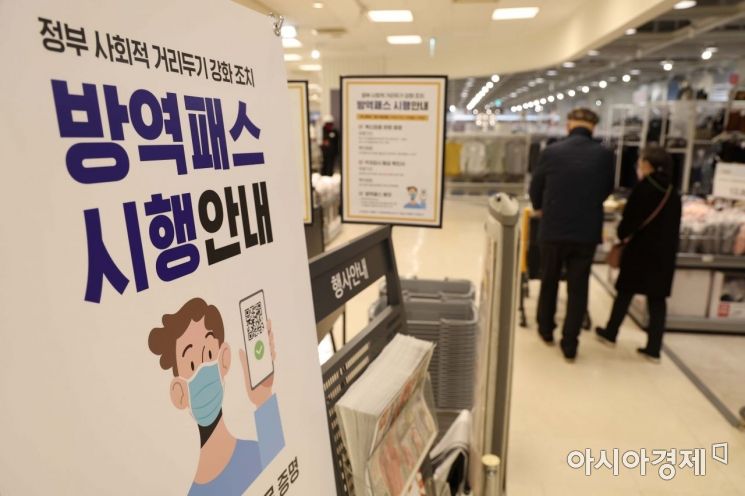
 On the 10th, large-scale stores such as shopping malls, marts, department stores, agricultural and marine products distribution centers, and bookstores with an area of 3,000㎡ or more were added to the mandatory application targets for the quarantine pass. Citizens are checking the validity of their quarantine passes to enter a large mart in Seoul. Photo by Mun Ho-nam munonam@
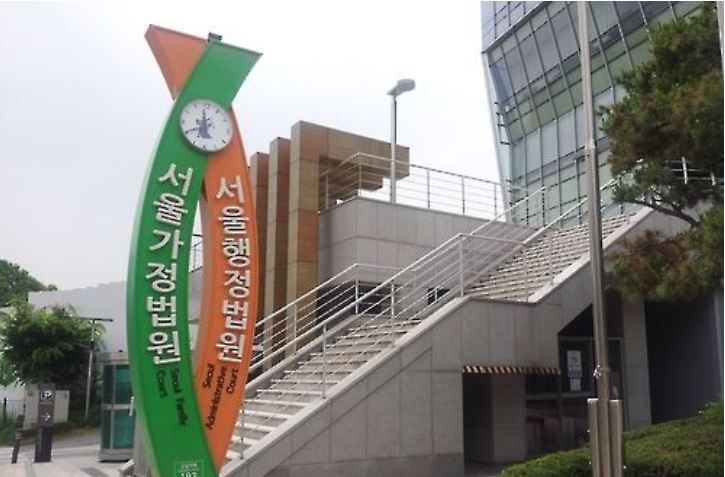
[Asia Economy Reporter Seongpil Cho] The Administrative Court of Seoul, Administrative Division 4 (Chief Judge Han Won-kyo) released a 23-page decision document on the suspension of the quarantine pass on the 14th. The ruling, which suspends the effectiveness of the quarantine pass only for large marts, stores, and department stores in Seoul, is presented in refined sentences explaining the judgment and its grounds. The court recognized the public interest of the quarantine pass. This somewhat contrasts with the Administrative Division 8 of the same court (Chief Judge Lee Jong-hwan), which raised questions about this aspect in its decision on the suspension of the youth quarantine pass. However, both rulings share concerns about the quarantine pass and include messages urging the government to proceed cautiously. This is also a judicial recommendation aimed at resolving the social conflicts caused by the quarantine pass policy.
Public Interest of Quarantine Pass Recognized, but...
The court largely accepted the government's arguments regarding the public interest of the quarantine pass. Considering the criticism that the government failed to adequately explain the public interest during the hearing on the 7th, this can be seen as a successful defense from the government's perspective. At that time, the government mentioned protecting the unvaccinated and preventing the collapse of the medical system as the public interests to be achieved through the quarantine pass, but the evidence was deemed insufficient. It is known that the government supplemented the weak arguments with additional explanatory materials submitted after the hearing.
In the decision document, the court stated, "The quarantine pass appears primarily aimed at securing medical response capacity by reducing the severity and fatality rates among unvaccinated COVID-19 confirmed patients and increasing the vaccination rate (third dose rate) to prevent the spread of infection." It continued, "According to the statistics submitted as explanatory materials, it is reasonable to believe that the quarantine pass can reduce the overall severity rate of COVID-19 confirmed cases," adding, "Maintaining the severity rate at an appropriate level is a necessary means to prevent the collapse of the medical system and to protect the life and health rights of severely ill patients." This implies recognition of the public interest in introducing the quarantine pass itself.
However, the court also pointed out that such a quarantine pass could cause irreparable harm. The court noted, "If the quarantine pass is implemented extensively without restrictions, unvaccinated individuals will be pressured to complete vaccination to use essential facilities," and "They may be forced into a situation where COVID-19 vaccination is mandatory." Ultimately, this judgment led to the conclusion to suspend the effectiveness of the quarantine pass for large marts, stores, and department stores in Seoul.
"Vaccination Should Be Voluntary"… Court's Recommendation
Additionally, at the end of the decision document, the court offered recommendations to the government regarding quarantine policies. First, it emphasized that the suppression of the COVID-19 outbreak is due to the 'people,' not the effect of the quarantine pass. The court stated, "Even before the implementation of the quarantine pass, the majority of the public quickly received vaccinations to protect themselves from COVID-19 risks," and "This likely prevented a sharp increase in severity and fatality rates from future COVID-19 infections."
The court expressed concerns about the government's current enforcement of a broad quarantine pass policy. It stated, "Inducing voluntary vaccination to control severity rates should be the minimally invasive measure that quarantine authorities prioritize." Furthermore, it added, "Even if the quarantine pass must be introduced temporarily, its scope should be minimized and operated at a level that does not infringe on the basic rights of the unvaccinated."
This is a repeated plea and recommendation from the court. The Administrative Division 8 of the same court, which partially accepted the suspension request for the youth quarantine pass, conveyed a similar message in its decision. At that time, the court said, "Forcing vaccination by imposing severe disadvantages such as restricting access to academies and study rooms on youths directly infringes on their bodily autonomy," and "Inducing voluntary vaccination to control severe illness rates should be the minimally invasive measure that quarantine authorities prioritize."

Is It Like 'Preaching to the Deaf'?
However, the government appears to have turned a deaf ear to these repeated court pleas. The Ministry of Health and Welfare expressed regret over the court's partial acceptance decision the day before, saying, "We find it regrettable." Additionally, Son Young-rae, head of the Social Strategy Division at the Central Disaster and Safety Countermeasures Headquarters, reiterated the necessity of the quarantine pass, emphasizing its effectiveness. The day after the partial acceptance of the youth quarantine pass suspension, Education Minister Yoo Eun-hye stated, "Regardless of the court's ruling (decision), we will continue to promote the necessity and effectiveness of vaccination to students and parents and encourage vaccination."
The Ministry of Health and Welfare also highlighted the dismissal of the quarantine pass suspension request filed by Hwang Jang-soo, leader of the minor political party Revolution 21, against the Minister of Health and Welfare by the Administrative Division 13 of the Seoul Administrative Court (Chief Judge Jang Nak-won) the day before. In a briefing, they emphasized, "(The court's decision) argued that the public interest is greater considering the increase in COVID-19 confirmed cases and the effectiveness of the quarantine pass." However, this case differs in the applicant's arguments and intent compared to the previous two requests. While the earlier applicants claimed irreparable harm due to 'basic rights infringement caused by forced vaccination,' Hwang cited 'significant inconvenience in purchasing daily necessities.' The court's dismissal reason mentioning 'You can shop online' was in this context.
In a situation where social conflicts triggered by the quarantine pass are diagnosed as stemming from poor communication, this kind of government response is seen as regrettable. The government plans to comprehensively review the court's decision and the quarantine situation and announce an official stance after the Central Disaster and Safety Countermeasures Headquarters meeting on the 17th.
© The Asia Business Daily(www.asiae.co.kr). All rights reserved.