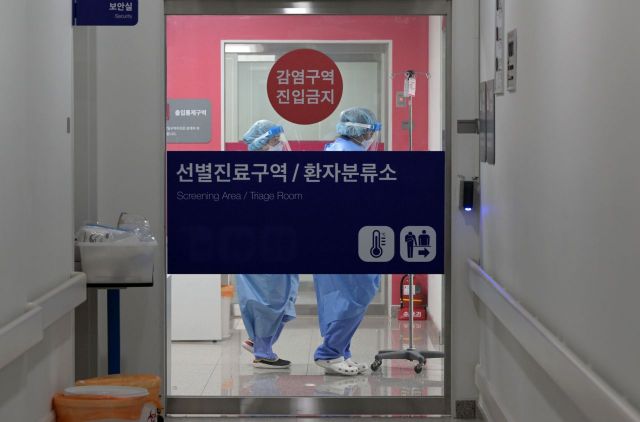
 On the morning of the 13th, medical staff are busy working at the COVID-19 Emergency Medical Center of Seoul Medical Center in Jungnang-gu, Seoul. Photo by Joint Press Corps
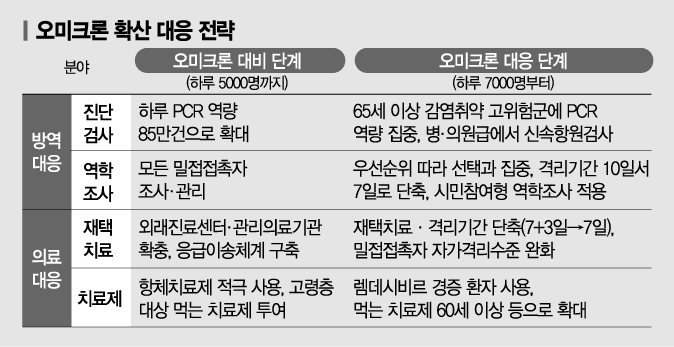
[Asia Economy Reporter Seo So-jeong] The government forecasts that the Omicron variant of COVID-19 will become the dominant strain domestically around the 21st of next week and is significantly overhauling the quarantine and medical response systems to tackle it. The Korea Disease Control and Prevention Agency (KDCA) anticipates that if social distancing measures are eased, confirmed cases could surge by approximately 10,000 to 30,000 by the end of February, with severe cases increasing sharply by 700 to 1,700, indicating that the current quarantine system will reach its limits in responding. Accordingly, the government will shift to a full-scale Omicron response phase once daily confirmed cases exceed 7,000 and shorten the patient isolation period from the existing 10 days to 7 days. Polymerase chain reaction (PCR) testing will be focused on high-risk groups, and plans are underway to implement paid rapid antigen testing at hospital and clinic levels.
◆ Omicron to become dominant strain domestically next week = On the 14th, the Central Disaster and Safety Countermeasure Headquarters and the Central Disease Control Headquarters announced the 'Omicron Spread Response Strategy for Sustainable Daily Recovery,' stating plans to transition the quarantine and medical systems in preparation for Omicron becoming the dominant strain. Park Hyang, head of the quarantine task force at the Ministry of Health and Welfare’s Central Disaster and Safety Countermeasure Headquarters, said, "The Omicron variant is 2 to 3 times more transmissible than Delta, and overseas cases such as in the UK show that confirmed cases doubled in just 2 days." She added, "Domestically, dominance is expected by the end of this month or mid-February, and the uncertainty associated with this is very high." According to joint analysis by the KDCA and the Korea Institute of Science and Technology (KIST), the Delta variant is expected to dominate domestically until around March 3, with confirmed cases increasing from 15,000 to 30,000 by the end of March. Although Omicron is spreading somewhat slower domestically compared to abroad due to strengthened quarantine measures, authorities expect it to become the dominant strain around the 21st.
Accordingly, the government will broadly divide its response strategy into an Omicron preparation phase for daily new cases up to 5,000 and a response phase starting from 7,000 cases. During the Omicron preparation phase, the existing 3T strategy?Test, Trace, Treat?will be maintained. PCR testing capacity will be increased from the current 750,000 tests per day to 850,000 tests per day, raising capacity by 100,000 tests. To block overseas inflow, entry restrictions remain on travelers from 11 countries including South Africa, direct flights from Ethiopia are suspended, and a 10-day quarantine is enforced for all arrivals, with quarantine exemption certificates issued minimally under stricter criteria to prevent Omicron importation. The PCR negative certificate requirement is tightened from within 72 hours to within 48 hours before departure, and circuit breaker measures on flights continue. Additionally, among close contacts, those who have completed their second vaccination dose will maintain the current 6-month quarantine exemption validity, but shortening of this validity period based on time elapsed since vaccination will be further reviewed.
◆ Paid rapid antigen testing if daily cases exceed 10,000 = When confirmed cases exceed around 7,000, the government will shift from conventional infection control to a response strategy focused on severe case prevention and voluntary, responsible measures. Since blocking overseas inflow becomes less meaningful with Omicron dominance, entry restrictions on the 11 countries will be lifted, and countries will be managed based on risk levels. To prepare for a surge in PCR testing demand, priority testing will be limited to high-risk elderly groups, vulnerable facilities with cluster infections, and epidemiologically linked individuals. The role of private medical institutions in diagnostic testing will be expanded by increasing paid rapid antigen testing, which will be covered by health insurance. Park explained, "The scale of the outbreak exceeding PCR testing capacity is about 10,000 daily confirmed cases. Rapid antigen tests, aside from PCR, can be used for vaccination proof and negative confirmation (quarantine pass), but self-tests will not be recognized."
In the response phase, to improve epidemiological investigation efficiency, a citizen-participatory epidemiological investigation will be introduced. The isolation period for confirmed cases will be shortened from 10 days to 7 days, with a recommendation to follow quarantine rules for 3 days after release. Contacts will be released from quarantine on the 7th day if a PCR test on the 6th day after last contact is negative. Furthermore, a self-reporting epidemiological investigation system will be fully implemented, where confirmed cases input their personal information and contacts themselves, and health centers verify the data, transitioning epidemiological investigations to a citizen participation model. Investigations will be focused on family, workplace, acquaintances, those aged 60 and over, nursing hospitals and facilities, and other vulnerable facilities (schools, medical institutions, facilities for the disabled, etc.), while investigations at other facilities will be reduced or discontinued.
Vaccination efforts will also be accelerated. From next month, the vaccination target will be expanded to children, and the fourth dose will be gradually implemented. Vaccination will be strongly encouraged for unvaccinated elderly aged 60 and over, who are at high risk of severe illness and death, and vaccinations for the unvaccinated will be carried out following the approval of the Novavax vaccine. Additionally, vaccination for adolescents aged 12 to 17 will be encouraged, and vaccination plans for children aged 5 to 11 are under review considering the approval and introduction schedule of pediatric vaccines by the Ministry of Food and Drug Safety.
© The Asia Business Daily(www.asiae.co.kr). All rights reserved.