[Asia Economy Reporter Choi Seok-jin, Legal Affairs Specialist] The Supreme Court has ruled guilty on charges of violating the Medical Service Act against a Western medicine doctor who performed 'Intramuscular Stimulation (IMS),' a treatment involving inserting needles 30 to 60 mm long into the patient's painful areas, on the grounds that it is difficult to distinguish from acupuncture, a traditional Korean medicine practice.
The Supreme Court maintained its stance that whether a Western medicine doctor's IMS procedure constitutes acupuncture, a traditional Korean medical practice, must be judged concretely on a case-by-case basis. However, it stated that "the physical examination process to locate the IMS treatment site is essentially no different from the palpation used in acupuncture to find the needle insertion points," increasing the likelihood that courts will recognize violations of the Medical Service Act in similar future cases.
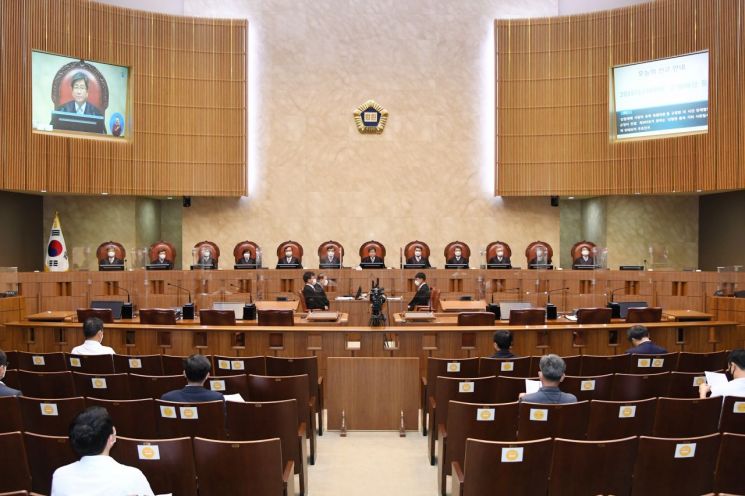
The Supreme Court's Second Division (Presiding Justice Cheon Dae-yeop) announced on the 14th that it overturned the lower court's acquittal ruling in the retrial of Dr. A, who was indicted for violating the Medical Service Act, and remanded the case to the Busan District Court.
The court pointed out, "Considering the characteristics of IMS treatment, the defendant's procedure is more similar to acupuncture, a traditional Korean medical practice, rather than being essentially different."
It added, "Nevertheless, the lower court acquitted the defendant on the grounds that it was difficult to definitively conclude that the defendant's procedure constituted acupuncture, misunderstanding the legal principles regarding traditional Korean medical acupuncture and failing to conduct necessary examinations, which affected the judgment."
Dr. A, a Western medicine doctor, was prosecuted for performing IMS treatment by inserting 30 to 60 mm long needles into the muscles and nerves around the lower back of patients complaining of pain due to herniated discs or numbness in the lower back at his clinic in December 2011.
However, the Busan District Court East Branch acquitted Dr. A in November 2013.
The reasons were ▲the medical and traditional Korean medicine communities sharply disagreed on whether IMS constitutes a traditional Korean medical practice, ▲related institutions such as the Ministry of Health and Welfare had not finalized the issue, and ▲the evidence submitted by the prosecution was insufficient to definitively conclude that the defendant performed acupuncture, a traditional Korean medical practice, or that IMS is a traditional Korean medical practice that Western doctors cannot perform.
On appeal by the prosecution, the Busan District Court again acquitted Dr. A in February 2014.
The court reasoned that ▲Western doctors claim IMS is based on modern medical anatomy and physiology, stimulating painful muscle areas directly rather than acupuncture points, differing from acupuncture based on meridian theory, while traditional Korean medicine doctors argue IMS is a form of acupuncture; however, academically and institutionally, it remains unresolved whether IMS is a traditional Korean medical practice or a modern medical procedure, and ▲although both IMS and acupuncture use needles as a treatment tool, there appear to be distinguishable differences in theoretical basis, treatment sites, and methods.
However, in October 2014, the Supreme Court overturned the second trial ruling and remanded the case to the Busan District Court with a guilty intent.
The court stated, "To determine whether the procedure claimed as IMS by the doctor constitutes acupuncture, a traditional Korean medical practice, or a distinct procedure, it is necessary to closely examine the specific treatment methods, tools, and sites, and reasonably judge each case in line with the legislative purpose of the dual medical system and social norms."
This means that IMS performed by Western doctors does not automatically constitute acupuncture and violate the Medical Service Act; whether it constitutes acupuncture must be carefully examined case by case.
The court also pointed out, "Although the defendant claims to have only performed IMS, the records do not specify the exact method or site of treatment. Witnesses who reported the defendant stated they received patient reports that the procedure was identical to acupuncture at traditional Korean medicine clinics and found needles commonly used in such clinics at the defendant's clinic. Therefore, the lower court should have thoroughly examined the specific treatment methods, tools, and sites to determine whether the IMS procedure constituted acupuncture."
It added, "Nevertheless, the lower court acquitted the defendant solely because it could not definitively conclude IMS was acupuncture, misunderstanding the legal principles regarding acupuncture and failing to conduct necessary examinations, which is the reason for overturning and remanding."
Following the remand, the Busan District Court re-examined Dr. A's treatment but again acquitted him.
The court reasoned that ▲the areas where needles were inserted corresponded to trigger points typically treated in IMS, ▲the method involved inserting a single needle deeply into the muscle trigger point, differing from acupuncture's shallow, perpendicular or oblique insertion at acupuncture points, which may be clustered or aligned, ▲unlike traditional Korean medicine's use of short needles for acupuncture points, the defendant used 30 to 60 mm IMS plunger needles to stimulate shortened or contracted muscles and nerves under pressure, ▲electrical stimulation was applied to the inserted needles using an electrical stimulator, ▲the treatment sites were in the lower back, typical for IMS, and conditions like herniated discs or shoulder numbness are chronic pain disorders suitable for IMS, and ▲although the defendant attended official IMS courses by the Korean IMS Society, he had no knowledge of traditional Korean medicine theories or acupuncture points and did not acquire knowledge of traditional Korean acupuncture procedures.
However, the Supreme Court judged that this remand trial decision was mistaken.
First, the court stated, "Acupuncture, which uses needles to prevent, alleviate, or treat diseases, is a core part of medical practices based on traditional Korean medicine, and when determining whether acupuncture-like acts performed without a licensed traditional Korean medicine doctor's authorization constitute unlicensed traditional Korean medical practice, understanding and respect for the medical and essential meaning of acupuncture must be ensured."
Furthermore, the court reasoned that ▲the physical examination process to locate treatment sites in the defendant's procedure is essentially indistinguishable from the palpation method used in acupuncture to find needle insertion points, showing overall similarity, ▲acupuncture points are not limited to meridian points but include extra-meridian points and Ashi points, the latter referring to painful areas similar to IMS trigger points, so the defendant's treatment sites, even if not meridian points, likely correspond to traditional acupuncture treatment sites, ▲acupuncture insertion methods include both shallow surface insertion and deep muscle insertion, and the needles used by the defendant are not significantly different in length, thickness, or material from commonly used Korean medicine clinic needles, ▲electrical stimulation via electrical stimulators is widely used in traditional Korean medical practices such as electroacupuncture and electrical stimulation therapy, among other reasons, the defendant's procedure is difficult to distinguish from acupuncture, a traditional Korean medical practice.
© The Asia Business Daily(www.asiae.co.kr). All rights reserved.