Delay in Establishing Domestic Hydrogen Ecosystem Due to Uncertainty in Passage of Hydrogen Act Amendment in National Assembly
Setbacks Inevitable for Government's Hydrogen Economy Activation Policy
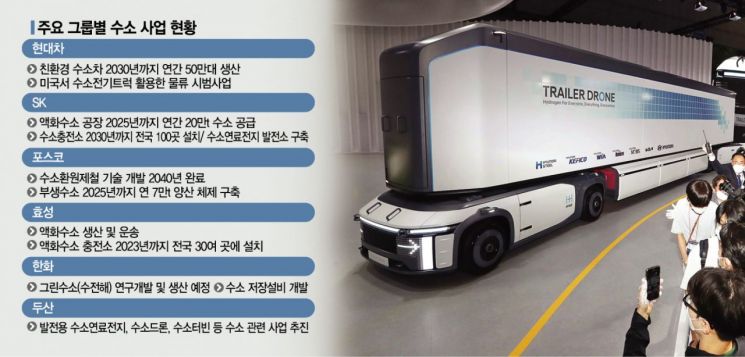
[Asia Economy Reporters Changhwan Lee and Haeyoung Kwon] As the National Assembly delays the passage of the Hydrogen Act amendment, it has been revealed that domestic companies, which are focusing on hydrogen as a future growth engine and making large-scale investments, are increasingly suffering damages. With both ruling and opposition parties putting brakes on the Hydrogen Act amendment, the government's ambitious hydrogen economy roadmap is also becoming uncertain.
Companies Held Back by the National Assembly
According to industry sources on the 11th, Doosan Fuel Cell's new orders for power generation hydrogen fuel cells until the third quarter of last year amounted to 28 megawatts (MW), a sharp 53% decrease compared to the same period the previous year. The cumulative orders last year were only about 20% of the target of 142 MW.
This is because the introduction of the Clean Hydrogen Power Supply Obligation System (CHPS), which was scheduled for last year, has been continuously postponed due to delays in the National Assembly's amendment of the Hydrogen Act, causing power generation companies' new orders to be delayed as well. CHPS is a system that obligates power companies to purchase hydrogen fuel cells, etc., and is being promoted to develop the hydrogen industry.
Delays in the Hydrogen Act amendment are also slowing the expansion of the domestic hydrogen vehicle ecosystem. Currently, there are only 131 hydrogen charging stations nationwide, causing significant inconvenience for hydrogen vehicle buyers in refueling. As a result, hydrogen vehicle sales have not increased significantly.
Last year, Hyundai's hydrogen vehicle Nexo sold only about 8,000 units domestically. The government has planned to increase the number of hydrogen charging stations nationwide to 450 by 2025, but there are criticisms that this is insufficient. Hyundai is also reportedly not planning to release a new hydrogen passenger car after the Nexo.
Nevertheless, the government has decided to nearly triple the supply of hydrogen vehicles by next year and to increase the number of specialized hydrogen companies to 100 by 2025, implementing various policies to revitalize the hydrogen economy. Experts say that this will only be possible if additional legislation, starting with the amendment of the Hydrogen Act, supports these efforts.
A representative from the Hydrogen Convergence Alliance (H2KOREA) said, "As the National Assembly delays the amendment of the Hydrogen Act, companies' hydrogen investments are being postponed or halted. Timely legislation and substantial policy support are essential for revitalizing the domestic hydrogen economy and leading the global hydrogen industry."
Hydrogen Act Amendment Stuck at Committee Stage
The problem is that the outlook for the Hydrogen Act amendment, which was stalled in this extraordinary session of the National Assembly, has become even more uncertain. At the end of last year, the ruling party blocked the passage of the bill in the legislative review subcommittee, arguing that the scope of clean hydrogen should not be broadly recognized, and on the first subcommittee meeting of the new year on the 5th, the opposition party also put a brake on it.
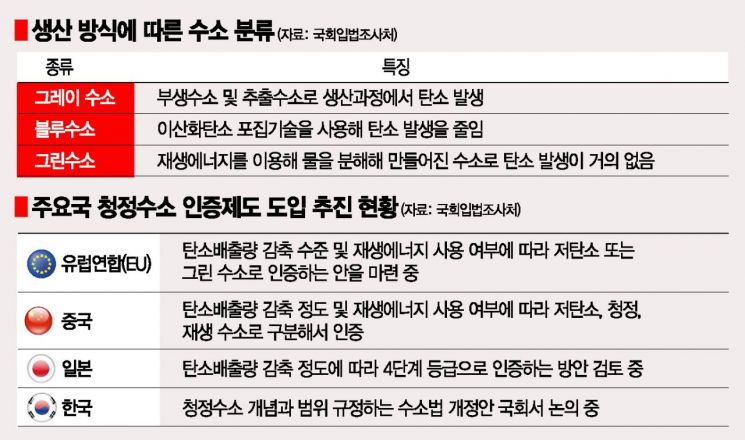
The Hydrogen Act defines clean hydrogen and provides incentives through a clean hydrogen certification system and a clean hydrogen power supply obligation system. Ultimately, the key issue is the scope of what is recognized as clean hydrogen. According to the currently proposed amendment, "clean hydrogen is defined as hydrogen that emits no carbon dioxide or emits significantly less carbon dioxide during the hydrogen production process."
In this regard, the ruling party argues that the law amendment and future policies should focus mainly on ‘green hydrogen,’ which produces zero carbon emissions, while the opposition party opposes the amendment, stating that even if the Hydrogen Act amendment passes, the hydrogen economy cannot be revitalized unless the government promotes hydrogen production using nuclear power through the ‘Basic Plan for Hydrogen Economy Implementation’ established every five years.
The Ministry of Trade, Industry and Energy plans to persuade the National Assembly by establishing a foundation in the Hydrogen Act to differentiate support for ‘carbon-free hydrogen’ and ‘low-carbon hydrogen’ according to future technological developments, but it is difficult to guarantee success at this point.
In particular, the opposition party is expanding the Hydrogen Act amendment into an anti-nuclear power policy, making bipartisan agreement difficult. Assemblyman Juhwan Lee of the People Power Party pointed out during the bill review process, "Clean hydrogen currently has a high power generation cost. Ideally, if clean hydrogen can be developed and supplied efficiently and cheaply, that would be best, but to move in that ideal direction, producing clean hydrogen using nuclear power, which has low generation costs, would reduce blue hydrogen and gray hydrogen."
He also questioned, "Small Modular Reactors (SMRs) can be a safer and more efficient energy source compared to currently operating nuclear power plants, so why should nuclear power be excluded from producing clean hydrogen?"
In response, Park Ki-young, the second vice minister of the Ministry of Trade, Industry and Energy, explained, "The Hydrogen Act amendment is a neutral regulation that neither intentionally excludes nor includes hydrogen produced by nuclear power. However, given the current situation where new nuclear investments are difficult, building new nuclear plants to produce hydrogen is somewhat challenging under the current system and circumstances."
An official from the Ministry of Trade, Industry and Energy said, "We do not know when the National Assembly schedule will be set, but we will continue to persuade lawmakers from both parties to pass the Hydrogen Act amendment."
© The Asia Business Daily(www.asiae.co.kr). All rights reserved.