Real Estate R114, Weekly Apartment Sale Price Trends in the Seoul Metropolitan Area
[Asia Economy Reporter Kim Hyemin] The Seoul apartment sale prices recorded the lowest increase rate in 20 months. The transaction market has further contracted as financial regulations have tightened since the beginning of the new year. In new towns, apartment prices in Dongtan sharply declined, turning into a downward trend.
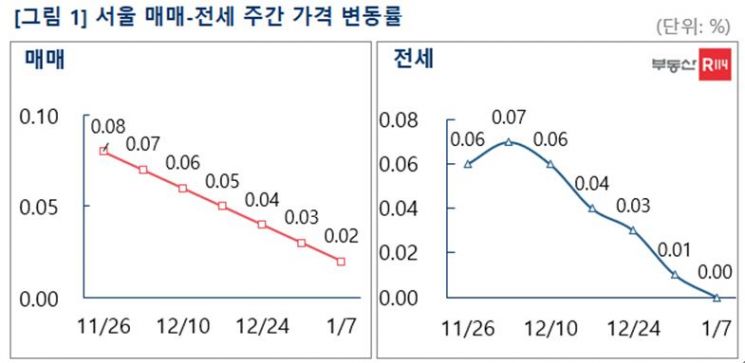
According to Real Estate R114 on the 9th, the Seoul apartment sale prices in the first week of January rose by 0.02% compared to the previous week. Redevelopment apartments increased by 0.07%, and general apartments rose by 0.01%.
This increase rate is the lowest since the end of May 2020 (0.01%). In particular, among the 25 autonomous districts in Seoul, apartment prices in Gwangjin-gu and Seodaemun-gu also joined the decline, with more than half, 16 districts, showing either flat or falling prices.
By region, the preference for a single well-located property was prominent, with Gangnam showing the highest increase rate of 0.08% compared to the previous week. Following were ▲Gangseo (0.07%) ▲Gangdong (0.06%) ▲Yongsan (0.06%) ▲Gwanak (0.05%) ▲Dobong (0.05%) ▲Guro (0.04%) ▲Geumcheon (0.03%) ▲Seocho (0.01%) which all rose. On the other hand, Gwangjin and Seodaemun fell by 0.03% and 0.01%, respectively, compared to the previous week.
New towns fell by 0.01% compared to the previous week. Although ▲Jungdong (0.06%) ▲Ilsan (0.03%) rose, Dongtan sharply declined (-0.08%), leading to the average decrease.
Gyeonggi and Incheon rose by 0.02% compared to the previous week. Apartment prices in the outskirts of the metropolitan area and non-regulated areas such as Pocheon (0.23%) and Icheon (0.06%) showed significant increases. However, Seongnam fell by 0.07% compared to the previous week.
The jeonse (long-term lease) market saw an increase in declining areas due to the winter off-season and contract renewals. Seoul showed a flat trend with a 0% change rate. This is the lowest weekly change rate since the end of June 2019. Among the 25 autonomous districts, seven districts fell, which was more than the five districts that rose.
By region, ▲Seodaemun (0.14%) ▲Guro (0.06%) ▲Mapo (0.03%) ▲Seocho (0.03%) ▲Songpa (0.01%) rose, while ▲Gwangjin (-0.06%) ▲Gwanak (-0.06%) ▲Dongjak (-0.05%) fell.
In new towns, Ilsan (0.06%) rose, while Pyeongchon (-0.03%) fell, showing a flat trend. Gyeonggi and Incheon rose by 0.01% compared to the previous week.
Lim Byungcheol, chief researcher at Real Estate R114, said, "The buying sentiment and transaction activity contraction that continued from the second half of last year are still ongoing in the new year," and predicted, "The flat transition of the apartment sale price change rate in the metropolitan area is imminent."
However, Chief Researcher Lim added, "With the early introduction of DSR phase 2 and the possibility of further interest rate hikes, the financial authorities' tightening of money supply continues, making it difficult for buying sentiment to recover, but factors causing housing price instability also remain," and forecasted, "Seoul apartment supply will decrease by more than 30% this year, the second year of the lease law enforcement will come in July, and the real estate policies of presidential candidates will also have considerable impact on the market."
© The Asia Business Daily(www.asiae.co.kr). All rights reserved.