[Asia Economy Reporter Lee Seon-ae] As the U.S. Federal Reserve (Fed) has signaled early tightening, concerns over liquidity reduction are expected to dominate investor sentiment in the financial markets for the time being.
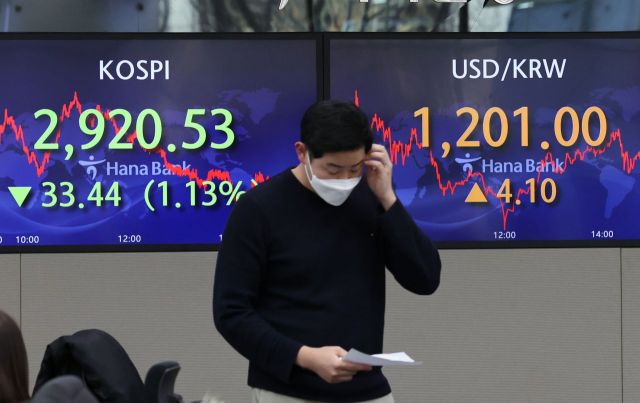
According to the Korea Exchange on the 9th, last week the KOSPI closed at 2,954.89, down 22.76 points (0.76%) from the previous week (2,977.65). In the KOSPI market last week, individual and foreign investors net purchased 1.9075 trillion KRW and 1.7838 trillion KRW respectively. On the other hand, institutions net sold 3.7394 trillion KRW.
The securities industry has suggested a KOSPI band of 2,850 to 3,020 for this week. Factors supporting an increase include the possibility of rising memory semiconductor prices and the potential end of selling by financial investment sectors. Factors for a decline include concerns over rising U.S. long-term Treasury yields, the spread of COVID-19 in the U.S. and Europe, and the dispersion of demand among individual investors ahead of large initial public offerings (IPOs).
Yumi Kim, a researcher at Kiwoom Securities, said, "Interest in U.S. inflation and the Fed's monetary policy actions will remain high in the financial markets this week. Since the release of the minutes of the December Federal Open Market Committee (FOMC) confirmed the Fed's intention to normalize monetary policy more quickly, sensitivity to inflation indicators and Fed officials' remarks may increase in the financial markets. With the January FOMC (January 25-26) approaching this week, policy uncertainty is likely to continue."
Jaeseon Lee, a researcher at Hana Financial Investment, also explained, "The upside of the domestic stock market is likely to be somewhat limited. As the market becomes more sensitive to U.S. liquidity reduction, employment and inflation indicators are likely to support the Fed's rate hikes."
Yongtaek Jung, chief researcher at IBK Investment & Securities, pointed out, "Concerns about COVID-19, inflation, and U.S. interest rate hikes are likely to pressure the market throughout the first half of the year and induce a decline in real economic indicators, so caution is necessary."
The internal supply and demand strength of the domestic stock market has also weakened. Amid large-scale selling by institutions, individual trading has also slowed. In particular, with the LG Energy Solution IPO upcoming, the general investors' subscription for public offering shares is scheduled for January 18-19, which is analyzed to limit individual investors' buying power.
Younghwan Kim, a researcher at NH Investment & Securities, said, "The selling pressure from the financial investment sector, which has dumped large volumes since the new year, is expected to ease before the options expiration date on the 13th." However, he pointed out, "The proportion of individual investor transactions in the KOSPI recently dropped to 55%, which is 10 percentage points lower than the post-COVID-19 average of 65%."
◇ Major Economic Indicator Releases and Event Schedule
▲ January 10: Europe January Sentix Investor Confidence Index, November Unemployment Rate
▲ January 11: U.S. December NFIB Small Business Optimism Index, Fed officials Bostic, Mester, and George speeches, JPMorgan Healthcare Conference (local time January 10-13)
▲ January 12: South Korea December Unemployment Rate, U.S. December Consumer Price Index, Fed official Bullard speech, China December Consumer Price Index, December Producer Price Index, Europe November Industrial Production
▲ January 13: U.S. Beige Book release, December Producer Price Index, Japan December Machine Tool Orders Preliminary
▲ January 14: South Korea January Monetary Policy Committee meeting, U.S. December Retail Sales, December Industrial Production, December Capacity Utilization, January University of Michigan Consumer Sentiment Preliminary, Fed officials Barkin and Evans speeches, China December Exports, December Imports, Japan December Producer Price Index
© The Asia Business Daily(www.asiae.co.kr). All rights reserved.