"Breaking the Stereotype of Mobility" Hyundai Motor Group Chairman Chung Euisun Accelerates Innovation
Cars Transforming into Smart Devices Capable of Connecting to Virtual Spaces
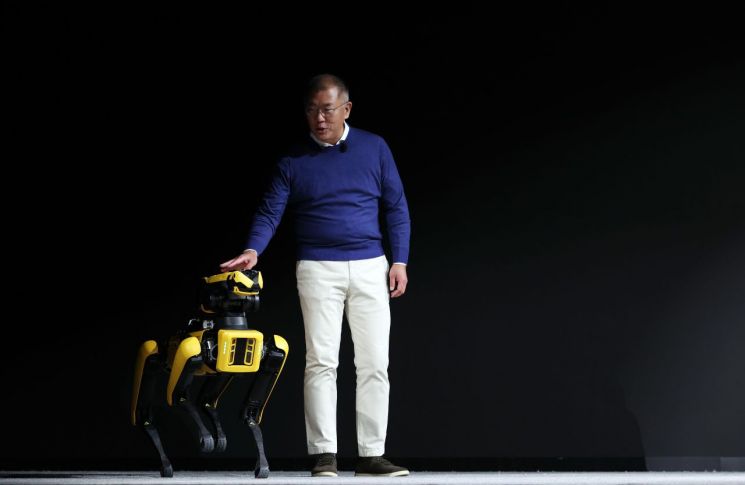 Hyundai Motor Group Chairman Chung Eui-sun is taking the stage with Boston Dynamics' quadruped robot 'Spot' at a press conference held on the afternoon of the 4th (local time) at the Mandalay Bay Hotel in Las Vegas, Nevada, USA. [Image source=Yonhap News]
[Asia Economy Reporter Changhwan Lee] "We aim to expand future mobility solutions based on robotics into ‘Metamobility.’ To achieve this, we will continue to pursue limitless challenges."
Jung Euisun, Chairman of Hyundai Motor Group, made a decisive move to capture the global mobility market at CES 2022, the world’s largest consumer electronics and IT exhibition held offline for the first time in two years.
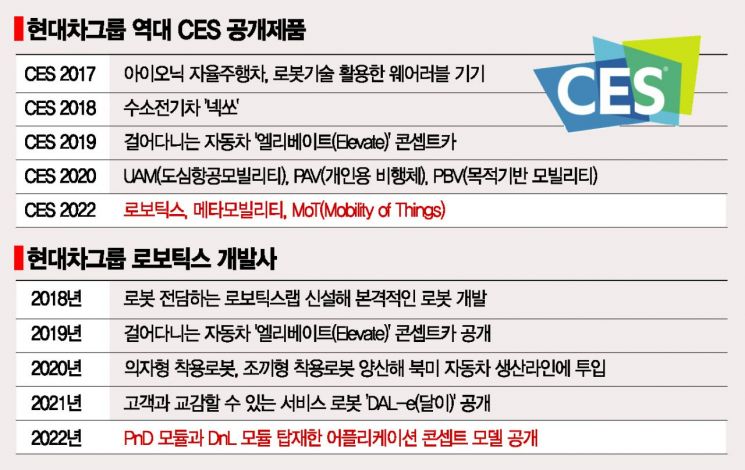
Following the UAM (Urban Air Mobility) business unveiled at the same venue in 2020, this time he declared Hyundai’s ambition to become a leader in the future mobility market by focusing on a new growth engine called ‘Metamobility,’ which will be realized through robotics and the metaverse.
"We will expand human mobility experiences through Metamobility"
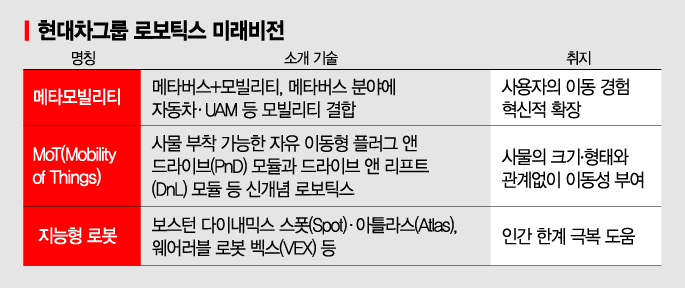
On the 4th (local time) in Las Vegas, USA, Chairman Jung explained that the future vision of robotics focuses on expanding the scope of human mobility experiences and realizing ultimate freedom of movement through Metamobility.
At CES 2020, Chairman Jung had introduced Hyundai Motor Group’s future aviation business, including UAM and PAV (Personal Air Vehicle), signaling a transformation from a mere car company to a mobility company. He emphasized that Hyundai will now combine the metaverse (extended virtual world) and robotics to extend the realm of mobility into virtual spaces, transforming into a company that continuously innovates.
Once Metamobility is realized, cars will transform into smart devices that enable access to virtual spaces, allowing users to experience various activities within realistic virtual environments implemented inside the vehicle. Depending on user needs, the car can become an entertainment space, a meeting room for work, or even a platform for enjoying 3D video games.
A smart factory will also be realized by building a twin factory in the metaverse that mirrors the real one, closely connecting all devices and equipment including robots, enabling users to operate and manage the actual factory through virtual space access.
Chairman Jung stated, "Robotics is no longer a distant dream but a reality," adding, "Hyundai aims to achieve great accomplishments through robotics."
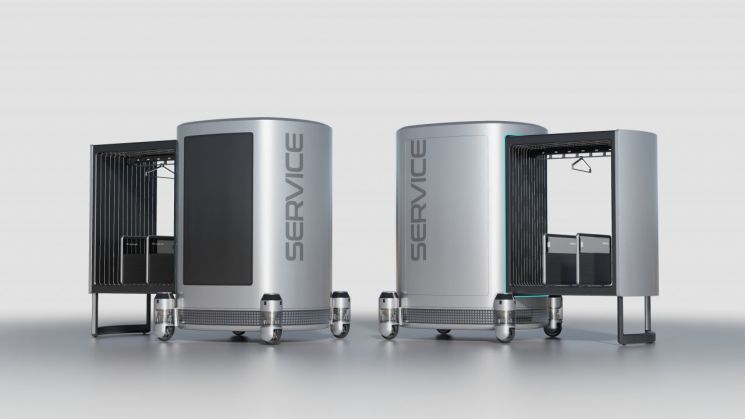
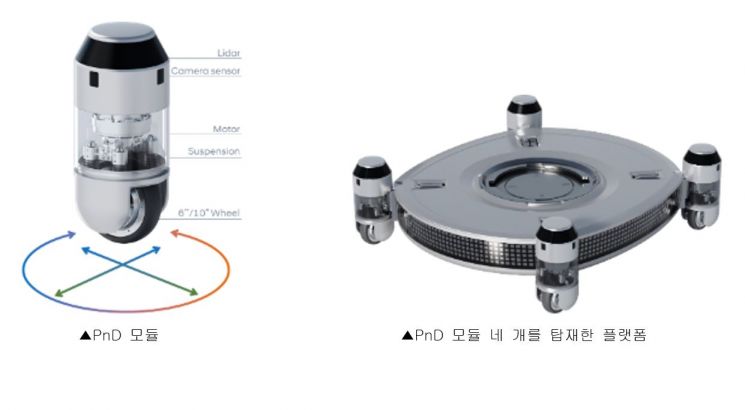 The PnD module unveiled by Hyundai Motor Company at CES 2022. The PnD module is a robot that forms the core of Hyundai's exhibition, integrating an in-wheel motor, steering, suspension, brake system, and environmental perception sensors into a single unified mobility solution. (Photo by Hyundai Motor Company)
Advanced Robotics Technologies Unveiled to Lead the Metamobility Era
At CES 2022, Hyundai showcased various advanced robotics technologies that will lead the Metamobility era, including the Plug & Drive module (PnD module), Drive & Lift module (DnL module), and Boston Dynamics’ Spot and Atlas robots.
The PnD module is the core robot of Hyundai’s exhibition. It is an integrated mobility solution combining an in-wheel motor, steering, suspension, brake system, and environmental perception sensors into a single structure.
The PnD module is designed to be attached to any object to provide mobility. Hyundai exhibited four concept models applying the PnD module: personal mobility, service mobility, logistics mobility, and L7.
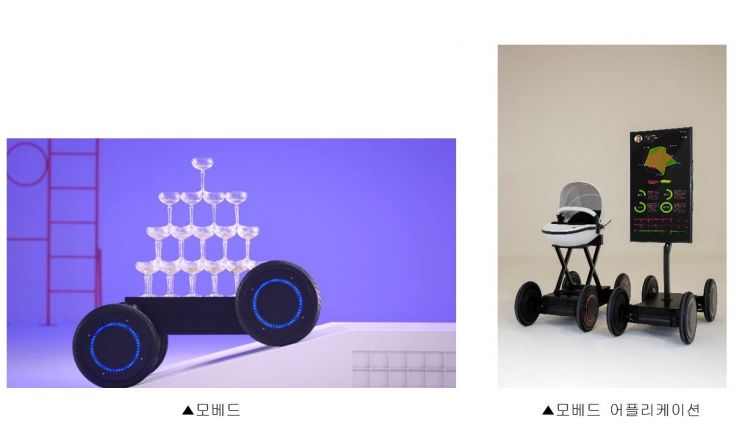 The compact mobility platform 'MobED' equipped with the DnL module. The DnL module is an integrated robotics solution based on an eccentric mechanism that combines the drive, steering, and brake systems into a single structure. (Photo by Hyundai Motor Company)
Hyundai also revealed the actual model of ‘MobED,’ a compact mobility platform equipped with the DnL module, at the exhibition. The DnL module applied to MobED is a robotics solution that integrates drive, steering, and brake systems into one structure.
Through independent movement of each wheel, it enables free mobility, and the motors mounted on each wheel allow the body to be lifted and lowered, enabling adjustment of the vehicle’s tilt to the desired angle.
It can function as a versatile platform with various applications, ranging from unmanned service mobility for guidance or delivery to versions that can carry passengers.
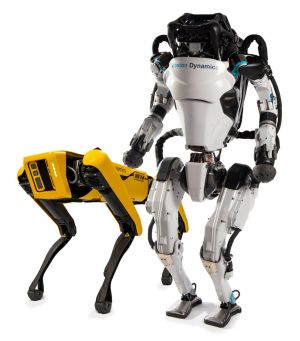
Hyundai also unveiled Boston Dynamics’ Spot and Atlas robots at the exhibition. Spot is a four-legged service robot equipped with vision sensors, acoustic sensors, temperature detection sensors, and stereo cameras, designed to perform missions in hazardous areas difficult for humans to access. Atlas is a humanoid robot regarded as the most human-like in appearance worldwide.
A Hyundai official explained, "We are closely collaborating with various partners to enable robots to be utilized in more fields and areas," adding, "We are particularly exploring ways for them to perform roles in outer space and on other planets."
© The Asia Business Daily(www.asiae.co.kr). All rights reserved.